
OPKO Health’s Portfolio Diversification Balances Pharmaceuticals and Diagnostics in Q2 2026
OPKO Health’s Q2 2026 results showcase revenue strength led by its multi-market pharmaceutical products and diagnostic services, offset by continued operating losses and the imperative for disciplined cash management.
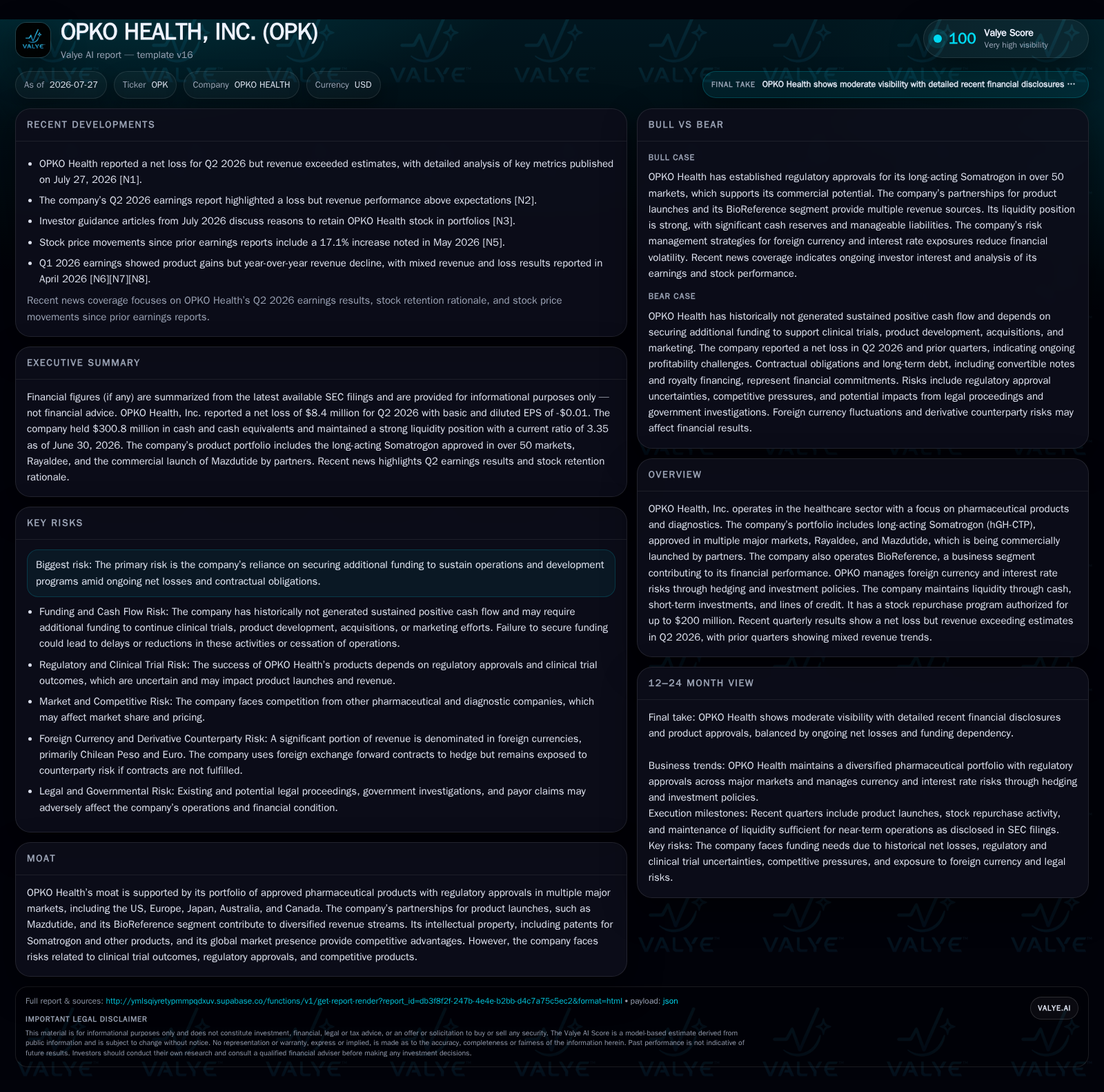
In Q2 2026, OPKO Health posted revenue exceeding expectations driven by its long-acting Somatrogon pharmaceutical approvals across major markets and robust diagnostic segment performance. Despite the revenue upside, the company remains unprofitable due to high R&D expenses and operational costs underlying product launches and pipeline advancement. The diversified portfolio, including BioReference diagnostics and partner-launched Mazdutide, provides revenue stability amid biopharma development risk. However, sustaining liquidity beyond current cash reserves will depend on execution of commercial initiatives and potential capital raises, given ongoing net losses and contractual obligations.
Q2 Operational Results: Revenue Upside Amid Persistent Operating Losses
OPKO Health reported second-quarter financial results for the period ending June 30, 2026, with revenues surpassing consensus estimates driven by strong sales of its long-acting growth hormone analogue Somatrogon (hGH-CTP), which holds regulatory approval in over 50 countries including the United States, European Union, Japan, Australia, and Canada [S2][N1][N2][S1]. Complementing this pharmaceutical revenue base, Rayaldee, approved for treatment of chronic kidney disease-related bone disorders in the U.S., contributed to the topline growth. The diagnostic segment, anchored by BioReference Laboratories, also delivered solid revenue performance supported by sustained test volumes [S2][S1].
Despite this revenue strength, OPKO continued to report operating losses primarily due to elevated research and development (R&D) expenditures essential for advancing clinical trials and commercial launch activities for pipeline candidates [S1][S2]. This reflects the capital-intensive nature of pharmaceutical innovation, where upfront investment in clinical development and regulatory compliance precedes profitability. The company’s operating model thus balances near-term revenue growth with ongoing cash burn driven by R&D and general administrative expenses.
Product Portfolio Strength: Long-Acting Pharmaceuticals and Diagnostic Services
OPKO’s diversified portfolio combines specialty pharmaceuticals with diagnostic laboratory services, providing a degree of revenue stability amid biopharma development risk. Somatrogon serves as a flagship product, a long-acting growth hormone analogue protected by robust patent coverage across key markets, which mitigates generic competition risk for several years [S1]. Rayaldee further diversifies the pharmaceutical segment with its niche indication.
The BioReference diagnostics business offers recurring revenue streams through laboratory testing services, characterized by lower gross margins but more predictable cash flows relative to pharmaceutical product sales, which are subject to regulatory milestones and market adoption variability [S1][S2]. This segment’s steady test volumes act as a financial stabilizer, partially offsetting the cyclicality inherent in drug commercialization.
Additionally, OPKO leverages partner licensing arrangements to commercialize pipeline assets while limiting direct sales and marketing expenses. Mazdutide, a glucagon-like peptide-1 receptor agonist, is primarily launched and marketed by partners, generating royalty income that supports revenue diversification without proportional increases in operating costs [S1][S2]. This approach aligns capital deployment with market risk and extends OPKO’s commercial footprint.
Competitive Positioning Within the Pharmaceutical and Biotechnology Landscape
OPKO occupies a mid-sized position in the pharmaceutical-biotech sector, combining drug commercialization with diagnostic services. This hybrid model resembles diversified pharmaceutical companies such as Novartis or Pfizer, which maintain multi-product portfolios spanning biologics and diagnostics. Unlike biotech firms focused exclusively on specialty biologics pipelines, such as Biogen or Regeneron, OPKO’s inclusion of BioReference diagnostics provides a hedge against the volatility of pharmaceutical product cycles.
Compared to pure diagnostic service providers like LabCorp or Quest Diagnostics, OPKO’s pharmaceutical segment introduces complexity in margin structure but offers upside participation in novel drug launches supported by global intellectual property rights [S1]. The company’s competitive positioning depends on balancing capital-intensive R&D investments with incremental profitability from existing product sales and diagnostic volume growth.
Growth Catalysts: Pipeline Advancement, Partner Commercialization, and Diagnostic Volume Expansion
Future growth drivers include successful clinical trial outcomes and regulatory approvals for pipeline candidates, which remain critical to expanding OPKO’s pharmaceutical portfolio [S1][S2]. Continued geographic and indication expansion for Somatrogon represents a key catalyst.
The commercial rollout of Mazdutide by partners is another growth vector, with royalty streams contingent on partner sales execution and market penetration. Monitoring partner-driven sales progress will be essential to assessing this revenue source’s trajectory.
Simultaneously, BioReference’s diagnostic test volumes contribute recurring revenue growth [S2]. As healthcare utilization trends support increased laboratory testing, rising diagnostic volumes provide a stable revenue base that complements pharmaceutical sales
Liquidity and Cash Runway Amid High Operating Expenses
As of June 30, 2026, OPKO held $300.8 million in cash, cash equivalents, and restricted cash, supported by current assets totaling approximately $500.2 million against current liabilities of $149.4 million, yielding a strong current ratio of 3.35 [F1][S4]. This liquidity position provides a buffer to support ongoing operations and debt service in the near term.
However, the company faces substantial contractual obligations, including open purchase orders of $40.9 million and operating leases aggregating nearly $45 million over future periods, necessitating disciplined working capital management [S18]. Clinical trial-related expenditures remain variable and dependent on patient enrollment rates, adding uncertainty to cash flow forecasts.
Management expresses confidence that existing cash resources are sufficient to fund operations beyond the next 12 months, assuming no significant acceleration in clinical programs or acquisitions [S4]. Nonetheless, the capital-intensive nature of pharmaceutical development and commercialization implies potential need for additional financing if operating losses persist or pipeline expansion accelerates.
Risk Factors: Clinical Trial Uncertainties, Patent Expirations, and Market Competition
OPKO’s business faces several risks typical of the pharmaceutical and biotechnology industry. Clinical trial delays or failures could impede regulatory approvals and delay revenue generation from pipeline products [S1][S2]. Regulatory compliance across multiple jurisdictions adds complexity and potential for setbacks.
Patent expirations pose a threat to exclusivity and pricing power, particularly for key products like Somatrogon. Intellectual property litigation outcomes could materially affect competitive positioning.
Market acceptance risks arise from competition with branded specialty biologics and generic entrants post-patent expiry, impacting pricing and sales volumes. Reimbursement challenges and payor dynamics further influence product adoption rates.
Reliance on partner commercialization, especially for Mazdutide, introduces execution risk tied to third-party sales effectiveness and market penetration.
Key Execution Milestones to Monitor
Near-term operational milestones will provide insight into OPKO’s strategic progress, including:
- Regulatory decisions on label expansions or new drug approvals within the pharmaceutical pipeline [N1][N2][S3].
- Quarterly sales updates on Mazdutide commercialization reported by partners.
- Diagnostic testing volume trends at BioReference Laboratories reflecting healthcare demand.
- Updates on funding strategy, including potential capital raises or debt refinancing impacting liquidity.
- Developments in intellectual property enforcement defending against generic or biosimilar competition.
Tracking these indicators will clarify the company’s ability to transition from R&D-driven losses toward sustainable profitability supported by diversified revenue streams.
Financial Position Summary
OPKO’s balance sheet as of June 30, 2026, shows cash and equivalents of $300.8 million, current assets of $500.2 million, and current liabilities of $149.4 million, resulting in a current ratio of approximately 3.35, indicating solid short-term liquidity [F1]. While total debt figures are dated, recent issuance of senior secured notes provides long-term financing capacity [S4][F1].
Maintaining a manageable cash burn rate will be critical to preserving financial flexibility and minimizing dilution risk from potential equity offerings if operating losses continue without commensurate revenue growth [S4]
This analysis is based solely on publicly available information as of July 27, 2026. It is intended for informational purposes and does not constitute investment advice or research views.
Disclaimer: This report includes AI-assisted interpretation and general industry context. Verification with primary sources is recommended for critical decisions.
Disclaimer: This is research-only, informational analysis and not investment advice. It may include AI-generated interpretation and general industry context. Always verify important details using primary sources.

Comments