
Gulf Resources Faces Regulatory and Financial Pressures Amid Capacity Expansion Efforts
Gulf Resources navigates regulatory compliance challenges and financial stress while pursuing production growth in its specialty chemical operations in China.
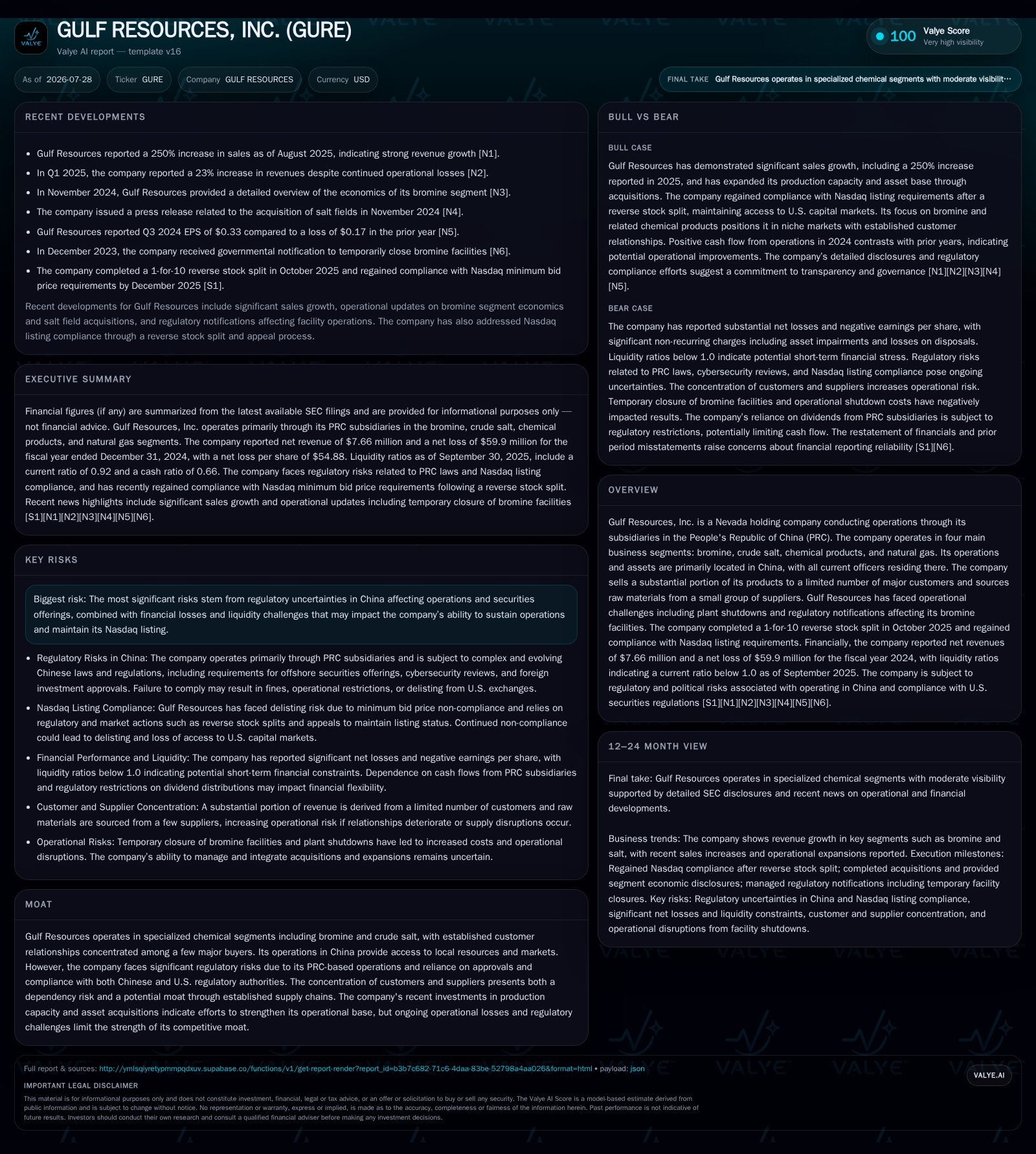
Gulf Resources, a specialty chemical producer focused on bromine, crude salt, chemical products, and natural gas in China, is contending with significant operational and regulatory challenges. The company continues efforts to regain Nasdaq compliance after delays in financial filings, faces risks from evolving Chinese regulatory oversight, and deals with customer and supplier concentration. Despite reporting net revenues of $7.66 million and a net loss of nearly $60 million for fiscal 2024, Gulf Resources is pursuing expansion of its production capacity to capture growing demand within its niche chemical markets. The company’s future hinges on successful regulatory navigation, stable supply chains, and improving operational execution.
Recent Operating Update
multiple prior period reports [S10].
Further compounding challenges for Gulf Resources is ongoing dialogue with U.S. regulatory bodies including the SEC concerning audit documentation availability located in China. The company faces risks related to the Holding Foreign Companies Accountable Act (HFCAA), which could prohibit trading of shares if its auditors cannot be inspected by the PCAOB for consecutive years [S1]. While Gulf Resources reportedly does not currently require certain PRC cybersecurity filings related to overseas listings under recent Trial Administrative Measures from CSRC effective March 2023 [S1], there remain substantial legal uncertainties about retroactive application of these rules to future offerings or equity financing activities.
Business Model Overview
Gulf Resources operates as a holding company incorporated in Nevada with subsidiaries conducting all manufacturing and operations within China [S1]. The firm’s business is divided into four main segments: bromine production, crude salt extraction, chemical product manufacturing (including chemical intermediates), and natural gas operations primarily supplying feedstocks for other segments [S1]. Its production facilities are located near raw material sources within China’s Shandong province industrial complexes [S3], leveraging local resource proximity to optimize cost structures.
Revenue arises predominantly from selling specialty chemicals like bromine—a halogen used extensively as flame retardants or pharmaceutical intermediates—and crude salt extracted from natural brine deposits used both directly and downstream chemically [S1]. Given the capital-intensive nature of such chemical facilities, Gulf focuses on maintaining adequate production capacity utilization rates to ensure fixed costs are absorbed efficiently.
Monetization typically comes through contracts or purchase agreements with a concentrated base of industrial customers who rely on stable supply chains for their own manufacturing needs. Similarly, raw material sourcing depends on a limited group of suppliers controlling key inputs like brine or natural gas feedstock. This dual concentration creates a dependence risk but may afford some bargaining power through established relationships once trust is built [S1]. Pricing dynamics often tie back to underlying raw material prices coupled with value-added processing steps.
Industry Structure and Competitive Positioning
The specialty chemicals industry—Gulf’s broader sector—comprises firms producing chemicals tailored for specific industrial end-uses such as agriculture inputs, pharmaceuticals intermediate production, flame retardants support materials, electronics manufacturing aids, and general industrial chemicals fabrication. These companies frequently operate upstream or midstream processing plants close to resource sources (e.g., salt mines for brine extraction) to reduce logistics costs.
Peers include larger players like Albemarle Corporation known for specialty bromine chemicals globally; Tianqi Lithium Corporation supplying chemical raw materials domestically in China; LANXESS AG offering diversified specialty chemicals worldwide; and Olin Corporation focusing on chlor-alkali intermediates. Gulf’s scale remains smaller relative to these global or regional champions but occupies an established niche within certain bromine-related chemical markets.
Competitive pressures arise primarily from pricing volatility in raw materials — especially salt brines affected by environmental factors — alongside regulatory compliance burdens unique to China's evolving environmental policies. Plant shutdowns driven by environmental inspections or safety issues can significantly disrupt output given tight capacity buffers typical in this sector [S1], adding operating risk.
Growth Drivers
Management cites plans for expanded production capacity designed explicitly to meet rising demand across their product lines driven by industrial growth domestically within China as well as increasing downstream demand across Asia [S29]. This aligns with broader industry themes where infrastructure development and rising manufacturing complexity increase need for bromine-based flame retardants and specialty chemical intermediates.
Moreover, Gulf leverages recent asset acquisitions intended to strengthen integrated operations vertically—from crude salt extraction through chemical processing—to improve margin profiles over time [S29]. The ability to maintain plant uptime amid regulatory compliance efforts will be crucial; improved operational efficiency offers scope for better cash generation despite current net losses.
Favorable regulatory developments enabling export capabilities or broader product licensing could unlock additional markets outside mainland China contingent upon satisfactory approvals from authorities like CSRC or CAC [S29]. However, management acknowledges uncertainties surrounding additional approvals required under emerging PRC laws that affect overseas listings or capital raising activities requiring CSRC filings [S1].
Risks and Watchpoints
The company faces pronounced regulatory risks tied both to Chinese government policies governing foreign securities issuance—including cybersecurity reviews—and U.S. audit transparency statutes enforced via HFCAA that threaten the stock's ongoing listing eligibility [S1]. Any delays or failures here would impose a severe negative impact on liquidity access.
High customer concentration heightens revenue volatility; losing one major customer could materially reduce sales given limited diversification reported [S1]. Similarly, supplier concentration exposes Gulf to input price shocks or supply interruptions particularly impactful given raw material cost intensity inherent in salt/brine-based processes.
Operationally, prior plant shutdowns driven by environmental enforcement actions underscore risks inherent in balancing production growth ambitions with increasingly stringent sustainability requirements inside China’s regulated manufacturing environment [N# not available; implied from sector trends].
What to Watch Next
Key near-term milestones center on Gulf meeting Nasdaq filing deadlines set forth under their accepted compliance plan by October 2026 which will influence listing retention prospects along with investor confidence [S27]. Progress on completing outstanding restatements without further SEC comments would signal strengthening financial controls.
Operationally, tracking announcements related to plant uptime improvements or new capacity brought online will indicate management effectiveness addressing prior shutdown vulnerabilities while volume growth signals market traction amidst intensified competition.
Lastly monitoring shifts in raw material pricing dynamics—particularly salt brines—and adjustments in contract pricing terms with customers can serve as important leading indicators about margin sustainability over coming quarters.
Financial Profile Discussion
Liquidity as measured by cash & equivalents stood modestly at roughly $11.2 million as of September 30, 2024 contrasted against current liabilities exceeding $17.1 million during the same period resulting in a current ratio below one at approximately 0.92 suggesting working capital constraints [F1]
Overall balance sheet health appears stretched given ongoing operating losses combined with unresolved regulatory hurdles impacting confidence among institutional participants potentially limiting debt capacity raising alternative financing funding cost structures higher relative peers who maintain stronger margin profiles amid better geographic diversification.
Disclaimer: This analysis is based solely on publicly available information including SEC filings up to July 27, 2026. It does not constitute investment advice or research view but aims at providing informed insight into Gulf Resources’ recent operational circumstances within its specialized chemical industry context.
Disclaimer: This is research-only, informational analysis and not investment advice. It may include AI-generated interpretation and general industry context. Always verify important details using primary sources.

Comments