
Bread Financial’s Q2 2026 Highlights Basel III Strength Amid Regulatory and Operational Focus
Bread Financial reports solid Q2 earnings with robust credit sales while managing regulatory consent orders and capital adequacy.
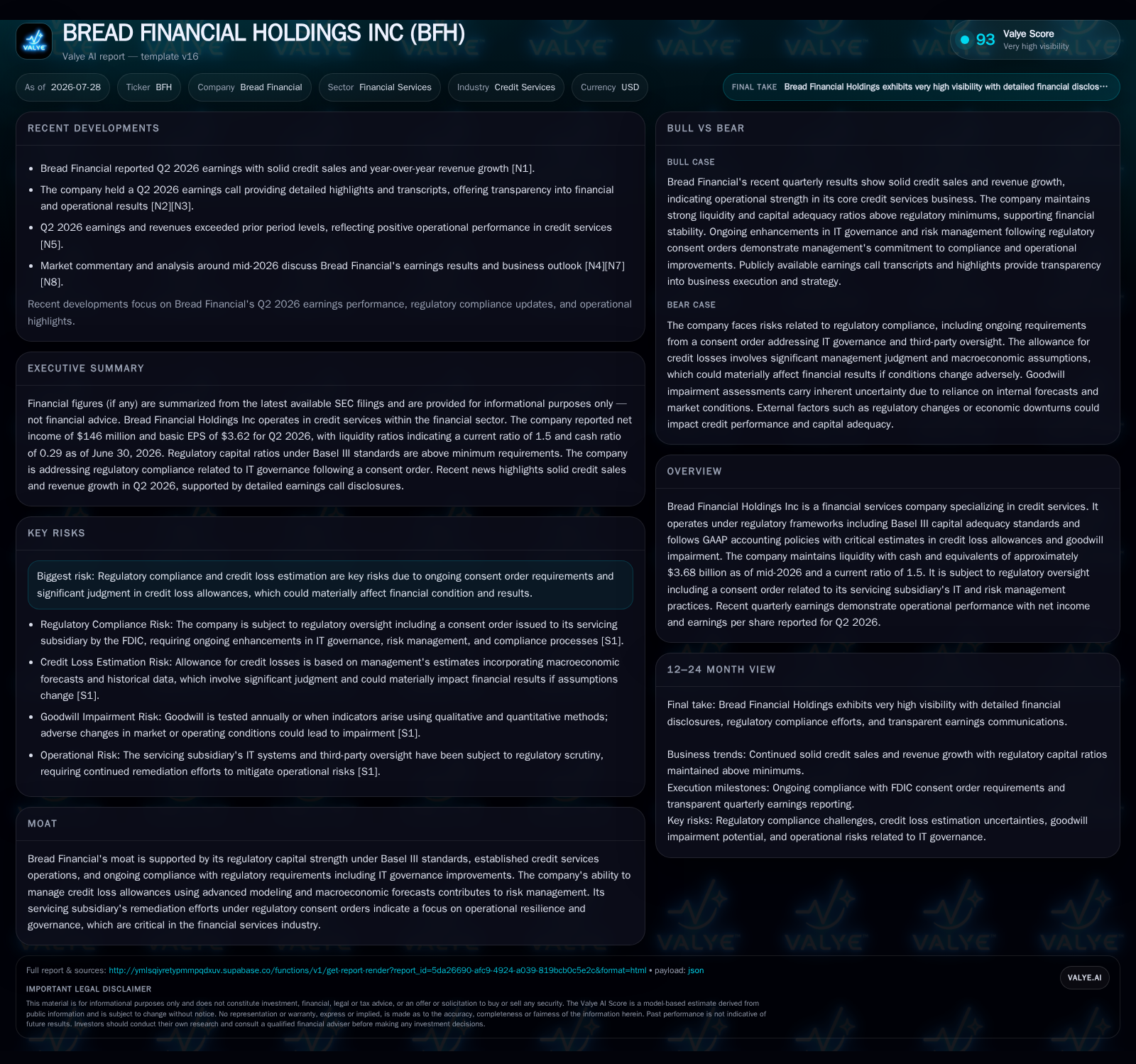
In its latest quarterly filing, Bread Financial Holdings Inc. demonstrated operational resilience marked by strong credit sales and revenue growth in Q2 2026, underpinning its credit services business. The company continues to navigate regulatory oversight, particularly a consent order governing its servicing subsidiary’s IT and risk management practices. Maintaining a healthy Basel III capital buffer and liquidity position supports ongoing credit portfolio management, even as credit loss allowance judgment and compliance remain critical watchpoints.
Recent Operating Update: Q2 2026 Earnings Performance
Bread Financial Holdings Inc.'s latest quarterly filing for Q2 ending June 30, 2026, reveals solid operational execution with revenues outpacing market estimates primarily due to strong credit sales growth and increased fee income streams associated with card usage [S2][N1]. While detailed revenue breakdowns are not fully disclosed within the excerpted data, external earning call commentary highlights an uptick in new account originations and average customer credit line utilization as demand indicators. These are typical levers in credit services revenue mechanics where both volume (credit extended/usage) and pricing (interchange fees, interest rates) contribute to top-line expansion.
Business Model: Revenue Mechanics and Risk Management
Bread Financial operates primarily as a consumer credit services firm issuing credit cards under multiple brand licenses and servicing consumer finance accounts. Its revenue is derived mainly from three streams: net interest income earned on outstanding credit balances; fee income encompassing interchange fees paid by merchants on card transactions; and ancillary fees related to servicing or late payments.
Revenue increases hinge critically on both consumer spending behavior and underwriting quality. The company employs detailed credit risk modeling techniques to manage allowance for credit losses—a pivotal estimate that influences loan loss provisions impacting net income directly [S1]. This allowance-setting process is forward-looking, incorporating macroeconomic forecasts which add variability but also guard against unexpected charge-offs during economic downturns.
Maintaining regulatory capital buffers mandated under Basel III standards is another cornerstone of the business model as these buffers support lending capacity while mitigating insolvency risks [S1]. Bread Financial's common equity tier 1 capital ratio stands at a healthy 13.0% (well above the regulatory minimum of 4.5%) as of December 2025, reflecting prudent capital management practices that enable both compliance and strategic growth opportunities
The servicing subsidiary plays a crucial role in customer account maintenance and collections but has faced heightened regulatory scrutiny manifested via a consent order addressing IT system governance and risk controls [S1]. This situation highlights operational vulnerabilities inherent in servicing operations where data integrity, cybersecurity posture, and process controls directly affect customer satisfaction, reputational risk, and regulatory ratings.
Industry Structure and Competitive Positioning
In the broader context of the U.S. credit services industry—dominated by large banks like Capital One and specialized card issuers like Synchrony Financial—Bread Financial occupies a differentiated niche focused on branded store cards along with co-branded products tied to retail partners. The competitive basis rests heavily on underwriting discipline, customer acquisition capability, digital engagement platforms, and regulatory compliance efficiency.
Compared to peers such as Synchrony Financial, which similarly report robust Basel III capital ratios exceeding minimum thresholds, Bread’s capital adequacy strength consolidates its ability to withstand cyclical shocks in consumer credit demand while pursuing moderate portfolio expansion [S1]. Fee income diversification through partnerships enhances revenue stability against net interest margin compression common amid rising interest rates.
Technology-wise, Bread's governance infrastructure includes board-level Risk & Technology Committees that oversee cybersecurity strategies—a vital differentiator as credit services firms are prime targets for cyberattacks given their sensitive customer data handling responsibilities. Their CISO possesses extensive industry experience emphasizing proactive risk oversight aligned with sector best practices [S1].
Growth Drivers
Several key vectors underpin Bread Financial's potential growth trajectory:
- Expansion of Credit Portfolio: Increasing new account originations supported by refined underwriting algorithms boosts loan volumes sustainably.
- Rising Consumer Credit Demand: Macro-economic tailwinds promoting consumer spending drive average utilization rates higher.
- Fee Income Upside: Growth in interchange revenues stems from higher transaction volumes linked to cardholder engagement.
- Technological Enhancements: Investments in data analytics improve credit loss forecasting accuracy reducing provisioning drag.
- Regulatory Adaptability: Compliance agility enables product innovation within permissible boundaries fostering customer acquisitions.
- Merchant Partnerships: Ongoing collaboration expands branded card acceptance footprints enhancing payment network effects.
These growth initiatives are corroborated by recent quarterly results demonstrating improved revenue mixes favoring fee-based income alongside interest yields—a dynamic beneficial for margin enhancement given lower incremental funding costs of fee revenues compared to interest spread reliance [N2][N3]
Risks and Watchpoints
Critical risks loom over Bread Financial’s operating landscape:
- Regulatory Compliance Risks: The active consent order governing its servicing subsidiary imposes operational constraints requiring continuous resource allocation for remediation; failure here risks penalties or further restrictions [S1].
- Credit Loss Allowance Uncertainty: Judgment involved in provisioning exposes earnings to volatility especially if macroeconomic conditions deteriorate unexpectedly or models misestimate future losses.
- Cybersecurity Threats: Persistent cyber risks necessitate vigilant IT security investments; lapses could compromise customer data or trigger costly incidents undermining trust.
- Competitive Pressure: Fintech entrants employing cutting-edge underwriting technology may erode market share by offering more appealing or accessible financing products.
- Interest Rate Sensitivity: Benchmark rate fluctuations impact net interest margins by altering borrowing costs relative to asset yields.
- Liquidity Considerations: Although current liquidity appears adequate ($3.68 billion cash) maintaining this buffer is essential given debt service obligations embedded in the capital structure [F1].
Monitoring these areas through metrics such as charge-off rates, delinquency trends, compliance milestones related to consent orders, cybersecurity incident frequency/severity reports, new account flow tracking, and capital ratios will be paramount for understanding execution success.
What to Watch Next
Investors should focus on several near-term developments for insights into Bread Financial’s operational momentum:
- Updates on consent order remediation progress outlining timeline adherence or emerging challenges impacting servicing operations.
- Quarterly disclosures providing granular metrics such as net interest margin shifts, loan loss provision adjustments reflecting economic outlook changes.
- Trends in new account originations alongside average credit line usage statistics indicating demand elasticity.
- Fee income contributions especially related to interchange demonstrating partnership effectiveness.
- Board-level commentary regarding cybersecurity posture evolution amidst sector-wide threats.
- Capital adequacy ratio evolution post-midyear results which will signal whether balance sheet leverage strategy remains consistent with Basel III requirements.
Financial Profile Discussion
Bread Financial’s balance sheet maintains liquidity strength with $3.68 billion in cash plus equivalents as of June 30, 2026, and a current ratio of about 1.5 reflecting liquid assets comfortably exceeding short-term liabilities [F1]
Key capital ratios reported for end-of-year 2025 reveal common equity tier 1 at 13.0%, tier 1 ratio at 13.4%, surpassing minimum regulatory thresholds which points toward sustainable Basel III capitalization supporting organic growth ambitions without excessive dilution or recapitalization pressures [S1]. The CET1 calculation prudently excludes goodwill impairment impacts affirming that tangible equity coverage sustains core lending activities even after intangibles adjustment.
Liquidity management emphasizing sizeable cash reserves underpins operational flexibility facilitating strategic initiatives such as investing in technological enhancements or navigating compliance-driven expenditures without resorting to expensive external funding sources. This financial steadiness acts as a moat reinforcing investor confidence relative to peers who may confront tighter leverage policies or greater refinancing risks under shifting interest rate regimes.
This analysis reflects information publicly disclosed up to July 28, 2026. It synthesizes filings from Q2 2026 forms supplemented by recent earnings releases without constituting investment advice or research views.
Financial position in context
As of 2026-06-30, companyfacts shows $3.7bn in cash and equivalents [F1]
Disclaimer: This is research-only, informational analysis and not investment advice. It may include AI-generated interpretation and general industry context. Always verify important details using primary sources.

Comments