
Agilysys Advances AI-Integrated Hospitality Software With Strengthened Financials
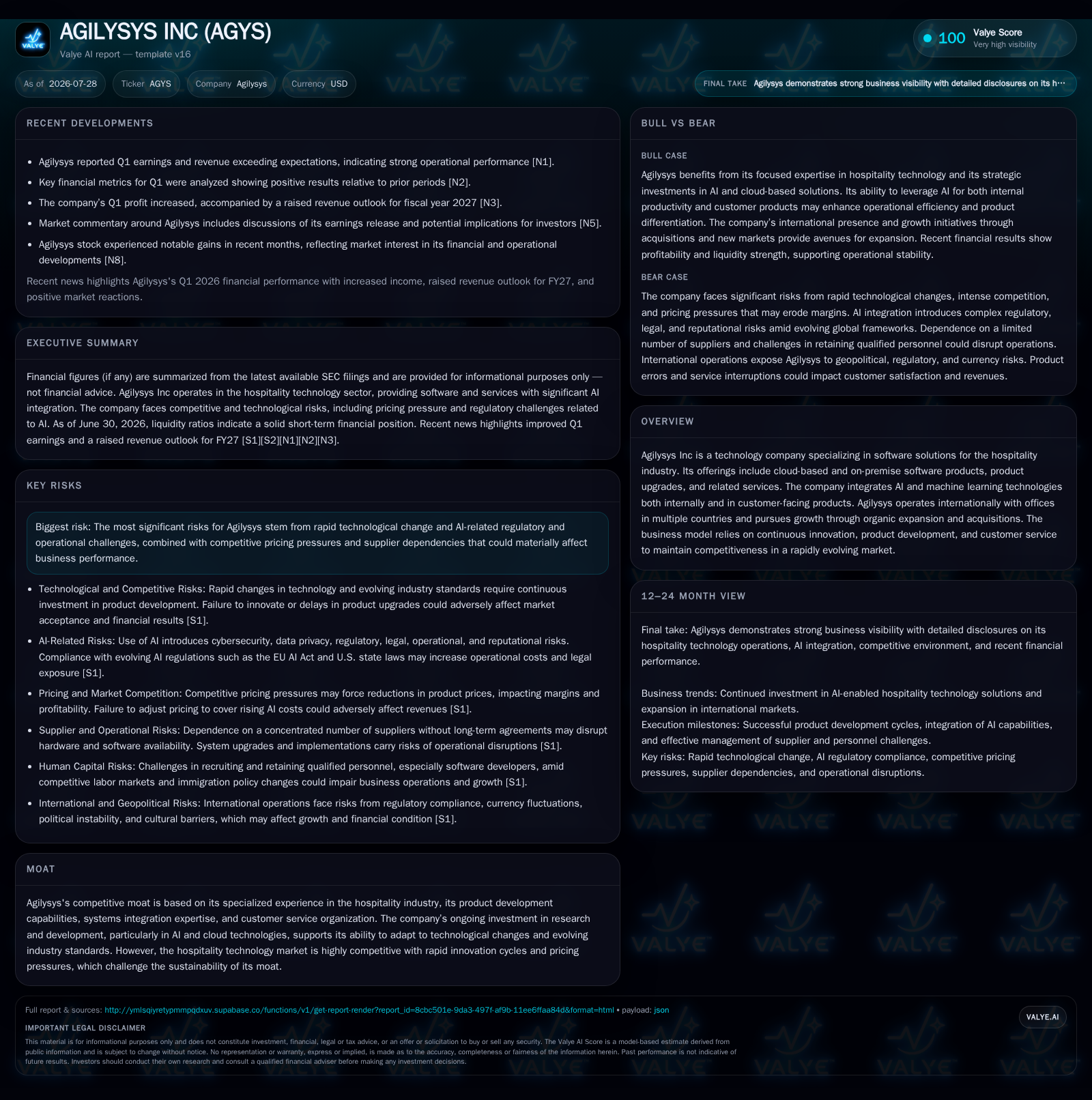
Agilysys's Q1 FY27 results highlight momentum in recurring revenue growth and product innovation driven by AI and cloud capabilities amid competitive pressures.
In its latest quarterly filing, Agilysys demonstrated progress in expanding subscription-based revenues anchored by AI-enhanced property management and point-of-sale software products. Despite pricing pressures inherent to the hospitality technology sector, ongoing investments in R&D support product differentiation and customer retention. The company’s balanced revenue model includes professional services which can fluctuate but remain critical for client implementations. Agilysys’s strong liquidity position underpins its strategic focus on innovation and geographic expansion, though risks from rapid technological change and regulatory complexity persist.
Q1 FY27 Performance Signals Recurring Revenue Momentum
Agilysys’s latest quarterly filing dated July 27, 2026, reveals encouraging developments in its revenue composition with a continued shift towards recurring subscription income—a core measure of SaaS strength—supported by growing adoption of its cloud-based hospitality management solutions [S2][S3][N1]. Management commentary highlights improvements in subscription revenue streams particularly tied to enhancements in property management system (PMS) and point-of-sale (POS) platforms that now embed advanced AI and machine learning features. This evolution aligns well with the broader industry trend of integrating intelligent automation to streamline hotel operations and optimize guest experiences.
Operationally, the company recorded a favorable earnings mix that offset pressure from project-based professional services, which tend to fluctuate quarter over quarter due to timing of implementations [S2]. The balance between stable annual recurring revenue (ARR) growth and variable professional services billings underscores the dual nature of Agilysys’s business model: long-term SaaS contracts underpin cash flow stability while professional services enable client-specific integration and customization essential for maintaining high customer retention rates and renewal rates [S1][S2].
Integration of AI Elevates Product Differentiation but Invites Pricing Scrutiny
A critical competitive lever for Agilysys lies in its expansion of AI-powered capabilities within its PMS and POS offerings. The firm reports ongoing investment into research and development aimed at embedding sophisticated analytics and automation directly into workflows that enhance operational efficiency for hospitality operators, such as automated inventory management, dynamic pricing, and guest personalization [S2][S6]. However, these advancements come with rising R&D expenses reflecting the cost intensity of developing AI-enabled solutions—a key factor exerting margin pressure and influencing the company’s research and development expense ratio [S2][S17].
The market context is challenging: competitors including large enterprise suites like Oracle Hospitality often engage in aggressive pricing strategies while newer entrants focus on nimble, cloud-native SaaS offerings [S6]. Agilysys faces the delicate task of pricing its advanced products at levels that recover growing AI infrastructure and cloud hosting costs without ceding market share. Successful price adjustments and effective monetization of AI-driven modules will be crucial to maintaining profitability as R&D outlays incrementally rise.
Balancing SaaS Subscription Growth with Professional Services Dynamics
Agilysys employs a hybrid revenue model blending subscription licensing fees with significant professional services income from implementation projects, systems integration, and customer support—typical within vertical SaaS firms serving complex hospitality enterprises [S1][S2]. Although subscription revenues provide recurring income visibility and contribute to ARR growth, the professional services segment introduces volatility linked to project delivery schedules and client onboarding cycles.
This dynamic affects operating leverage: quarters with strong services billings can boost margin temporarily but may not be sustainable as a standalone driver. Conversely, steady ARR expansion signals improved client stickiness through contract renewals—a vital metric for long-term cash flow health and customer retention [S2]. Monitoring the relative proportions of subscription revenue versus professional services over subsequent quarters will clarify whether subscription momentum can increasingly dominate and improve gross margin stability.
Competitive Pressures and Market Position in the Hospitality Vertical SaaS Landscape
Within the niche hospitality vertical, Agilysys competes against a spectrum of players ranging from comprehensive providers like Oracle Hospitality to specialized PMS or POS vendors targeting sub-segments [S6]. While Agilysys’s competitive moat stems from deep domain experience, systems integration capabilities, and customer service excellence, the rapid pace of technological change risks eroding differentiation absent continuous innovation.
Pricing pressure is intensified by commoditization tendencies common in software markets where functionally similar products compete largely on price points [S6]. Additionally, AI integration raises barriers as firms must justify higher costs with clear operational benefits. Agilysys’s challenge is thus twofold: sustain technology leadership via R&D while navigating competitive pricing without margin dilution. Key hospitality SaaS KPIs such as ARR growth rate, churn rate, average revenue per user (ARPU), and renewal rates will be critical to benchmarking competitive positioning.
Growth Opportunities from Cloud Adoption and Geographic Expansion Initiatives
The ongoing migration from legacy on-premise deployments toward cloud-hosted SaaS platforms provides a structural tailwind benefitting Agilysys’s product suite [S1][S2]. Cloud adoption enables more flexible scaling for customers along with streamlined deployment of upgrades—especially vital for fast-evolving AI functionalities and integrated guest experience platforms.
Geographically, the company is pursuing incremental penetration across various international markets including Europe, Middle East, Asia-Pacific regions where travel sector expansion fuels demand [S1][S12]. These efforts face typical cross-border challenges such as regulatory compliance complexities, localization needs for language and cultural adaptation, and channel development efforts. Nonetheless, successful execution could broaden Agilysys’s addressable market substantially and diversify revenue sources.
Key Strategic Risks: Technological Change, Pricing Pressure, and Regulatory Compliance Challenges
Agilysys operates within an environment marked by swift technological advances requiring continuous heavy investment in product development—and particularly in AI innovations—that may not always yield commensurate financial returns immediately [S1][S5][S10]. Failure to anticipate or respond adequately could cause loss of competitiveness or obsolescence.
Regulatory risks are elevated as emerging frameworks around data privacy, AI ethics, and security standards vary internationally, imposing further operational burdens and compliance costs [S10][S16]. Non-compliance or adverse reputational outcomes linked to AI or data handling could impact sales cycles or lead to legal liabilities.
Additionally, exposure to hospitality sector cyclicality means macroeconomic shocks or downturns can constrain IT spending by clients, leading to delayed purchasing or scaled-back budgets impacting revenue visibility [S1][S5]. Supplier dependencies for critical software components also represent potential points of disruption given marketplace consolidation trends.
What To Watch: Product Innovation Milestones and Customer Retention Metrics Next Quarter
Upcoming quarters should reveal whether Agilysys can maintain or accelerate current ARR growth rates reflecting successful upselling of AI-enabled modules within their PMS/POS lineup [S2]. Customer renewal rates and churn metrics will be critical signals confirming satisfaction amid integration complexities typical of such vertical SaaS deployments.
Further evidence would include timely launches of strategic product upgrades embedding machine learning analytics or automation features promised during recent R&D cycles—milestones that can underpin pricing power amidst competitive pressure. Monitoring professional services billings relative to software licensing revenues could elucidate shifts in business mix affecting margins and operating leverage.
Financial Profile Discussion
Financial position in context
As of June 30, 2026, companyfacts shows Agilysys holds approximately $124 million in cash and equivalents with no reported debt, resulting in a net cash position of about $124 million and a current ratio of 1.74x, indicating solid short-term liquidity [F1]. This financial flexibility supports ongoing investments in R&D and strategic initiatives including geographic expansion and AI integration [S2]. The absence of debt reduces refinancing risk and provides capacity to absorb margin pressures from rising development costs.
Disclaimer: This is research-only, informational analysis and not investment advice. It may include AI-generated interpretation and general industry context. Always verify important details using primary sources.

Comments