
Hycroft Mining Advances Resource Assessment Amid Exploration-Stage Challenges
Hycroft Mining remains in the exploration and development phase with updated technical reports but no commercial production.
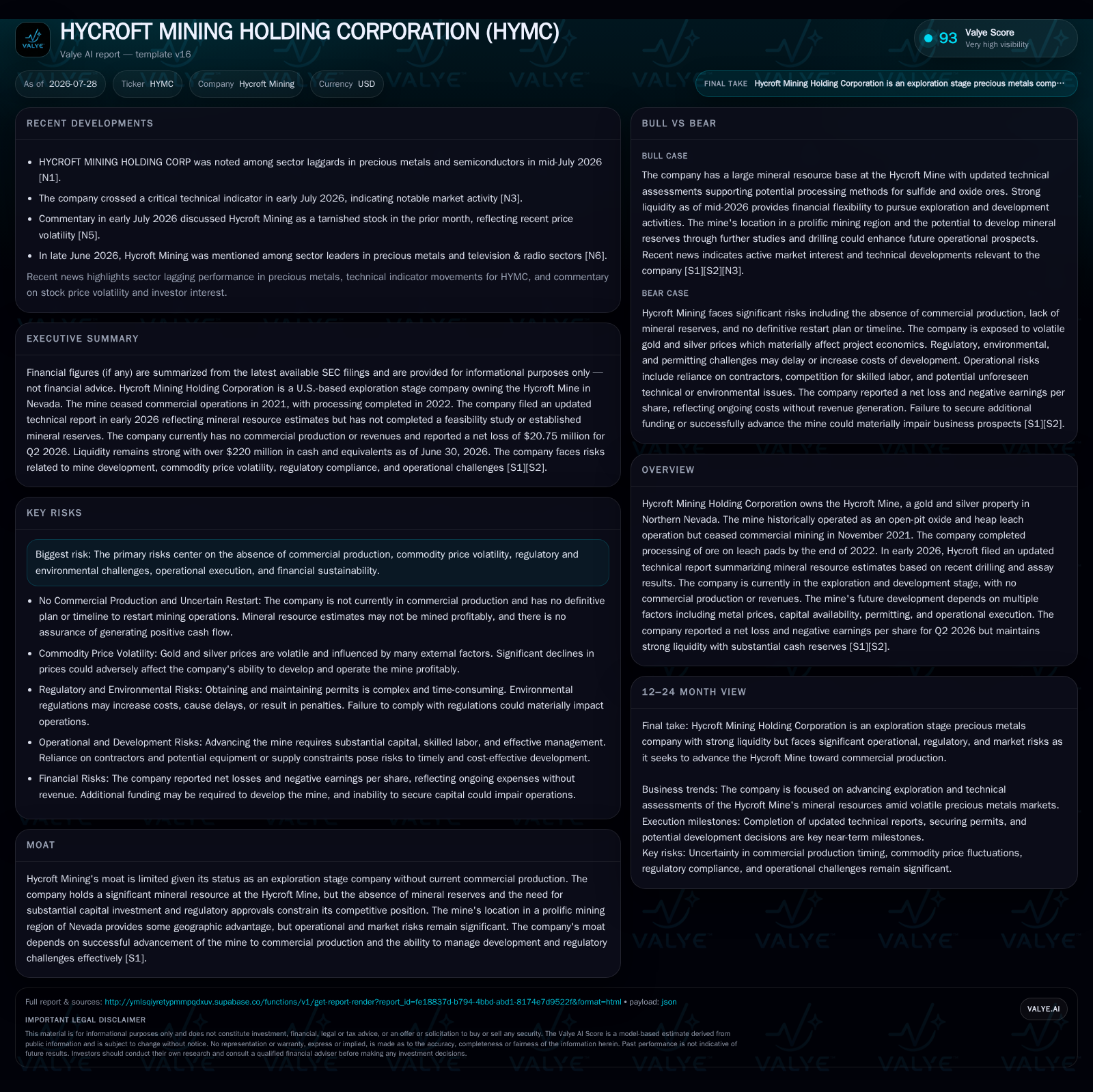
Hycroft Mining Holding Corporation, owner of the Hycroft Mine in Northern Nevada, continues to navigate the challenges of advancing an exploration-stage gold and silver asset. The company completed processing of historic ore in 2022 and recently filed an updated Technical Report Summary reflecting expanded mineral resources and new processing strategies. However, it remains without commercial production or revenue, dependent on metal prices, capital availability, permitting, and execution risks. Strong liquidity supports ongoing exploration and development efforts, though significant uncertainties remain regarding the mine’s economic viability and timeline for restart.
Recent Operating Update: Latest Quarterly Filing Highlights
Hycroft Mining Holding Corporation remains in the exploration and development phase of its flagship Hycroft Mine asset as of its latest quarterly filing ending June 30, 2026 [S2][S3]. The company has not reported any commercial production or revenues since ceasing mining activities in November 2021 [S1]. Processing of previously mined ore placed on leach pads was completed by the end of 2022, marking the end of residual recovery operations from historic stockpiles [S1]. The Q2 2026 results reflect ongoing project advancement costs rather than operational cash flow generation, with a net loss consistent with exploration and development overheads [F1].
Liquidity remains a key strength, with approximately $220.5 million in cash and equivalents supporting modest current liabilities of $5.7 million, resulting in an exceptionally high current ratio near 39x, typical for a non-producing mining developer [F1]. Total debt was approximately $135.8 million as of September 30, 2025, contributing to manageable leverage given the substantial cash reserves [F1].
In February 2026, Hycroft filed an updated Technical Report Summary (TRS) effective January 21, 2026, which supersedes the prior 2023 assessment following extensive additional drilling through the end of 2024 [S1][S17]. This report incorporates a refined mineral resource estimate and outlines a dual processing strategy combining milling with pressure oxidation (POX) for sulfide and transition ores alongside heap leaching for oxide mineralization. This approach aims to enhance processing recoveries by addressing sulfide mineralization not amenable to heap leaching alone [S1]. While promising, these processing strategies remain subject to further pilot testing and feasibility validation.
Business Model: Exploration and Development Focused on Resource Advancement
Hycroft operates as an owner and developer of mineral assets without current revenue generation, relying on advancing mineral resource estimates toward economically viable mineral reserves [S1][F1]. Revenue will depend on successfully transitioning from exploration and resource definition to mine development, requiring completion of feasibility studies, permitting approvals, and securing substantial capital expenditure (CapEx) funding to restart open-pit mining and processing operations focused on gold and silver extraction.
The company’s value proposition centers on controlling a significant mineral resource base in Northern Nevada, a prolific and mining-friendly jurisdiction. However, the absence of measured or indicated mineral reserves underscores the speculative nature of the project. Mineral resource estimates are based on assumptions including metal prices of $3,100 per ounce of gold and $36 per ounce of silver, processing recoveries using the combined POX milling and heap leaching approach, and operational cost assumptions [S1]. These estimates are subject to revision based on metal price fluctuations, metallurgical test results, and further drilling.
Historically, the Hycroft Mine operated as an open-pit oxide heap leach operation until November 2021, when mining ceased due to economic constraints [S1]. The updated processing strategy incorporating POX milling reflects an effort to unlock additional sulfide mineralization and improve overall recoveries, but this introduces technical complexity and capital intensity beyond prior operations.
Industry Structure and Competitive Positioning
Hycroft occupies a midstream position in the precious metals mining value chain, focused on exploration, resource definition, and development without current downstream production or refining capabilities [S14]. Its competitive set includes junior and mid-tier U.S.-focused precious metals miners advancing development-stage projects, alongside large-scale producers such as Barrick Gold Corporation and Newmont Corporation, which operate extensive producing mines with established cash flow
The mine’s location in Northern Nevada provides logistical advantages including infrastructure access and a supportive regulatory environment. However, these benefits do not fully mitigate challenges inherent in restarting a complex mining operation, including securing updated permits, scaling up novel metallurgical processes like POX milling, managing reclamation financial assurances, and raising substantial capital amid volatile metal markets.
Established producers benefit from steady-state production volumes measured in hundreds of thousands to millions of ounces annually, generating operating cash flow that supports sustaining CapEx and growth investments. In contrast, Hycroft’s lack of current production limits its ability to self-fund development, necessitating reliance on equity raises or strategic partnerships amid investor caution toward non-producing assets.
Growth Drivers: Resource Expansion and Metal Price Sensitivity
Key growth drivers for Hycroft include successful conversion of mineral resources into proven and probable reserves supported by pilot programs validating processing recoveries using POX milling combined with heap leaching. Exploration drilling aimed at delineating ore grades and expanding resource confidence—measured in grams per tonne (g/t) of gold and silver—is critical to improving economic feasibility.
Metal price trends exert significant influence on project economics, as higher gold and silver prices increase cut-off grades and expand economically minable mineralization. The company’s current resource estimates are calculated using elevated price assumptions, and material declines could necessitate downward revisions impacting project viability [S1].
Permitting milestones and regulatory approvals represent important operational inflection points enabling transitions from planning to construction phases. Completion of a formal feasibility study incorporating full economic modeling would further clarify project economics and support capital raising efforts. Positive metallurgical test results and demonstration of processing recoveries at scale would enhance developmental outlooks and investor confidence.
Industry-wide demand for bullion, driven by macroeconomic uncertainty and safe-haven investment trends, may provide indirect support for advancing projects like Hycroft’s mine restart plans.
Risks and Watchpoints
Hycroft faces multiple risks inherent to exploration-stage precious metals mining projects, including:
- Commodity Price Volatility: Fluctuations in gold and silver prices can materially affect mineral resource classification and project economics, potentially leading to resource downgrades or deferred development.
- Regulatory and Permitting Challenges: Compliance with evolving environmental regulations and reclamation standards may extend timelines and increase costs, including requirements for financial assurances to cover reclamation obligations [S4][S5].
- Technical and Operational Execution: Scaling up sulfide ore processing via POX milling introduces metallurgical complexity distinct from prior heap leach operations, with risks to recovery rates and operating costs.
- Capital Availability: Securing sufficient funding for mine redevelopment amid uncertain restart timelines may be challenging, with potential dilution from future equity issuances.
- Legal and Litigation Exposure: Ongoing warrant-related lawsuits present contingent liabilities and management distractions, though currently not expected to materially impact financial condition [S4][S5].
- Environmental and Reclamation Obligations: Financial provisions for land restoration and water treatment may divert resources from exploration and development activities.
Monitoring these risk factors through company disclosures on feasibility study progress, permitting status, capital raises, and litigation updates will be important for assessing project advancement.
What to Watch Next
Key developments to monitor in the coming quarters include:
- Updates to mineral resource and reserve estimates incorporating ongoing drilling and assay results.
- Progress toward completion of a formal feasibility study with detailed economic modeling.
- Milestones in regulatory permitting aligned with updated mine plans and sulfide processing strategies.
- Capital structure developments such as equity offerings or strategic partnerships to fund development.
- Announcements regarding operational readiness or pilot plant testing validating processing recoveries.
- Metal price movements influencing resource classification and project economics.
- Resolution or progress in ongoing litigation matters.
Transparent and timely communication on these fronts will be critical for evaluating Hycroft’s prospects within the capital-intensive precious metals mining sector.
Financial Profile Discussion
As of June 30, 2026, Hycroft held $220.5 million in cash and equivalents against current liabilities of $5.7 million, resulting in a current ratio of approximately 39.21x, reflecting a strong liquidity position designed to support exploration and development activities rather than operational working capital needs [F1]. Total debt was approximately $135.8 million as of September 30, 2025, with no more recent public update indicating material changes [F1].
The company continues to incur operating losses consistent with exploration and corporate overhead expenditures typical for non-producing mining developers [F1]. Future capital requirements are expected to increase as metallurgical testwork scales and mine restart planning advances, underscoring the importance of prudent capital management and potential external financing.
This analysis is based solely on publicly available information as cited from SEC filings and news reports up to July 28, 2026. It does not constitute investment advice.
Financial position in context
As of 2026-06-30, companyfacts shows $220.5 million in cash and equivalents [F1]. Current assets of $225.6 million and current liabilities of $5.7 million imply a current ratio near 39.21x for 2026-06-30 [F1].
Disclaimer: This is research-only, informational analysis and not investment advice. It may include AI-generated interpretation and general industry context. Always verify important details using primary sources.

Comments