
Core Scientific’s AI Data Center Pivot Tests Growth Amid Heavy Indebtedness
Core Scientific’s shift from bitcoin mining to HPC colocation is reshaping revenue streams but faces financial and customer concentration constraints.
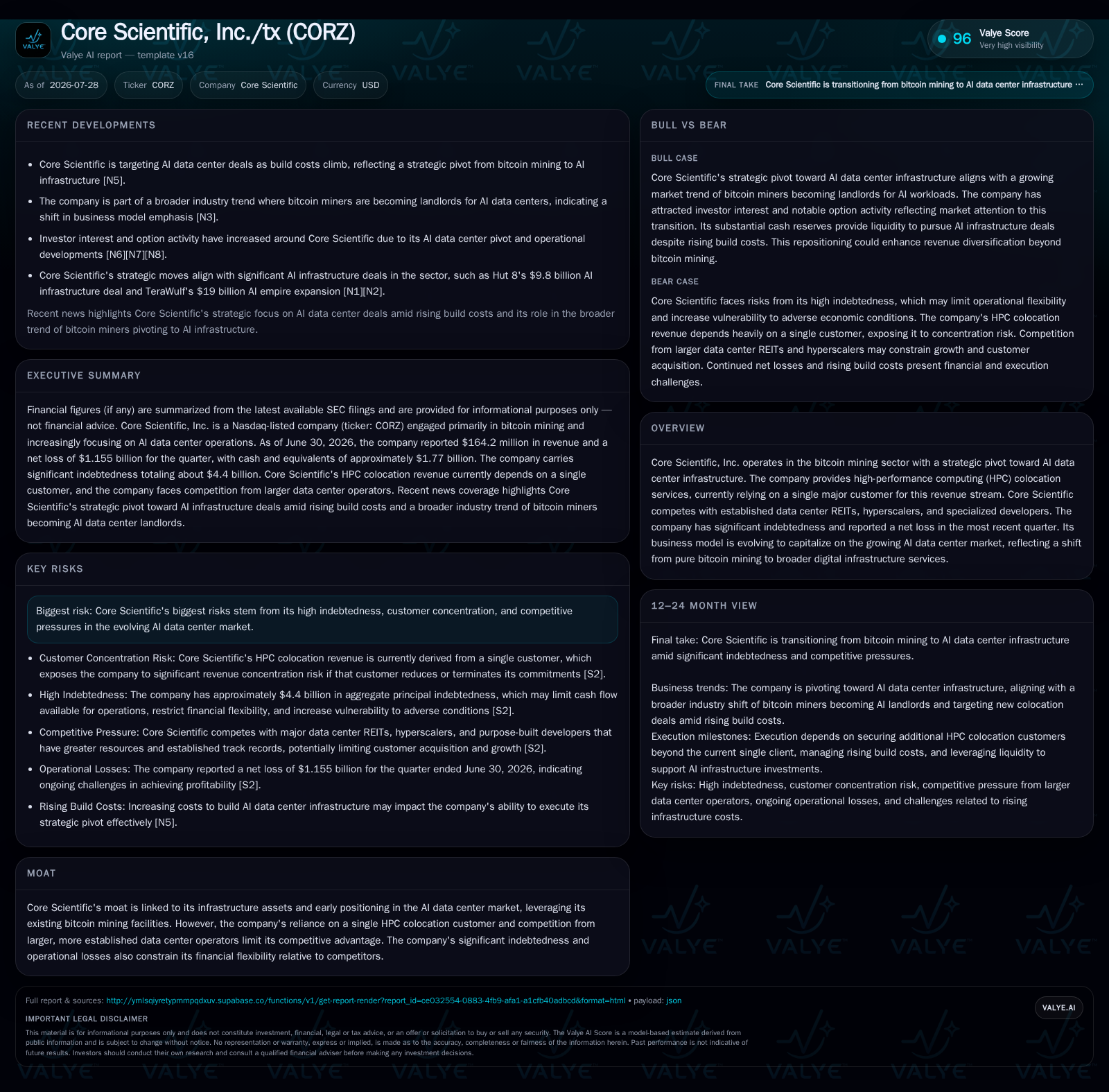
Core Scientific is actively transitioning its business model away from legacy bitcoin mining toward high-performance computing (HPC) colocation services centered on AI infrastructure. The latest Q2 2026 filings reveal this pivot increases dependence on a single HPC customer, elevating revenue concentration risk while the company manages an elevated indebtedness burden near $4.4 billion. Despite sector tailwinds in AI-driven compute demand, Core Scientific’s limited scale versus data center REITs and hyperscalers, coupled with tight liquidity and ongoing net losses, raise questions about growth sustainability and capital flexibility. Key operational and financial indicators over the next quarters will be critical signals for the company's trajectory.
Q2 2026 Operating Update: Leverage and Customer Concentration Remain Key Challenges
Core Scientific’s Q2 2026 financial disclosures reaffirm the company’s substantial leverage position, with total debt outstanding near $4.4 billion and net debt approximating $2.6 billion after accounting for cash and equivalents of about $1.77 billion as of June 30, 2026 [S2][F1]. Despite ongoing strategic efforts to pivot its business model, Core Scientific continues to report net losses through the end of 2025, reflecting persistent challenges in reaching profitability amid its transition [F1]. These financial constraints underscore the company’s limited capital flexibility and heighten risks associated with its growth trajectory.
Concurrently, Core Scientific’s high-performance computing (HPC) colocation revenue is currently concentrated entirely in a single large customer contract, exposing the company to significant revenue concentration risk [S2]. This dependency amplifies downside exposure if the customer reduces, delays, or terminates its commitments. The competitive landscape intensifies this risk, as Core Scientific competes for additional HPC tenants against well-capitalized data center REITs and hyperscale cloud providers that benefit from larger scale, broader customer diversification, and greater access to capital [S2].
Transitioning Revenue Streams: From Bitcoin Mining Hash Rate Sales to HPC Colocation Fees
Historically, Core Scientific generated revenue primarily through bitcoin mining operations, where income correlated directly with hash rate deployment and cryptocurrency market prices [S1][S2]. The company is now actively shifting toward AI-focused HPC colocation services, leveraging its physical infrastructure assets to host high-density computing workloads for AI and machine learning applications [S1][S2]. This transition changes the revenue model from volatile, price-sensitive mining income to more stable, contractually based colocation fees.
HPC colocation revenue is derived from contracted fees based on server space occupancy, power consumption billed per megawatt-hour, and service-level agreements that guarantee uptime and reliability—key operational metrics in digital infrastructure [S1][S2]. However, Core Scientific’s current HPC revenue is dependent on a single customer contract, limiting diversification and increasing operational risk. The company’s ability to secure additional HPC clients and increase colocation occupancy rates will be critical to stabilizing and scaling revenue streams.
Competitive Positioning: Scale and Diversification Disadvantages Versus Data Center REITs and Hyperscalers
Within the digital infrastructure sector, Core Scientific competes against established data center REITs such as Equinix and Digital Realty, which operate extensive global footprints supporting a diversified customer base ranging from enterprises to hyperscale cloud providers [S1][S2]. These peers benefit from scale economies, stronger pricing power, and broader access to capital markets, enabling more aggressive capacity expansion and infrastructure upgrades.
Core Scientific’s more limited geographic reach and customer base constrain its bargaining leverage with energy suppliers and equipment vendors, impacting cost efficiency. Additionally, the company’s elevated indebtedness restricts its ability to finance growth initiatives on favorable terms, placing it at a competitive disadvantage relative to less leveraged peers [S2].
Peers in the bitcoin mining sector pivoting toward AI infrastructure, such as Hut 8 and TeraWulf, provide a relevant comparative framework. These companies have demonstrated either more efficient energy utilization or tighter balance sheet management, underscoring Core Scientific’s financial constraints despite pursuing similar strategic shifts [N1][N2]
Indirect competition also arises from hyperscale cloud providers like AWS and Google Cloud, which increasingly internalize AI and HPC capacity rather than outsourcing colocation services. This trend limits the addressable market for Core Scientific’s HPC colocation offerings beyond a few high-density customers.
Growth Drivers and Market Opportunities in AI Data Center Infrastructure
The rapid expansion of AI and machine learning workloads globally is driving heightened demand for AI-optimized data center infrastructure capable of supporting high server utilization and scalable power density [N3]. This sector tailwind underpins Core Scientific’s strategic pivot toward HPC colocation services tailored for AI applications.
However, scaling AI-focused data centers requires significant capital expenditures to acquire advanced computing hardware, upgrade power delivery systems, and enhance cooling infrastructure. Maintaining competitive power usage effectiveness (PUE) is essential for sustaining margins amid volatile electricity costs, especially given Core Scientific’s Texas-based facilities [S2].
Recent strategic moves, such as issuing warrants to semiconductor supplier AMD, indicate efforts to secure critical technology supply chains necessary for deploying AI compute hardware [S3]. Geographic expansion into regions with favorable energy costs and regulatory incentives for green energy adoption could provide additional growth avenues aligned with increasing ESG considerations among hyperscalers and enterprise customers.
Risks: Capital Intensity, Customer Concentration, and Market Dynamics
Core Scientific faces several structural risks common to capital-intensive digital infrastructure operators, amplified by company-specific factors:
- High Leverage: The company’s $4.4 billion debt load limits liquidity and operational flexibility, increasing vulnerability to adverse market conditions and constraining capital expenditure capacity [S2][F1].
- Customer Concentration: Dependence on a single HPC colocation customer heightens revenue volatility risk and limits growth potential absent new contract wins [S2].
- Energy Cost Volatility: Electricity expenses constitute a significant portion of operating costs for both bitcoin mining and HPC data centers, exposing margins to price fluctuations.
- Technological Obsolescence: Rapid innovation in AI and HPC hardware necessitates continuous reinvestment, which may strain financial resources if capital is constrained.
- Competitive Pressure: Larger, better-capitalized data center REITs and hyperscalers pose formidable competition for customer acquisition and pricing power.
- Regulatory and Environmental Compliance: Increasing scrutiny on energy consumption and environmental impact may elevate compliance costs and operational complexity.
These factors collectively create a challenging environment where Core Scientific’s operational performance and financial health are closely intertwined.
Monitoring Core Scientific: Key Indicators and Milestones
Several concrete metrics and developments will be critical to assess Core Scientific’s progress:
- New HPC Customer Contracts: Securing additional HPC colocation clients beyond the current single customer would reduce concentration risk and support revenue diversification.
- Colocation Occupancy and Server Utilization: Improvements in these operational KPIs would signal effective capital deployment and revenue scalability.
- Debt Refinancing or Reduction: Any initiatives that lower interest expenses or extend debt maturities would enhance free cash flow and strategic flexibility.
- Energy Efficiency Gains: Progress in lowering PUE and managing power costs would improve margin profiles and competitive positioning.
- Strategic Partnerships: Expanding ecosystem relationships, such as with technology suppliers or AI companies, could provide pipeline stability and differentiation.
Absent meaningful progress on these fronts, Core Scientific’s elevated leverage and concentrated revenue base may continue to constrain investor confidence and operational momentum.
Financial Profile: Leverage and Liquidity Constraints
As of June 30, 2026, Core Scientific held approximately $1.77 billion in cash and equivalents against total debt of about $4.385 billion, resulting in net debt near $2.615 billion [F1]. The company’s current ratio of approximately 0.89x reflects tight near-term liquidity [F1].
Ongoing net losses and negative operating income through 2025 further pressure cash flow availability, limiting discretionary spending on infrastructure upgrades and capacity expansion critical to the AI HPC pivot [F1][S2]. Additionally, restrictive covenants in credit agreements may limit the company’s ability to incur additional debt or pursue aggressive growth investments without lender approval, further constraining operational agility [S2][S25].
In comparison, larger data center REITs and hyperscalers typically benefit from lower leverage ratios and better access to capital markets, enabling more robust investment in infrastructure and customer acquisition.
Conclusion
Core Scientific’s transition from bitcoin mining to AI-focused HPC colocation services aligns with broader industry trends driven by surging AI compute demand. However, the company’s current financial profile marked by heavy indebtedness and concentrated HPC revenue exposes it to significant operational and financial risks. Competitive pressures from established data center REITs and hyperscalers with greater scale and diversification compound these challenges.
The company’s ability to secure additional HPC customers, improve operational efficiency, and manage leverage will be pivotal in determining the sustainability of its growth trajectory. Key performance indicators such as colocation occupancy rates, server utilization, energy efficiency metrics, and debt servicing capacity warrant close monitoring in upcoming quarters to gauge progress amid a complex and capital-intensive market environment.
Disclaimer: This analysis is for informational purposes only and does not constitute investment advice. All financial data and claims are sourced from Core Scientific’s SEC filings and publicly available reports [S1][S2][S3][F1][N1][N2][N3].
Disclaimer: This is research-only, informational analysis and not investment advice. It may include AI-generated interpretation and general industry context. Always verify important details using primary sources.

Comments