
Centene Navigates Medicaid Membership Declines and Elevated Medical Costs Amid Regulatory Shifts
Centene’s Q2 2026 update reveals ongoing Medicaid enrollment pressures linked to eligibility redeterminations and continued medical cost inflation, underscoring the critical role of its integrated care approach and regulatory expertise in managing margin risks.
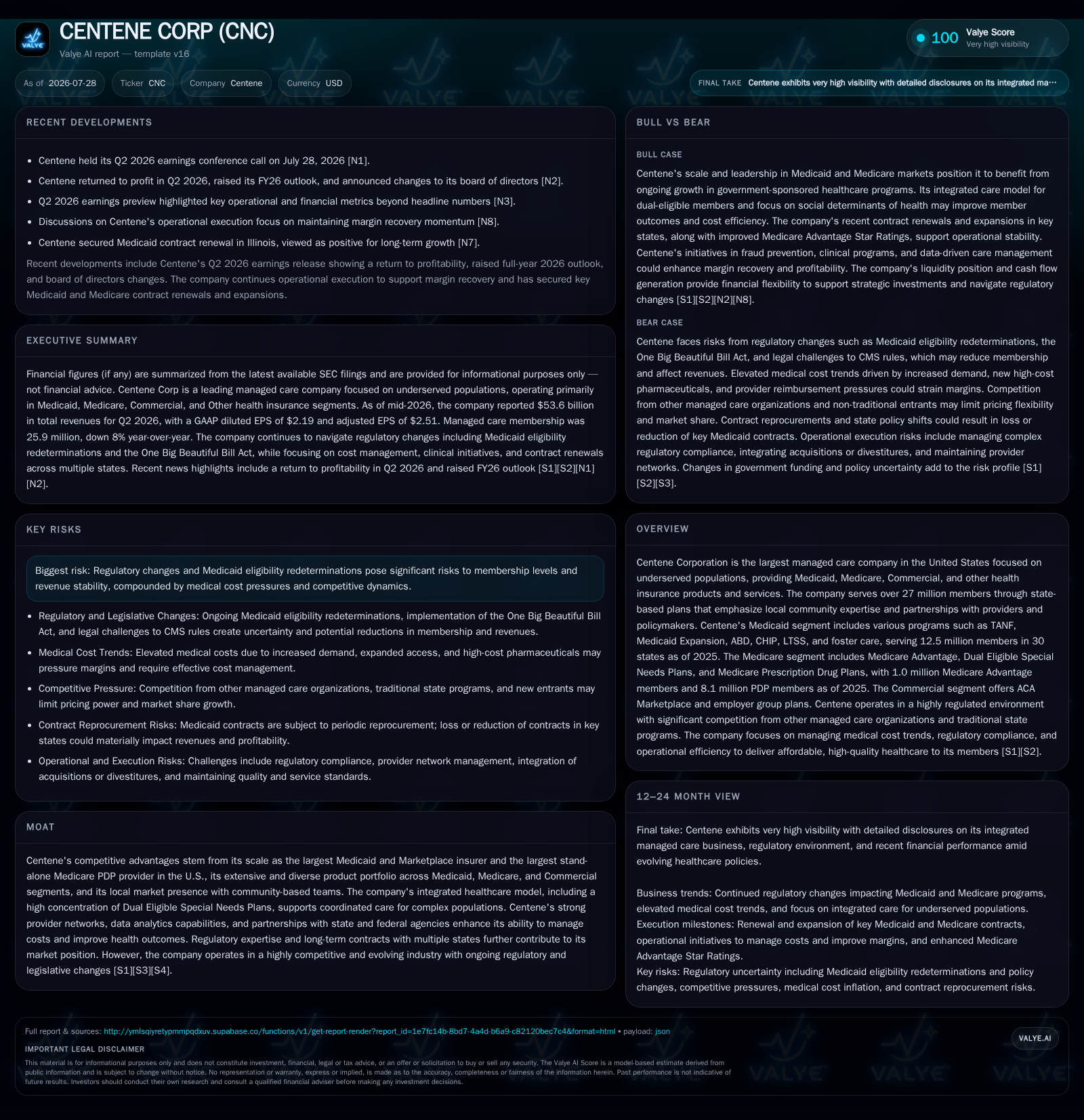
Centene’s Q2 2026 filing highlights persistent Medicaid membership declines driven by post-pandemic eligibility reviews, partially offset by state expansions. Elevated medical costs from expanded coverage and specialty drugs continue to pressure margins. The company leverages its scale, diversified government-focused portfolio, and strong liquidity position to manage these challenges. Key near-term indicators include state rate adjustments aligned to member acuity and premium deficiency reserve developments.
Recent Operating Update
Centene’s second quarter 2026 Form 10-Q highlights ongoing operational challenges primarily driven by Medicaid membership declines following the resumption of eligibility redeterminations after the COVID-19 public health emergency ended on March 31, 2023 [S2]. Despite some membership gains from new state entries and program expansions, the net Medicaid enrollment trend remains negative and is expected to continue as states proceed with eligibility verification processes. Given Medicaid members constituted approximately 12.5 million of Centene’s 27.6 million total members as of December 31, 2025, these enrollment shifts have direct implications for premium revenue stability and margin pressure in this premium-driven managed care model [S1].
Alongside membership headwinds, Centene faces sustained elevated medical cost trends. These are fueled by increased utilization linked to state-level policy expansions such as behavioral health carve-ins and home- and community-based services (HCBS), as well as the growing impact of high-cost specialty pharmaceuticals [S2]. These cost drivers complicate actuarial forecasting and premium setting, increasing variability in financial outcomes. The company continues to work closely with state partners to align Medicaid premium rates with evolving member acuity and recent medical cost trends, leveraging data analytics to support actuarial soundness and risk adjustment program design [S2].
Notably, Centene recorded no premium deficiency reserve for the 2026 Medicare Advantage contract year, following significant reserves established in 2025 due to earnings volatility associated with complex cost-sharing progression within benefit plans [S2]. Premium deficiency reserves serve as a critical indicator of underwriting risk when premiums do not fully cover incurred claims, making their absence in 2026 a positive signal amid ongoing cost pressures.
Business Model Overview
Centene operates as a government-focused managed care organization delivering Medicaid, Medicare Advantage (including Dual Eligible Special Needs Plans, D-SNPs), Medicare Prescription Drug Plans (PDP), and Commercial insurance products. The company’s revenue is primarily generated through risk-based capitation contracts with federal and state agencies, where Centene receives fixed premiums per member per month (PMPM) and assumes responsibility for managing healthcare delivery costs through extensive provider networks.
Premium revenues are predominantly paid by government programs or federally subsidized Marketplace plans, with profitability hinging on managing medical costs relative to premiums—measured by the Health Benefits Ratio (HBR)—and controlling administrative expenses captured by the Selling, General & Administrative (SG&A) expense ratio [S1]. Centene’s integrated care model emphasizes local presence via state-based subsidiaries supported by centralized analytics and care coordination capabilities, which are critical for managing populations with complex chronic conditions influenced by social determinants of health.
The Medicaid segment accounted for approximately 57% of external revenues as of year-end 2025 [S1]. This segment encompasses diverse programs including Temporary Assistance for Needy Families (TANF), Medicaid Expansion populations, aged/blind/disabled groups (ABD), Children’s Health Insurance Program (CHIP), foster care, long-term services and supports (LTSS), and Medicare-Medicaid Plans (MMP) covering dual eligibles. This diversity requires granular actuarial modeling sensitive to evolving member acuity driven by policy changes
Medicare operations include Medicare Advantage plans—featuring one of the highest concentrations of D-SNP members nationally—and stand-alone Prescription Drug Plans available nationwide. The commercial segment comprises ACA Marketplace offerings alongside individual and employer group plans targeting underinsured populations.
Industry Structure & Competitive Position
The managed healthcare market is concentrated among a few large players including UnitedHealth Group, Molina Healthcare, Anthem, and Centene. Differentiation arises from scale in government-sponsored lines, breadth of product portfolio, local market integration, depth of provider networks, adoption of advanced data analytics, and regulatory expertise facilitating long-term state contracting.
Centene distinguishes itself as the largest Medicaid insurer by membership count and the largest stand-alone PDP provider nationwide [S1]. Its community-centric approach—embedding local teams within markets—fosters trusted relationships with providers and policymakers, enabling tailored clinical initiatives aimed at improving health outcomes and managing costs.
Despite these strengths, competition remains intense amid generally low margins typical in government payor-managed care, where premiums are set through competitive bids constrained by regulatory frameworks. Effective risk adjustment capabilities are essential for Centene given the high morbidity profile of its populations; accurate risk scoring ensures appropriate reimbursement levels and mitigates underpayment risks tied to changing health statuses.
Growth Drivers
Key structural drivers supporting Centene’s growth outlook despite near-term enrollment headwinds include:
- Continued expansion of state Medicaid programs where political environments favor coverage extensions.
- Growth in Medicare Advantage offerings focused on dual eligibles via D-SNPs aligned with higher acuity populations benefiting from coordinated care.
- Innovation in integrated healthcare models incorporating social determinants of health to reduce avoidable utilization and enhance cost-effectiveness.
- Renewal or expansion of risk-based contracts across states ensuring predictable premium revenue streams.
- Deployment of advanced analytics improving fraud detection and optimizing clinical pathways to reduce wasteful spending.
- Demographic trends such as aging populations increasing chronic disease prevalence, augmenting demand for managed care solutions designed for medically complex beneficiaries.
Success depends materially on effective navigation of regulatory environments, including securing actuarially sound premium rates that reflect shifting member profiles post-redeterminations [S1][S2].
Risks & Watchpoints
Centene faces several risks primarily centered on:
- Regulatory changes affecting eligibility, notably under the One Big Beautiful Bill Act (OBBBA), which introduces work and community engagement mandates starting circa 2027. These changes may reduce enrollment or increase acuity among remaining members, impacting rate setting and profitability [S1].
- Volatility from inaccurate medical cost projections exacerbated by emerging high-cost therapies or unexpected utilization surges.
- Enrollment declines amplifying fixed administrative expenses, pressuring SG&A efficiency ratios.
- Provider network adequacy challenges or reimbursement disputes threatening mandated access standards.
- Market contraction pressures within the ACA Marketplace influencing metal-tier distribution and potentially lowering average premiums.
- Exposure to fraud, waste, and abuse allegations inherent in complex claims processing within government payor systems.
- Variability in the pace of state implementations of policy changes complicating forecasting for membership trends and rate approvals.
What To Watch Next
Upcoming indicators include:
- State Medicaid rate-setting outcomes incorporating updated acuity assessments post-redeterminations, providing insight into future margin sustainability.
- Developments regarding premium deficiency reserves, particularly within Medicare Advantage lines, signaling potential underwriting risks.
- Membership trajectory updates beyond Q2 clarifying whether declines stabilize or accelerate amid ongoing eligibility reviews into late 2026 and early 2027.
- Progress on clinical initiatives focusing on cost containment, especially around behavioral health integration and pharmacy management, given their outsized impact on spend.
- Impacts from recent divestitures, including the full exit from Magellan Health businesses, concentrating efforts on core government-sponsored managed care operations.
- Trends in SG&A expense ratios indicating operational leverage potential amid fluctuating revenue bases.
Financial Profile Discussion
As of June 30, 2026, Centene held $24.15 billion in cash and cash equivalents, with total current assets approximating $46.7 billion against current liabilities near $40.8 billion, yielding a current ratio of approximately 1.15, reflecting solid short-term liquidity [F1][S2]. The company’s net debt position is strongly negative, as cash holdings far exceed any short-term borrowings, providing a robust liquidity buffer amid regulatory uncertainties.
Operating cash flows remain strong, with nearly $8 billion generated over the first half of 2026, supporting internal funding capacity alongside undrawn revolving credit facilities offering additional capital flexibility [S2]. Despite reported net losses for full-year 2025 partly attributed to impairment charges stemming from divestitures ($389 million after-tax) and elevated medical costs, liquidity strength enables continued investment, including approximately $400 million planned capital expenditures primarily for technology infrastructure enhancements during the remainder of 2026 [S2].
Centene’s stock repurchase program retains approximately $1.8 billion in available authorization; however, no repurchases occurred during Q2, suggesting cautious capital deployment amid ongoing enrollment and reimbursement uncertainties [S2]
Overall, Centene’s substantial balance sheet positions it well against cyclical headwinds typical in managed healthcare, where timing of regulatory shifts can temporarily disrupt free cash flow before normalization through rate resets or population stabilization.
Disclaimer: This is research-only, informational analysis and not investment advice. It may include AI-generated interpretation and general industry context. Always verify important details using primary sources.

Comments