
Resideo Technologies’ Spin-Off Strategy and Profitability Challenges in 2025
Resideo faces operational shifts with the ADI spin-off, a sharp net loss, and capital allocation amid volatile commodity and trade risks.
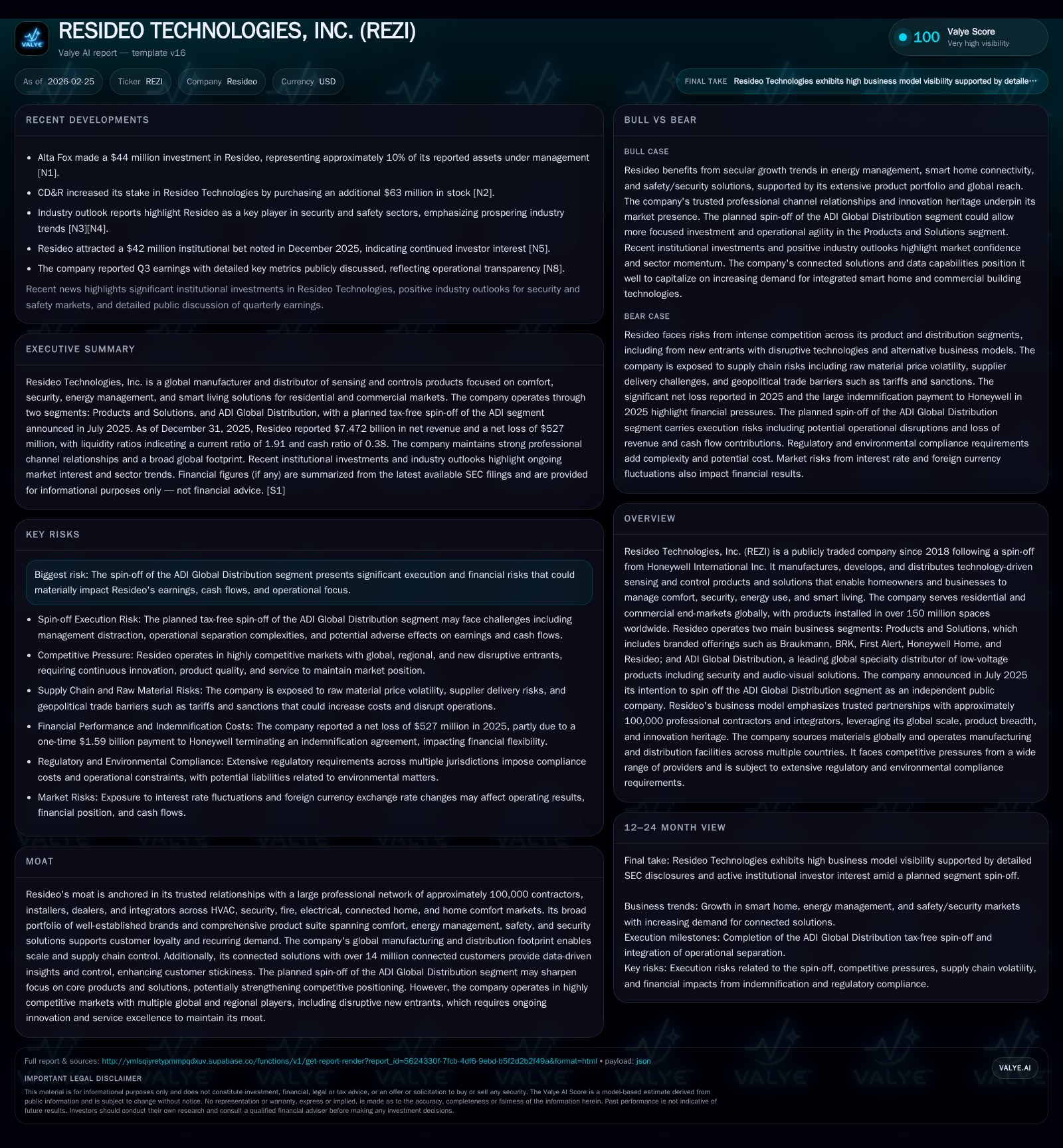
Resideo Technologies, spun off from Honeywell in 2018, operates two core segments: Products and Solutions, and ADI Global Distribution, with plans to spin off ADI by late 2026. Its 2025 results showed solid operating income growth of 16.7% but a significant net loss of $527 million due to restructuring, impairment charges, and spin-off related costs. Operating cash flow turned sharply negative, reflecting working capital pressures and deferred revenue movements. The company’s moat lies in its extensive professional network and trusted brand portfolio across HVAC, security, safety, and connected home markets. However, risks including tariffs, supply chain challenges, and financing costs cloud prospects. Key milestones include the ADI spin-off execution and monitoring cash flow turnaround to support further reinvestment or shareholder returns.
Company Overview
Resideo Technologies, Inc. (REZI) emerged as an independent public company in late 2018 following its spin-off from Honeywell International Inc., positioning itself as a global manufacturer and distributor of sensing and control technologies designed for comfort, security, energy management, and smart living applications [S1][S16]. Serving both residential and commercial end-markets worldwide, Resideo's footprint includes over 150 million installed devices encompassing HVAC controls, fire safety detectors, security solutions, as well as connected home systems [S16].
The company's business structure splits into two segments: Products and Solutions—which offers branded items such as Honeywell Home, First Alert, BRK—and ADI Global Distribution—a leading specialty distributor of low-voltage security and audio-visual products [S10]. In July 2025, Resideo announced its plan for a tax-free spin-off of the ADI segment ("ADI Spin-Off"), targeting enhanced strategic focus by separating the distribution operations from its core manufacturing capabilities [S10].
Historical Performance
Operating income exhibited resilience through recent years with some volatility associated with acquisitions and restructuring:
Historical performance (annual)
| FY | Net ($mm) | CFO ($mm) | OpInc ($mm) | Capex ($mm) | Net YoY |
|---|---|---|---|---|---|
| 2025 | -527 | -1137 | 607 | 116 | -554.3% |
| 2024 | 116 | 444 | 520 | 80 | -44.8% |
| 2023 | 210 | 440 | 547 | 105 | -25.8% |
| 2022 | 283 | 152 | 611 | 85 |
Note: Omitted columns lack sufficient annual XBRL coverage in the provided tags (need ≥2 annual points): Rev, Div. Source: SEC companyfacts cache [F1].
Capital returns and efficiency (annual)
| FY | Buybacks ($mm) | FCF ($mm) | ROE% |
|---|---|---|---|
| 2025 | 0 | -1253 | -18.1 |
| 2024 | 1 | 364 | 3.5 |
| 2023 | 41 | 335 | 7.6 |
| 2022 | 67 | 11.2 |
Source: SEC companyfacts cache [F1].
Table Note: Revenue data not disclosed in provided tags.
While operating income improved notably in FY25 (+16.7%), the net loss of $527 million marked a stark reversal from prior positive earnings driven primarily by non-operating expenses including goodwill impairments related to the anticipated ADI separation and restructuring charges [N1][S1][S14]. Additionally, the drastic swing to negative cash flows from operations (-$1.14 billion) reflects significant working capital build-up attributed partly to deferred revenues within the distribution segment [S4][S12].
Capex spending rose substantially indicating ongoing investment in plant modernization and technology solutions aligned with smart home trends [S22]. Despite such investment commitment, ROE approximated at negative 18%, underscoring profitability challenges linked to transitional costs.
Future Growth Prospects
Growth drivers rest fundamentally on secular demand for integrated comfort, energy efficiency management, safety enhancements via interconnected devices—all amplified by accelerating adoption of IoT-enabled smart home technologies [S16]. The company's expansive professional installer network (~100k strong) furnishes a durable competitive advantage facilitating direct channel access that competitors find hard to replicate easily .
The Products and Solutions segment could benefit from expanding its connected customer base—currently over 14 million users—to capitalize on data analytics-driven services offering predictive maintenance or automated system optimization [S10]. Meanwhile, the ADI spin-off is expected to allow differentiated strategic focus for each standalone entity; however it also introduces near-term execution risks including operational separation complexities which could disrupt sales or inflate costs [N1].
External factors that may cap growth include exposure to tariff regimes affecting raw materials import costs (notably copper, steel alloys), semiconductor shortages impacting supply chains for sophisticated sensing devices, as well as competitive pressure from new entrants leveraging software-centric solutions or direct-to-consumer models outside traditional pro channels [S17][S24][S25]. Increased regulatory scrutiny around privacy issues for connected devices likewise requires ongoing compliance vigilance.
Forecasts and Milestones
While explicit forward guidance remains limited publicly pending full separation of ADI Global Distribution planned post mid-2026 (subject to market conditions), key milestones will be:
- Completion of the ADI spin-off transaction expected by late calendar year 2026[N1]
- Stabilization of operating cash flows post-spin-off reflecting streamlined working capital dynamics
- Monitoring margins trajectory within Products & Solutions segment where investment in R&D reached $128 million in FY25 demonstrating innovation emphasis[S14][S22]
- Potential incremental accretive M&A or organic product introductions targeting further penetration into energy management or security categories
Investors should watch developments around tariff impacts on sourcing costs alongside industry's adaptation pace towards integrated IoT-based ecosystems which could drive sustained revenue acceleration.
Returns and Capital Allocation
Resideo's capital allocation narrative includes an absence of dividend payments reported recently - instead focusing on debt management following large refinancing activities completed through incremental term loans maturing up to 2032 bearing fixed amply hedged rates (~1.57%) against market SOFR volatility [S4][S19]. Total debt stands at approximately $3.2 billion driven largely by an expanded variable rate term loan facility augmented by senior note issuances in prior years[S15][F1].
Share repurchase activity effectively paused during FY25 amid strategic transition costs but authorized programs remain unexpired allowing flexibility depending on market circumstances[S18]. Cash balances remained healthy at $661 million year-end supporting liquidity needs[S15].
Operating cash flow deterioration (-$1.14 billion) caused free cash flow also deeply negative after capex outlays[S15], emphasizing near-term cash generation headwinds resulting mainly from the planned separation-related expenses plus working capital normalization needs.
Industry Context (Analysis)
In the context of building automation and specialty distribution sectors impacted by ongoing raw material inflationary pressures coupled with semiconductor supply instability globally—as seen industry-wide—the company’s broad global footprint offers both cost control benefits but also complexity challenges in maintaining tight inventory levels without eroding service standards . Resideo competes against both legacy industrial manufacturers with deep OEM relationships as well as emerging technology companies innovating rapidly on cloud-connected platforms creating hybrid competitive dynamics.
Further integration between hardware products sold through its professional channels paired with software-as-a-service business models represents a pathway toward higher-margin offerings but requires continued R&D investment plus channel education.
Summary Opinion (No Investment Advice)
Resideo Technologies stands at a strategic inflection point marked by the pending carve-out of its distribution arm intended to enhance operational focus on the core products business serving HVAC/safety/security professionals globally. Its foundational brand loyalty across multiple legacy names coupled with a massive installed base secures recurring demand but emerging competitive threats combined with macro trade uncertainties impose caution.
The fiscal year ended December 31, 2025 reflected growth in operating profit overshadowed by a significant net loss due primarily to spin-off related restructuring expenses along with negative cash flows signaling transitional disruptions.
Key developments ahead include successful execution of the ADI spin-off while returning toward consistent positive cash flow generation reflective of operational stability post-separation.
Balancing near-term investment against capital structure sustainability remains crucial for preserving optionality in future shareholder returns or further product innovation initiatives.
This analysis is based solely on reported financial statements, regulatory filings as of February 24–25th, 2026 ([F1],[N1]–[N6],[S1]–[S29]), industry context interpretations without providing any investment advice or recommendations.
Disclaimer: This is research-only, informational analysis and not investment advice. It may include AI-generated interpretation and general industry context. Always verify important details using primary sources.

Comments