
Reliability Inc Advances Workforce Solutions with Margin Gains and Capital Structure Simplification
Q1 2026 results highlight staffing margin expansion amid EOR revenue decline, alongside a pivotal share settlement enhancing strategic flexibility.
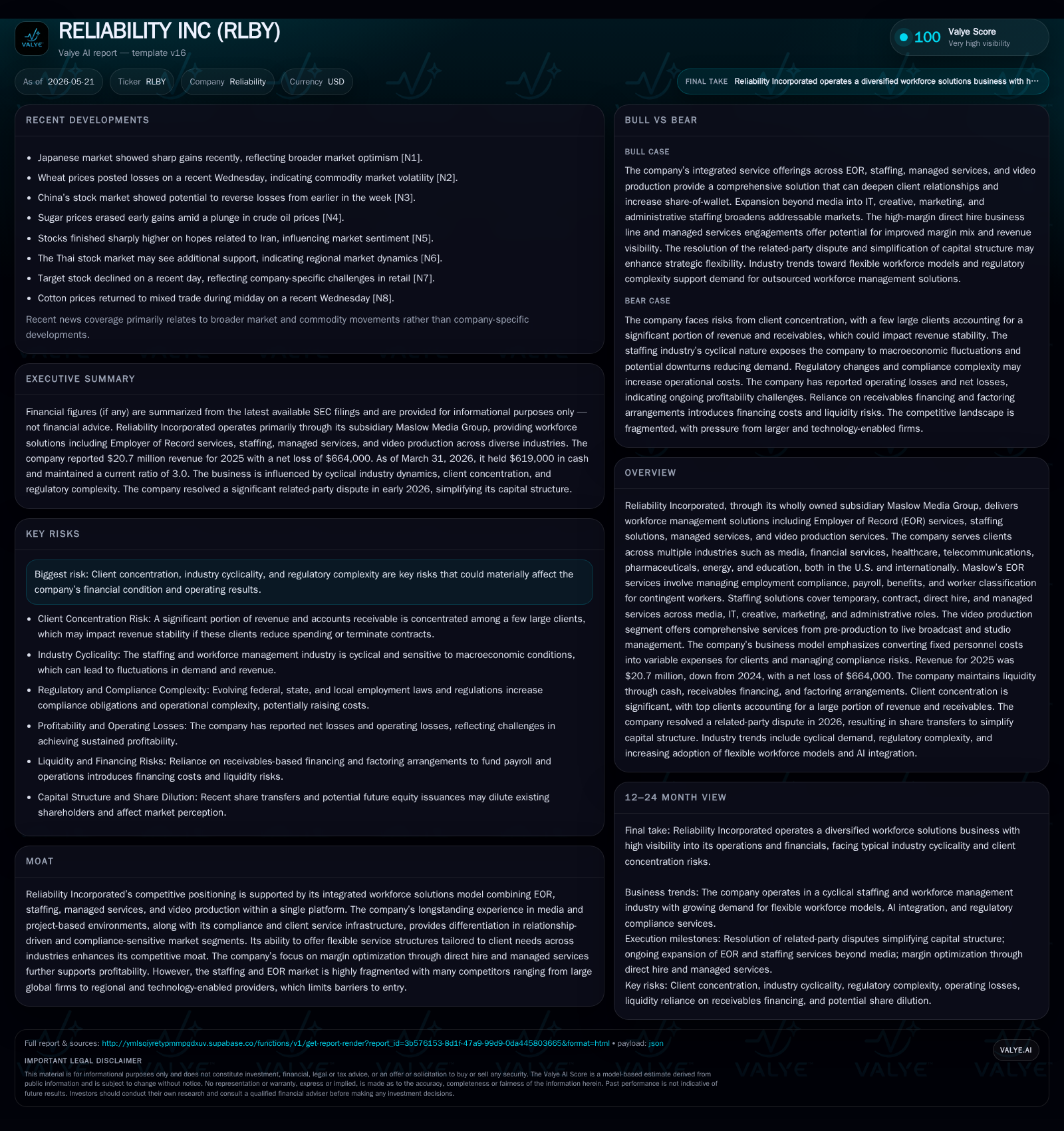
Reliability Incorporated’s Q1 2026 filing reveals ongoing revenue pressure from reduced Employer of Record (EOR) activities offset by improved staffing segment margins. A February 2026 settlement returned over 253 million shares to the company, increasing unissued shares and enabling future equity issuance capacity. Operating through its Maslow subsidiary, the company leverages integrated workforce solutions targeting compliance-heavy media and professional staffing niches. Growth is driven by expanding higher-margin staffing and managed services, cross-selling within clients, and disciplined cost management. Risks include client concentration, regulatory complexity, federal spending variability, and financing cost sensitivity tied to receivables factoring.
Latest Quarterly Operating Update
Reliability Incorporated’s Q1 2026 Form 10-Q filing dated May 20, 2026 details ongoing operational dynamics [S2]. The company continues to experience revenue contraction primarily due to diminished Employer of Record (EOR) service demand as some enterprise clients reduce contingent workforce engagements. Conversely, the staffing segment demonstrated resilience with gross margins expanding by nearly 90 basis points to around 23%, up from approximately 18.7% in the prior year period [S1]. This margin improvement partially offsets revenue declines driven by lower EOR activity.
A significant corporate development was the February 2026 settlement agreement with the Vivos Group—former controlling shareholders involved in ownership disputes. This agreement resulted in the transfer of roughly 253 million shares back to Reliability as treasury stock without affecting authorized share count [S3]. The company has initiated court proceedings to finalize this transfer through its transfer agent. Completion of this process will simplify the capital structure and enhance strategic flexibility for recapitalization or acquisition opportunities [S2].
The company employs receivables financing arrangements including traditional factoring facilities and receivables purchase programs with JPMorgan Chase and MUFG Bank offering relatively lower-cost liquidity albeit with delayed funding following invoice approval.
Business Model and Service Portfolio
Reliability operates primarily through its wholly owned subsidiary Maslow Media Group (MMG), providing integrated workforce solutions encompassing Employer of Record (EOR) services, diverse staffing models (temporary, contract, direct hire), managed service programs (MSP), and video production support spanning multiple industries such as media, financial services, healthcare, telecommunications, pharmaceuticals, energy, and education domestically and internationally [S1]
The EOR model helps clients mitigate complex multi-state employment compliance risks—including payroll administration, benefits management, tax reporting, and worker classification—critical in freelance-dense environments. Staffing offerings cover IT, creative marketing roles, administrative functions tailored largely toward media-centric projects. Video production services provide end-to-end support from pre-production through live broadcast execution aligned with project-based workforce needs.
This integrated service platform enables clients to flexibly scale workforce requirements while outsourcing employment compliance risks and administrative burdens. Growth strategies emphasize increasing higher-margin direct hire placements and managed service contracts that generate fee-based revenues without corresponding payroll liabilities—thereby enhancing revenue visibility and gross margins [S7]
Competitive Environment and Industry Dynamics
The U.S. temporary staffing industry is highly fragmented with numerous competitors ranging from global publicly traded firms to regional providers and emerging technology-enabled platforms offering digital talent sourcing solutions [S1]. Barriers to entry are moderate; differentiation derives from strong client relationships within specialized verticals like media production, deep regulatory expertise especially around labor classification laws, and exceptional service execution.
Reliability’s competitive advantage lies in its extensive media industry knowledge combined with vertically integrated services targeting project-based contingent workforces requiring real-time compliance oversight—a domain where generic technology platforms often fall short. Demand is cyclical: expanding during economic growth due to increased labor market participation yet vulnerable during downturns when discretionary staffing budgets tighten.
Margin Expansion Driven by Staffing Segment
Despite overall revenue decline mainly attributable to softer EOR performance (~13.6% year-over-year drop), Reliability posted an approximate 90 basis point increase in gross margin driven by a shift toward higher-margin staffing mix [S1]. Staffing gross margins improved from about 18.7% to near 23%, reflecting growth in direct hire assignments and managed service engagements which typically deliver superior margin profiles compared to traditional temporary placements.
This evolving revenue mix supports profitability enhancement since direct hires yield fee income detached from employee wage exposure while MSP contracts offer longer durations fostering steadier cash flows. Operational efficiencies stemming from targeted cost containment measures implemented in late 2025 also contributed favorably to margin expansion [S17]. The firm plans continued emphasis on scaling these higher-value offerings while maintaining disciplined expense management.
Growth Opportunities and Strategic Levers
Growth drivers include macroeconomic trends favoring flexible workforce deployment as evolving worker classification standards across multiple states heighten demand for outsourced employer-of-record solutions beyond traditional media verticals into healthcare/pharmaceutical sectors where regulatory complexity is pronounced [S7].
Cross-selling complementary IT, creative marketing, HR staffing solutions within existing accounts aims at increasing wallet share while reducing customer acquisition costs. Video production services complement workforce offerings enabling bundled contracting advantages for content creation projects.
Receivables purchase programs provide moderately lower-cost liquidity facilitating working capital management essential for scaling payroll-heavy operations without excessive debt reliance—aligning cash flow timing with billing cycles improves financial stability [S5]. Ongoing investments in commercial leadership strengthen pipeline development expected to translate into top-line growth subject to broader economic conditions.
Risks and Operational Constraints
Key risks encompass elevated client concentration—with top five enterprise clients generating significant recurring revenue—and federal budget fluctuations potentially impacting public sector-related contracts affecting media support demand amid government spending priorities or operational restructurings [S1][S2]
Regulatory complexity relating to evolving employer-of-record frameworks introduces compliance risks; stricter state labor classification standards could raise costs or limit operational scope. Although recent ownership litigation was resolved through settlement removing material uncertainty, legacy reputational effects may require ongoing attention [S19][S21]. Dependence on receivables factoring exposes the company to financing cost volatility linked to client payment delays impacting operating margins.
Key Near-Term Developments to Monitor
Critical upcoming milestones include finalizing the transfer of returned shares into treasury stock via court consent judgment—this action underpins scheduling of shareholder meetings and unlocks potential equity transactions enhancing capital structure flexibility [S3][S21]. Monitoring sales pipeline progress alongside receivables financing utilization will be important indicators of operational momentum amidst payment cycle variability [S2][S4].
Execution on expanding managed service contracts combined with growth in direct hire placements will serve as tangible metrics for margin improvement strategy effectiveness. Regulatory developments affecting employment compliance frameworks remain key external variables influencing risk management approaches.
Financial Overview: Liquidity and Profitability Snapshot
As of March 31, 2026 fiscal year-end balance sheet metrics indicate a cash position approximating $619 thousand against minimal total debt near $14 thousand producing a net cash positive position reflective of conservative leverage management [F1]
Management projects stable SG&A expenses for calendar year 2026 focusing incremental hiring on commercial roles designed to drive revenue growth while sustaining disciplined cost controls ensuring operational leverage progression [S17]
This analysis integrates recent SEC filings with contextual industry insights specific to Reliability Incorporated’s evolving business dynamics without constituting investment advice.
Disclaimer: This is research-only, informational analysis and not investment advice. It may include AI-generated interpretation and general industry context. Always verify important details using primary sources.

Comments