
RLJ Lodging Trust’s Urban-Focused Hotel Portfolio Faces Growth and Leverage Constraints
Premium-brand urban hotels underpin RLJ's solid operational base, while leverage management and market dynamics shape its near-term trajectory.
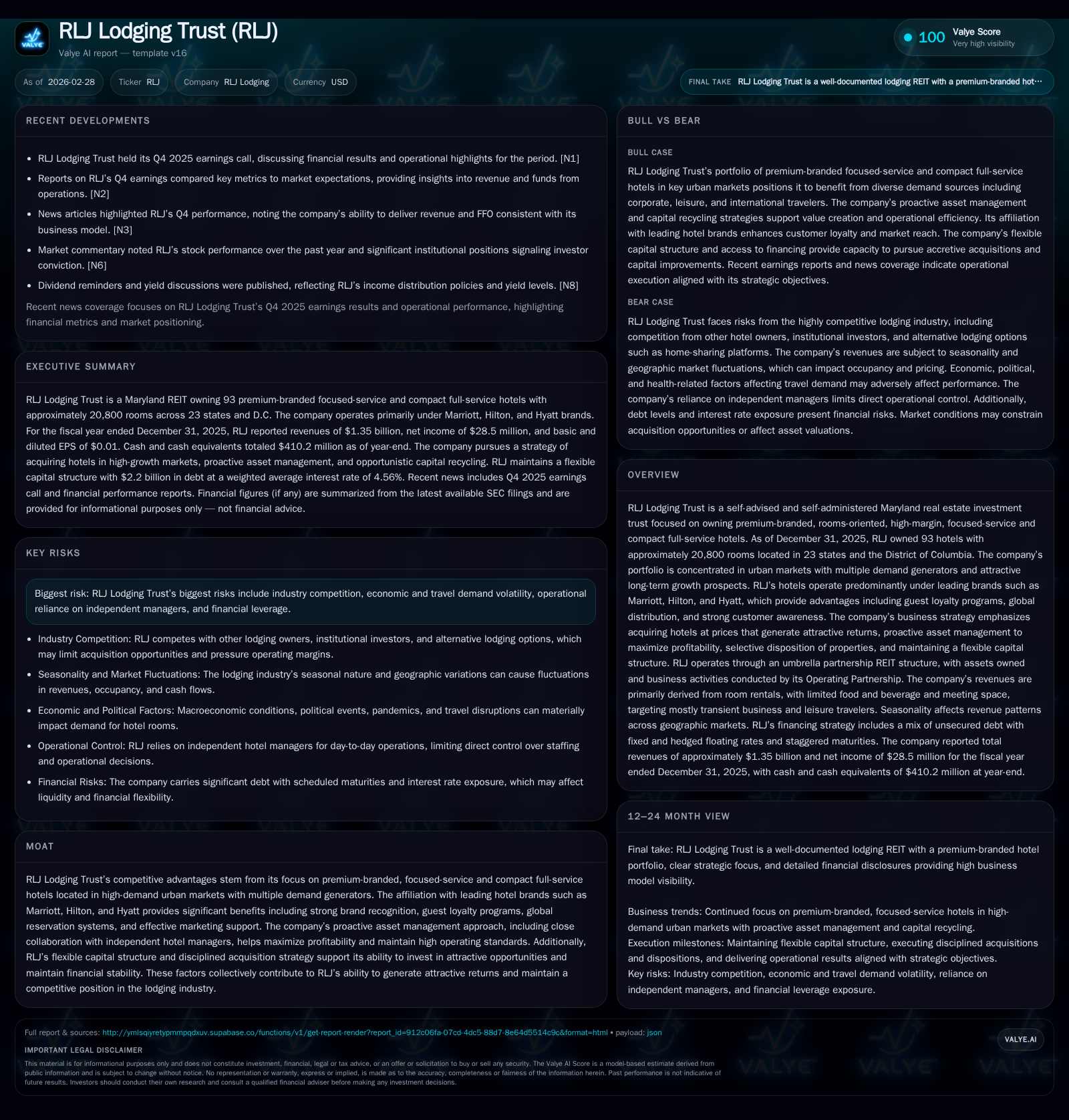
RLJ Lodging Trust, a Maryland REIT owning primarily premium-branded focused-service and compact full-service hotels, ended 2025 with 93 hotels concentrated in high-demand urban markets. Despite stable top-line revenues approaching $1.35 billion, net income and operating cash flow declined year-over-year due in part to margin pressures and investments. The company has actively managed capital through refinancing to extend debt maturities into 2029 and beyond, supporting liquidity but also maintaining significant leverage. Growth prospects hinge on selective acquisitions and asset repositioning within targeted urban locales, yet macroeconomic volatility and competitive pressures impose constraints going forward.
Company Overview
RLJ Lodging Trust operates as a self-advised Maryland real estate investment trust (REIT) owning a portfolio focused on premium-branded, high-margin focused-service and compact full-service hotels primarily situated in major urban markets across the United States. As of December 31, 2025, RLJ's portfolio comprised 93 hotels totaling roughly 20,800 rooms spread over 23 states and the District of Columbia [S1][S6]. The geographic concentration targets cities exhibiting multiple demand generators such as corporate offices, governmental hubs, educational institutions, and tourism attractions which underpin long-term growth prospects.
Most properties are affiliated with leading global franchisors — Marriott International, Hilton Worldwide Holdings, and Hyatt Hotels — which provide strategic advantages including robust guest loyalty platforms, global reservation infrastructure, extensive distribution reach, and heightened brand awareness [S6].
Historical Financial Performance
RLJ's top-line revenue for fiscal year (FY) 2025 was approximately $1.35 billion USD, marking a slight decline of roughly 1.4% compared with $1.37 billion in FY2024 [F1]. Room revenues constituted the majority of total revenues consistent with RLJ's focused-service hotel model.
Net income contracted sharply by over $39 million (-58.1%) year-over-year to $28.5 million USD in FY2025 from $68 million USD the prior year, reflecting increased operating expenses including property enhancements alongside inflationary pressures on labor and input costs across its portfolio [F1]. Operating cash flow (CFO) also decreased by nearly 15% year-over-year to $243.8 million USD in FY2025 from $285.4 million USD in FY2024 [F1], partially driven by increased capital expenditures.
Capital spending accelerated as RLJ invested $126 million USD into renovations and capital improvements designed to maintain brand standards and enhance competitive positioning — up about 27% from prior periods [F1][S24]. At the same time, RLJ returned capital to shareholders through dividends ($0.60 per common share declared for FY2025) and invested nearly $28.6 million USD toward share repurchases under an authorized buyback program [F1][S13].
Historical performance (annual)
| FY | Rev ($mm) | Net ($mm) | CFO ($mm) | Rev YoY | Net YoY |
|---|---|---|---|---|---|
| 2025 | 1350 | 29 | 244 | -1.4% | -58.1% |
| 2024 | 1369 | 68 | 285 | +3.3% | -11.0% |
| 2023 | 1326 | 76 | 315 | +11.1% | +82.2% |
| 2022 | 1194 | 42 | 257 |
Source: SEC companyfacts cache [F1].
Capital returns and efficiency (annual)
| FY | Buybacks ($mm) | ROE% |
|---|---|---|
| 2025 | 29 | 1.3 |
| 2024 | 22 | 3.0 |
| 2023 | 76 | 3.3 |
| 2022 | 58 | 1.7 |
Source: SEC companyfacts cache [F1].
Note: Capex data for FY2018-2025 includes significant investments linked to property improvements encompassing room upgrades and public space refurbishments.
Portfolio Strategy and Competitive Moat
RLJ's investment thesis centers on ownership of premium-branded focused-service or compact full-service hotels located within urban cores benefiting from multifaceted demand elements [S6]. Such hotels typically generate revenue predominantly from room rentals — limiting food & beverage and meeting space operations — which streamlines operating costs relative to traditional full-service hotels.
This operational focus facilitates higher profit margins due to lower labor intensity and volatility while capturing RevPAR (Revenue Per Available Room) levels comparable to larger full-service hotels [S6]. Moreover, alliance with Marriott, Hilton, and Hyatt delivers substantial brand equity advantages critical in an increasingly competitive lodging landscape where guest experience consistency drives bookings.
Additionally, RLJ pursues proactive asset management via close oversight of independently managed hotel operations under contract arrangements [S16]. This hands-on management includes advising on capital planning, property design enhancements, guest experience initiatives, market repositioning via rebranding or renovations—all geared toward maximizing operational profitability.
RLJ's disciplined acquisition strategy targets assets priced below replacement cost with potential for value creation through renovations or strategic repositioning [S6]. Opportunistic capital recycling—selective dispositions coupled with reinvestment into accretive opportunities—is also integral.
Debt Profile and Capital Structure
As of December 31, 2025, RLJ maintained approximately $2.2 billion USD in total indebtedness bearing a weighted average interest rate near 4.56%, comprised of unsecured revolving credit facilities ($600 million capacity), multiple term loans maturing between 2026-2028 (totaling roughly $1 billion), mortgage loans secured against certain properties (~$181 million net), plus senior notes aggregating $1 billion due through September 2029 [S4][S7][S8][F1].
In early 2026 refinancing transactions addressed upcoming debt maturities: the company extended its revolving credit facility maturity date to February 2030 with options allowing extension into early 2031; simultaneously upsized and recast existing term loans while securing a new seven-year delayed draw term loan maturing February 2033 [S25][S26]. This proactive refinancing aims to neutralize near-term repayment pressure—especially addressing the scheduled July 2026 maturity against the company's $500 million senior notes—with proceeds earmarked for timely repayment at maturity.
Financial covenants under existing credit agreements mandate leverage ratios below defined thresholds (max net indebtedness/EBITDA ≤7.25x), fixed charge coverage ratios ≥1.5x EBITDA adjusted for FF&E reserves), capped secured indebtedness ratios ≤45%, unencumbered indebtedness ≤60%, among other restrictions [S10][S12][S23]. The company was compliant across these metrics at year-end.
While this capital structure provides flexibility for pursuing growth opportunities consistent with RLJ’s strategy it entails risk during economic downturns or uneven recovery phases—particularly for lodging firms reliant on discretionary travel spending [S10]. Elevated leverage exposes RLJ’s distributable cash flows to interest burdens which could curtail dividend prudence during stressed cycles.
Growth Prospects: Drivers and Constraints
RLJ’s focused presence in growing urban hubs supported by branded franchises positions it well amid continuing recovery trends for U.S.-based business travel demand following earlier pandemic impacts [N1][N3]. The company’s strategy emphasizes disciplined acquisitions targeting recently constructed or reno-ready hotel assets at prices below replacement cost that offer upside through targeted repositioning or renovations [S6]. Enhancements aim at refreshing guest offerings aligned with evolving preferences while sustaining RevPAR momentum.
The pipeline of opportunities is augmented by RLJ’s ability to deploy flexible capital facilitated by amended credit facilities enabling funding outweighing immediate refinancing needs—a feature that supports measured expansion even amid moderate macroeconomic uncertainty [S26].[N3]
Conversely risks stemming from intense competition notably from institutional players possessing deeper balance sheets could constrain acquisition volume or pricing advantage; moreover ongoing inflationary wage pressures combined with tighter labor markets may further compress margins absent offsetting price gains [S16].[N3]
Sector headwinds related to episodic travel volatility driven by economic fluctuations or geopolitical unrest underpin further uncertainty surrounding underlying fundamentals despite preferential brand alignments acting as competitive moats.
Forecasts & Key Milestones to Monitor
While explicit earnings guidance is not provided in recent disclosures [N3], investors should watch several areas that dictate future performance:
- Stabilization or improvement in RevPAR trends across primary urban markets post-renovation initiatives;
- Execution outcomes on asset recycling strategies balancing acquisitions against dispositions;
- Maintenance of compliance with debt covenants amid evolving interest environments;
- Distributions trajectory given cash flows relative to leverage levels;
- Market share evolution against intensifying competition particularly in key gateway cities.
Progress against these benchmarks will illuminate sustainability of earnings resilience alongside growth momentum.
Returns & Capital Allocation Dynamics
RLJ reported modest net income yielding an approximate return on equity near 1.3% for FY2025 given net income of $28.5 million on equity base circa $2.17 billion USD at year-end [F1]. This low figure reflects compressed margins amidst rising costs but is partly counterbalanced by tax-efficient REIT distribution mechanisms favoring shareholder returns through dividends rather than earnings retention.
Cash flow generation remains robust albeit trending downwards—from operating cash flow of nearly $244 million USD less roughly $126 million capex leaves estimated free cash flow around $118 million USD indicating sufficient internal resources for dividends plus moderate buybacks mostly confined within board authorizations [F1][S13][N8].
Dividend per share increased steadily from $0.36 three years prior to $0.60 declared for FY2025 demonstrating commitment notwithstanding fluctuating earnings streams; meanwhile share repurchases continue selectively reducing share count though at diminished scale versus prior peak activity years reflecting prudent cash stewardship amid economic uncertainties [F1][S13].
Risks Summary
Key risk factors confronting RLJ include cyclical nature of lodging demand exposed to economic disruptions impacting corporate travel budgets; competition both from traditional rivals as well as non-hotel alternative accommodations; dependency on independent managers controlling daily operations impacting execution effectiveness; significant financial leverage heightening exposure to interest rate shifts; potential regulatory shifts affecting REIT tax status or capital practices; plus seasonality influencing intra-year cash flow variability given geographic mix including Northeastern U.S winters versus Florida peak seasons [S1][S16].[N2]
While mitigating factors exist such as premier branding partnerships conferring customer loyalty capture advantages alongside active asset management efforts optimizing operational efficiency—external variables deserve continuous attention given their capacity to disrupt otherwise stable business trajectories.
Conclusion
RLJ Lodging Trust presents a compelling pure-play premium-branded hotel REIT profile anchored by urban-focused assets benefiting from diverse demand generators supplying stable revenue foundations supported by strong franchisors Marriott, Hilton Group Lines,. Its recent financial results underscore tradeoffs between growth-fueling investments versus squeezed profitability amid wider lodging industry headwinds especially related to cost inflation and competitive pressures.
The company’s proactive debt restructuring initiatives greatly smooth liquidity risks allowing breathing room into the next decade albeit leaving leverage elevated relative to peers creating sensitivity towards operational downside scenarios.
Growth will rely heavily on measured acquisition discipline leveraging market dislocations appropriately priced below replacement cost alongside ongoing asset enhancements fostering RevPAR gains amidst fluctuating macro travel patterns.
Investors should prioritize monitoring portfolio performance trends post-capex cycles combined with balance sheet metrics navigating evolving rate environments while appreciating that broader lodging cyclicality remains a persistent challenge despite structural strengths embedded within RLJ’s focused service model.
_ This report is prepared solely for informational purposes based on publicly available information including regulatory filings (10-K), earnings call transcripts as well as company facts data presented without endorsement or investment recommendation._
Disclaimer: This is research-only, informational analysis and not investment advice. It may include AI-generated interpretation and general industry context. Always verify important details using primary sources.

Comments