
RLX Technology Strengthens Global Reach with Improving Margins and Solid Liquidity
RLX's Q1 2026 filing highlights operational improvements driven by international expansion and margin enhancement amid regulatory challenges.
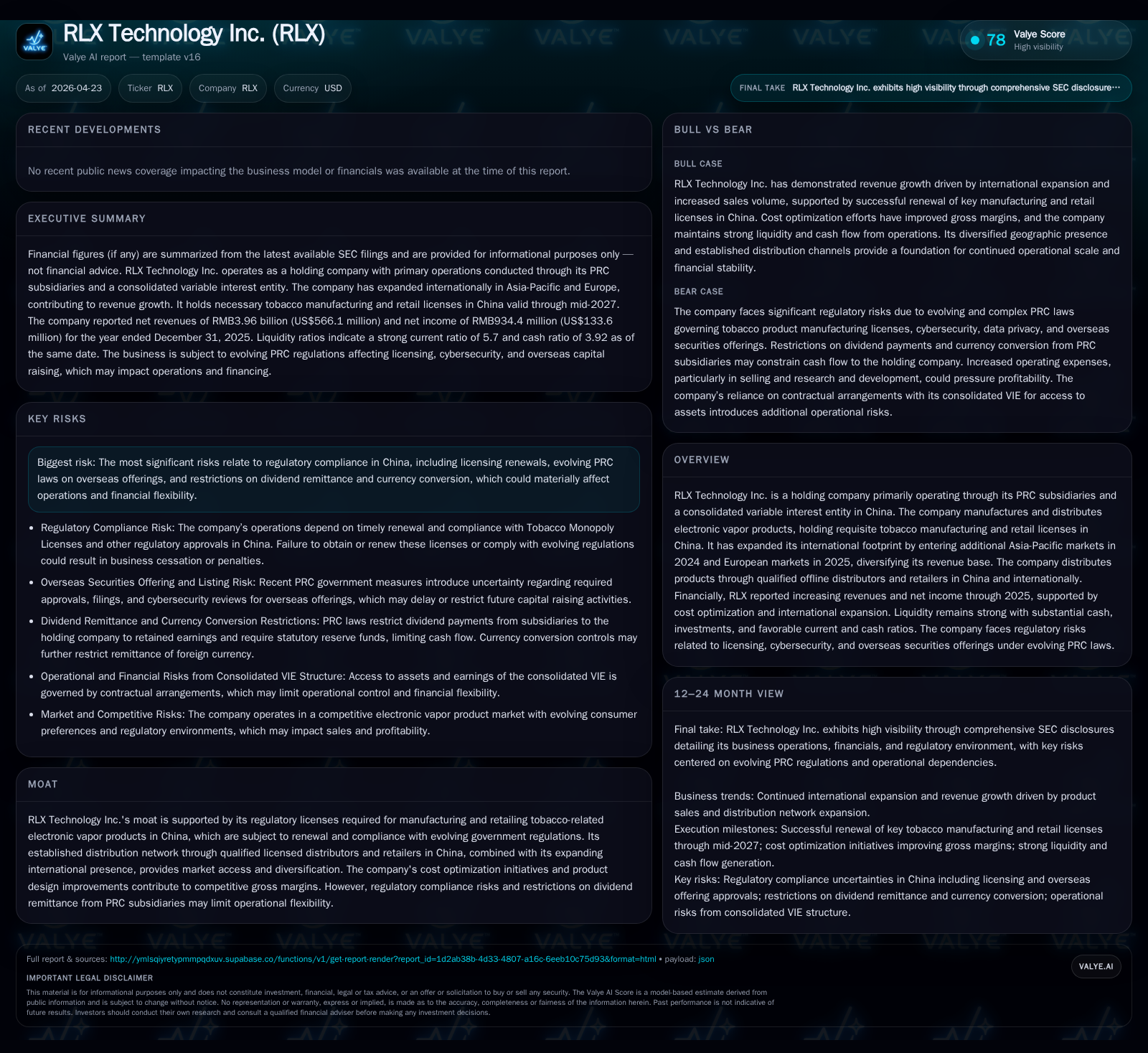
RLX Technology's most recent quarterly filing in March 2026 illustrates continued revenue growth supported by expanding international sales and cost optimization efforts. The company maintains strong liquidity and a solid balance sheet, which underpins its strategic global diversification. While regulatory compliance in China presents ongoing constraints, RLX’s licensed manufacturing and distribution model combined with expanding presence in Asia-Pacific and Europe position it well within the competitive vapor products industry. Key upcoming milestones include licensing renewals and further overseas market penetration.
Latest Quarter Highlights and What They Mean
The most recent interim operating report filed by RLX Technology on March 13, 2026 [S2] sets the stage for understanding the company’s near-term trajectory. While providing limited granular Q1 metrics beyond affirming ongoing momentum, the filing confirms that sales continue to advance steadily through expanded distribution channels domestically and internationally. This results in higher accounts receivable levels tied to offline distributors reflecting stronger wholesale activity. Operational efficiency gains also begin to materialize, contributing to improved profit conversion ratios.
Crucially, RLX's liquidity remains robust with maintained cash reserves supplemented by short-term investments under prudent treasury management. This financial foundation provides flexibility for scaling production capacity and supporting further international market entries despite the regulatory complexity inherent in its sector.
Business Model Economics and Product Offering Analysis
RLX Technology primarily generates revenue through manufacturing and distributing electronic vapor products—commonly known as e-cigarettes—under stringent regulatory oversight in China. The company holds pivotal tobacco manufacturing licenses issued by the State Tobacco Monopoly Administration as well as retail licenses for its physical stores within China [S1][S23]. The licensing regime creates formidable entry barriers since obtaining or renewing these Tobacco Monopoly Licenses requires thorough compliance reviews that are essential to continued operation.
Product-wise, RLX offers a range encompassing e-liquid formulations together with vaporizing devices. Alongside a focus on product quality improvements driven by cost optimization efforts—such as design upgrades that retain consumer appeal while reducing component costs—the company's unit economics have strengthened meaningfully over the last few years [S6][S7]. Gross margin improvements nearing 30% in 2025 underscore successful management of production efficiency while balancing excise taxes that increased modestly but remain well-integrated into pricing strategies.
Customer adoption sustains via qualified offline distributors with wholesale tobacco licenses who supply authorized retailers across the National Transaction Platform in China. This exclusive distribution structure under PRC regulation ensures end-users receive compliant products but also extends inventory turnover periods impacting working capital [S1][S7]. Internationally, RLX replicates this distributor-retailer chain model selectively to account for varying jurisdictional regulations.
Competitive Environment and Industry Dynamics
Within China's highly regulated electronic vapor industry, RLX leverages its secured franchise rights granted by robust tobacco manufacturing licenses—a significant competitive moat [S23]. Renewing these licenses timely is critical; failure could lead to operational halts or penalties that materially impact revenues.
Competitively, RLX faces several established domestic peers but benefits from an entrenched offline retail footprint and extensive licensed distributor relationships that are not easily replicated. Price competition exists but is somewhat mitigated by regulatory controls on product standards and excise taxes which bind all participants similarly.
Supply chain considerations around component sourcing remain important given global semiconductor shortages impacting device manufacturing broadly; however, RLX's cost control measures aided margin resilience [S6]. Furthermore, cybersecurity policies imposed by Chinese regulators introduce additional compliance layers affecting digital aspects such as data privacy management across distribution platforms [S24]. These factors collectively configure an industry environment where operational discipline alongside regulatory adherence dictate market standing.
Expansion Strategies: Drivers for Growth and Potential Headwinds
A salient feature of RLX’s recent progress is its deliberate pursuit of international diversification beyond China’s domestic market constraints [S1][S5]. After entering multiple Asia-Pacific countries in 2024, the company accelerated its footprint into European regions throughout 2025. These moves mitigate concentration risk while tapping nascent vapor markets with rising adoption trends.
The global expansion strategy hinges on cultivating optimal business partnerships overseas complemented by product launches tailored to local preferences. Distribution strategies mirror the China model relying predominantly on qualified offline distributors supplying retailers rather than direct-to-consumer channels—allowing scalability without overextending fixed costs [S7].
However, challenges persist including variable regulatory regimes across jurisdictions requiring careful navigation plus geopolitical sensitivities concerning cross-border capital flows impacting reinvestment potential. Domestically, dividend remittance restrictions stipulated under PRC law constrain liquidity transfers from subsidiaries to the holding company level thereby necessitating strong internal cash generation for external investment needs [S20].
Overall, while cost optimization initiatives improve operating leverage potential as volumes scale internationally, macro regulatory uncertainties particularly related to overseas offerings impose caution [S24].
Regulatory Framework and Risk Assessment
RLX operates under a complex legal matrix primarily shaped by PRC government controls affecting manufacturing licenses renewal cycles valid through mid-2027 [S23]. Failure to meet licensing requirements or adverse changes in interpretation risk business interruptions or penalties.
In addition to tobacco-specific oversight, evolving securities regulations highlight mounting scrutiny over Chinese companies’ overseas listings exemplified by CSRC’s Trial Administrative Measures issued March 2023 [S24]. Compliance demands include mandatory filings for overseas stock offerings which could delay or complicate future capital raising endeavors.
Cybersecurity regulations enforced by CAC further impose data governance obligations to safeguard user information underpinning platform services integral to distribution networks [S24]. Non-compliance here risks reputational damage plus direct sanctions.
Currency conversion controls restrict foreign exchange availability potentially limiting the holding company’s access to dividends declared from PRC subsidiaries constraining capital deployment flexibility despite healthy consolidated cash positions [S20][S16]. Collectively these factors represent key operational constraint vectors necessitating sustained regulatory liaison focus alongside proactive legal risk management.
Key Upcoming Catalysts to Monitor
Strategic watchers should prioritize several near-term milestones:
- Timely renewal status of Tobacco Monopoly Licenses post-2027 expiration windows which are pivotal for ongoing manufacturing operations within China.
- CSRC clarifications or procedural updates concerning overseas securities offering filing requirements affecting RLX's future equity financing plans.
- Progress reports on scaling new international markets including distributor onboarding metrics and end-market retail penetration rates indicative of demand sustainability.
- Quarterly financial reporting trends revealing margin evolution linked to cost optimization effectiveness versus inflationary or supply pressures.
- Updates relating to cybersecurity compliance status signaling any government audits or enforcement actions. Monitoring these markers will afford sharper insight into execution momentum and risk mitigation efficacy amid complex operating conditions.
Summarized Financial Snapshot and Metrics Review
RLX has exhibited notable financial improvement culminating in full-year 2025 performance supported by international expansion and cost discipline [F1][S1]:
- Net income surged approximately 74% year-over-year reaching USD 132 million driven by volume growth coupled with favorable revenue mix effects.
- Operating income swung from losses (-USD 14.7 million in FY24) into positive territory at roughly USD 47 million reflecting margin enhancements from optimized product designs.
- Gross margins improved from ~26% (FY24) to almost 30% (FY25), evidencing effective cost management even as excise duties rose moderately.
- Accounts receivable increased substantially alongside higher distributor sales volumes (RMB190 million or approx. USD27 million end-2025), suggesting extended credit terms impacting working capital profiles.
- Inventory turnover days shortened amid better inventory management combined with acquisition integration benefits resulting in improved asset utilization.[S21]
- Cash generated from operating activities remained robust at approximately USD158 million providing ample coverage for increased capex (USD17 million) focused on warehouse acquisition supporting inventory storage needs.[F1][S10]
- Liquidity remains formidable with cash & equivalents near USD793 million complemented by short-term investments ensuring a current ratio exceeding 5x enhancing financial stability.[F1][S3]
- Dividend payments continued modestly (~USD13 million) alongside share repurchases trending lower after elevated activity in prior years evidencing balanced capital allocation.[F1][S13]
Historical performance (annual)
| FY | Net ($mm) | CFO ($mm) | OpInc ($mm) | Capex ($mm) | Net YoY |
|---|---|---|---|---|---|
| 2025 | 132 | 158 | 47 | 17 | +74.4% |
| 2024 | 76 | 117 | -15 | 1 | +0.5% |
| 2023 | 75 | 28 | -70 | 4 | -64.0% |
| 2022 | 209 | 71 | 154 | 6 |
Source: SEC companyfacts cache [F1].
Capital returns and efficiency (annual)
| FY | Div ($mm) | Buybacks ($mm) | FCF ($mm) |
|---|---|---|---|
| 2025 | 13 | 26 | 141 |
| 2024 | 12 | 81 | 116 |
| 2023 | 13 | 140 | 24 |
| 2022 | 73 | 65 |
Source: SEC companyfacts cache [F1].
(Financials sourced from consolidated figures reported under US GAAP)
This profile underscores RLX's transition towards sustainably profitable operations enabled by both topline expansion abroad and disciplined cost management internally. However, structural limitations around dividend remittance from PRC operations require maintaining sufficient internal cash flow to support growth initiatives without overreliance on external funding.
This analysis reflects publicly disclosed information through April 23, 2026, synthesizing SEC filings—including latest quarterly updates—to assess RLX Technology Inc.’s operating strategy within a challenging regulatory environment combined with evolving competitive dynamics. It is intended solely for informational purposes without any investment recommendation or advice.
Disclaimer: This is research-only, informational analysis and not investment advice. It may include AI-generated interpretation and general industry context. Always verify important details using primary sources.

Comments