
Rein Therapeutics Updates RENEW Trial and Navigates Funding Amid Clinical Milestones
Latest quarter disclosures highlight Rein Therapeutics’ progression in its Phase 2 pulmonary fibrosis trial and a substantial equity raise enhancing its financial runway.
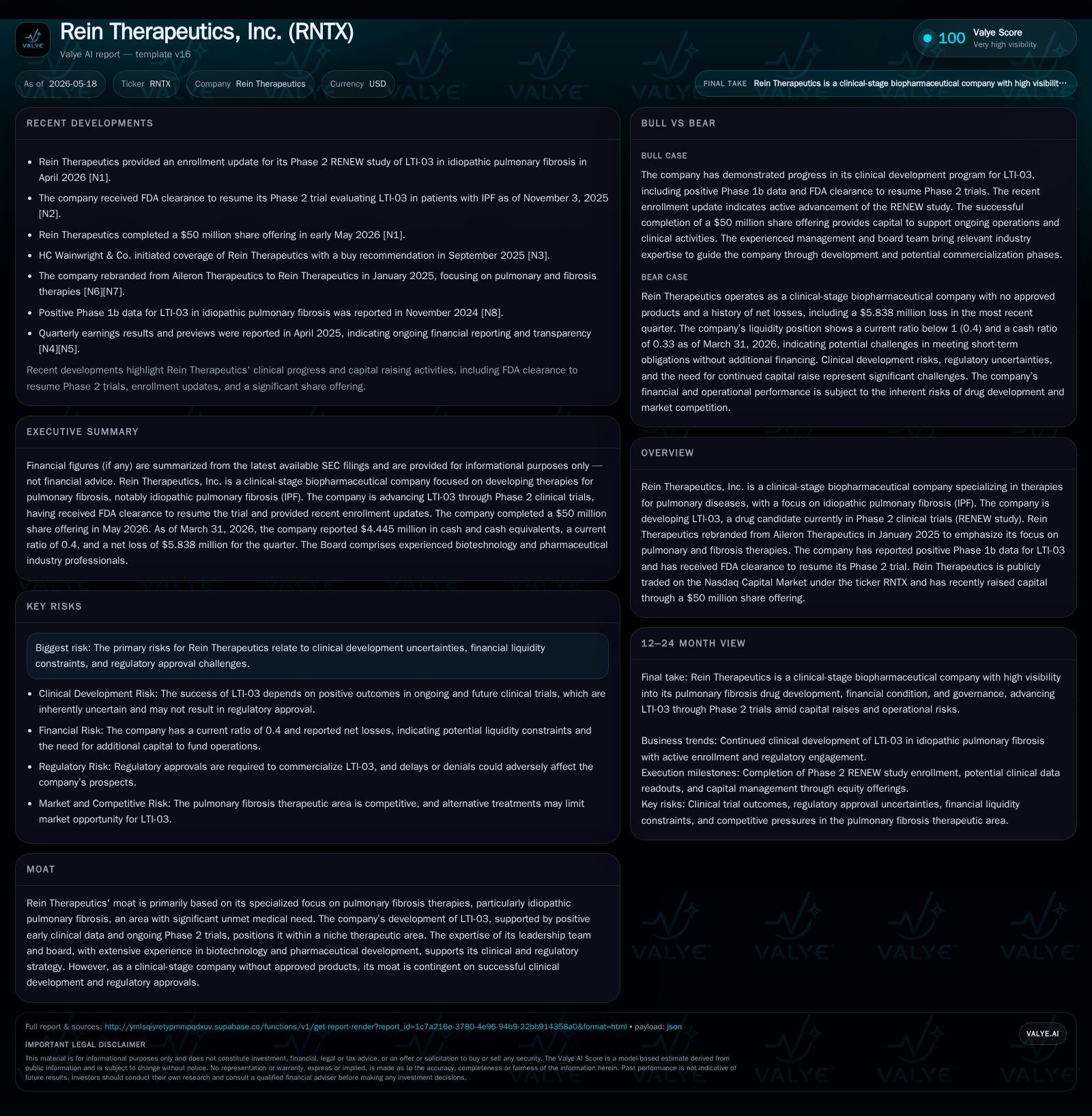
Rein Therapeutics, a clinical-stage biopharma focused on idiopathic pulmonary fibrosis (IPF), reported significant advances in its ongoing Phase 2 RENEW study of LTI-03, including resumed enrollment after FDA clearance. Concurrently, the company executed a $50 million share offering to bolster liquidity amid typical biotech cash burn pressures. Rein’s concentrated pipeline, anchored by LTI-03’s promising Phase 1b data, positions it within a specialized niche with limited direct competition but high development risk. The near-term outlook pivots on trial enrollment completion, regulatory feedback, and interim data readouts that can validate product efficacy and support further financing or partnerships.
Recent Operating Highlights: Q1 2026 Update and Market Impact
Rein Therapeutics' latest quarterly filing dated May 15, 2026 (10-Q) confirms the resumption of patient enrollment in its Phase 2 RENEW study evaluating LTI-03 for idiopathic pulmonary fibrosis (IPF) following FDA clearance received late in 2025 [S2][S16]. This milestone is crucial as it reinstates clinical momentum after earlier recruitment delays tied to regulatory concerns. Complementing this operational progress, Rein completed a public offering of 50 million shares at $1.00 per share in early May, securing net proceeds estimated at $46.1 million [S3][S25][N1]. This capital infusion addresses the critical need for funding to sustain clinical development efforts and associated overhead during continued pre-revenue status.
Despite the market dip concomitant with the share dilution announcement [N1], the raised funds enhance Rein's runway enabling more aggressive trial execution and potential exploration of complementary growth initiatives. These developments anchor Rein's near-term narrative firmly around clinical validation and financial stability — two non-negotiable pillars for any clinical-stage biotech progressing from hypothesis to marketable therapy.
Clinical Pipeline and Drug Development Model: LTI-03 and IPF Focus
Rein operates as a single-product focused biopharmaceutical company dedicated to addressing pulmonary fibrotic diseases, principally IPF—a chronic progressive lung disease marked by irreversible scarring leading to respiratory failure [S1]. Its lead candidate, LTI-03, represents a novel therapeutic approach currently tested in a Phase 2 randomized controlled trial named RENEW.
The company’s business model centers on advancing LTI-03 through pivotal clinical stages in hopes of securing regulatory approval that could position it as a differentiated therapy within the IPF treatment landscape. The positive Phase 1b results reported previously underpin internal confidence and support ongoing investment into Phase 2 efforts. This pipeline concentration confers both strategic focus and risk exposure; success hinges almost entirely on LTI-03 demonstrating meaningful benefit along accepted regulatory endpoints.
This approach aligns with broader clinical-stage biotech norms where companies build valuation around one or two lead assets until achieving proof-of-concept. Regulatory clearance to resume Phase 2 enrollment signals updated safety or protocol adaptations are satisfactory to FDA criteria, further reinforcing LTI-03’s developmental legitimacy.
Pulmonary Fibrosis Therapeutics Market: Competitive Positioning and Differentiation
IPF remains an area of high unmet need despite existing treatment options such as pirfenidone and nintedanib which slow disease progression but do not reverse fibrosis nor significantly improve quality of life long-term. Rein targets this space with LTI-03 aiming potentially at novel mechanisms or improved safety/tolerability profiles.
In such specialized niches, market entry barriers stem from stringent regulatory demands given patient vulnerability and complex clinical endpoints. Pricing power is generally moderated by payor scrutiny balanced against limited alternatives for patients. Moreover, switching costs for clinicians are moderate but can be influenced by meaningful improvements in efficacy or side effect profile.
Rein benefits from leadership experienced in biotechnology product development which aids regulatory navigation – a critical competitive advantage for small biotechs. However, scale disadvantages remain due to absence of commercial infrastructure or diversified pipeline offerings which constrains bargaining power vis-à-vis larger pharmaceutical incumbents.
Growth Drivers: Clinical Milestones, Regulatory Pathways, and Market Opportunities
Primary growth drivers revolve around key inflection points linked directly to clinical execution. Foremost among these is accelerating patient enrollment completion in the RENEW Phase 2 study post-FDA clearance [S2][N2]. Rapid recruitment enables reaching definitive endpoints sooner facilitating interim analysis or final data release.
Subsequent catalysts include positive interim or top-line efficacy readouts validating LTI-03’s therapeutic value proposition. Favorable data could catalyze next-stage discussions with regulators potentially smoothing future NDA submission pathways.[S2]
Regulatory engagement remains an ongoing driver whereby adaptive trial designs or accelerated approval mechanisms might mitigate lengthy commercialization timelines typical in orphan disease segments like IPF.
Market opportunity scaling beyond initial IPF indications depends on demonstration of broad antifibrotic activity or combinatory use with existing standards of care – possibilities not ruled out but contingent on initial success. The recent $50 million equity raising directly supports these ambitious developmental aims by shoring up required financial resources.
Risks and Constraints: Clinical, Financial, and Regulatory Considerations
Risks are multi-dimensional encompassing inherent uncertainties typical to early-stage biopharmaceuticals. Clinically, LTI-03 must prove safety and efficacy amidst complex pathophysiology—a hurdle disproportionate relative to many other therapeutic areas [S2]. Regulatory setbacks remain possible given evolving standards or unexpected adverse findings.
Financially, Rein’s cash position at quarter end was $4.45 million backed by approximately $4.92 million total debt resulting in net debt near half a million USD [F1], coupled with a current ratio of just 0.4 signaling liquidity pressures as current liabilities substantially exceed short-term assets also observed in recent filings [F1][S2]. The fresh capital injection mitigates but does not eliminate fund sufficiency risks especially if enrollment timelines extend or unplanned expenditures arise.
Recent share issuance dilutes existing ownership stakes while creating potential future selling pressure from warrants issued during the offering process [S25], all typical dynamics depressing short-term stock sentiment.
Strategically exposed is also the single-product concentration risk - failure or delay of LTI-03 would significantly impact corporate valuation and operational continuity.
Key Upcoming Catalysts to Monitor
Several discrete milestones stand out:
- Continued monitoring of patient enrollment pace transparency as published via periodic filings or press releases [N2][S2].
- Timing of planned interim efficacy assessment from the RENEW study which could materially influence investor perceptions and partner interest.
- Any notable FDA communications potentially altering trial parameters or approval pathways detected through regulatory filings.
- Additional financing initiatives beyond this recent offering that would further shape runway length insights.
- Partnership announcements representing strategic validation through external investment or commercial collaboration opportunities.
Tracking these will provide clearer line-of-sight on clinical risk mitigation progress and capital adequacy essential to sustaining company trajectory.
Financial Position Snapshot
As reported at March 31, 2026 quarter-end via companyfacts update [F1], Rein displayed cash & equivalents totaling approximately $4.45 million against total debt near $4.92 million yielding a net debt figure close to $478 thousand USD alongside a current ratio approximately at 0.4 underscoring pressing working capital constraints. This reflects typical operating realities faced by clinical-stage pure-play biotechs prior to revenue generation where cash burn primarily funds R&D expenditure.
The fresh equity raise announced on April 30 and closed May 4 brought net proceeds around $46 million providing meaningful liquidity extension designed specifically to underwrite continued trials throughput without immediate refinancing pressures [N1][S3][S25]. Despite this infusion, careful management of expenses aligned with operational milestones will be critical given underlying balance sheet indicators signaling tight near-term coverage absent further capital inflows.
Disclaimer: This analysis is based solely on publicly available filings up to May 18, 2026 including SEC disclosures and Nasdaq news items; it does not constitute investment advice but aims to inform industry participants about Rein Therapeutics' operating status and strategic positioning within its niche biopharma sector.
Disclaimer: This is research-only, informational analysis and not investment advice. It may include AI-generated interpretation and general industry context. Always verify important details using primary sources.

Comments