
Root Inc's Profitability Rebound and Strategic Cash Management in a Complex Insurance Market
Root Inc combines sharp technology-driven underwriting with prudent capital stewardship while contending with stringent regulatory and operational constraints.
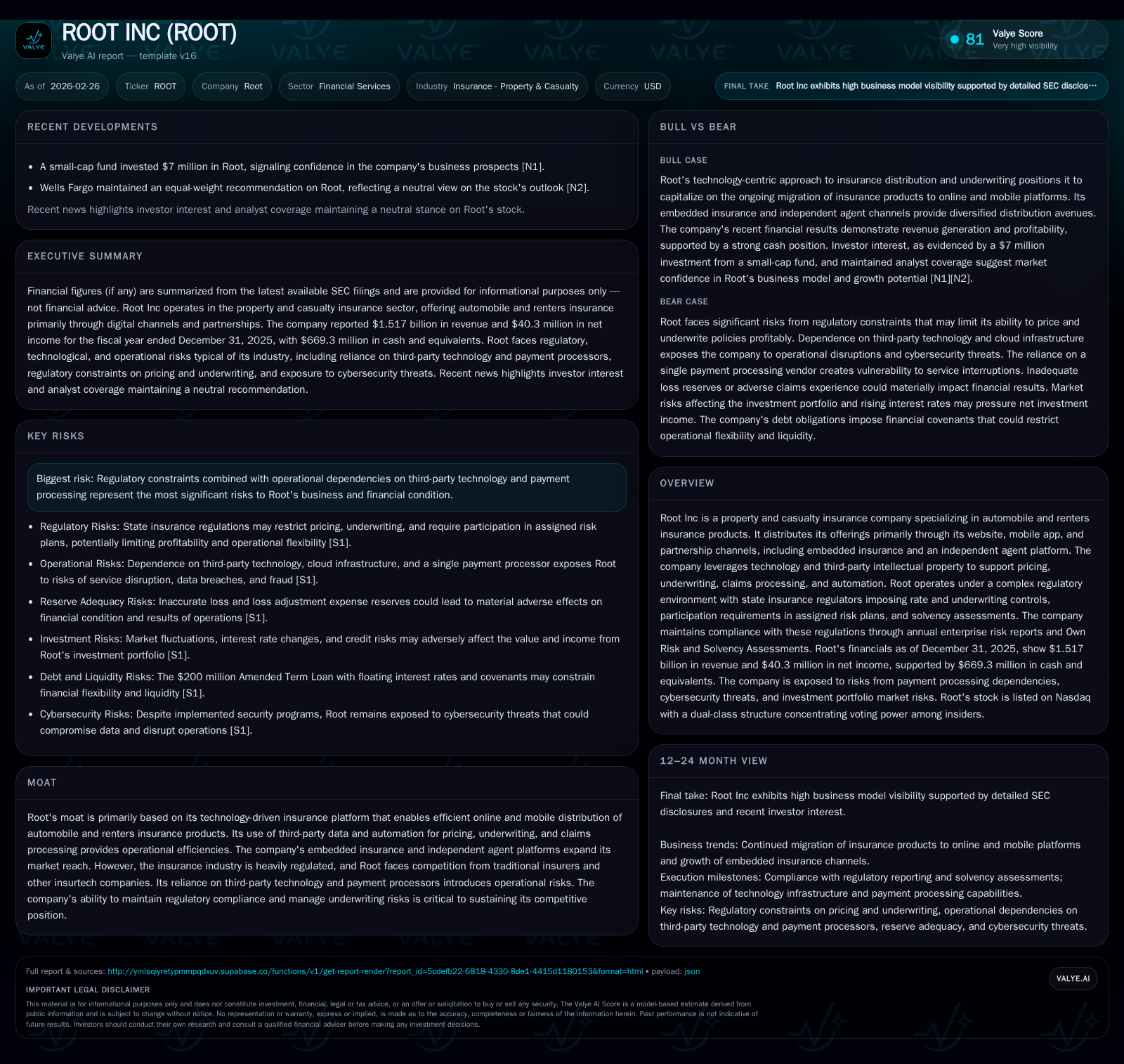
Root Inc demonstrated robust revenue growth driven by its technology-enabled underwriting platform, achieving a 29% increase in 2025. Despite regulatory pressures limiting pricing flexibility and compressing operating income, the company posted a 30% rise in net income and improved operating cash flow. Root maintains a strong liquidity position with $669 million in cash against $200 million of floating-rate debt subject to restrictive covenants. The company does not pay dividends or conduct share buybacks, focusing on reinvestment within a tightly regulated insurance environment. Operational risks arise from dependence on third-party cloud infrastructure and payment processors, underscoring ongoing challenges balancing growth, capital discipline, and compliance.
Accelerated Revenue Growth Backed by Innovative Underwriting Technology
Root Inc's revenue surged nearly 29% from approximately $1.176 billion in fiscal year 2024 to $1.517 billion in fiscal year 2025 [F1]. This growth highlights the effectiveness of Root’s technology-driven platform which integrates third-party data and automation to optimize pricing and underwriting for automobile and renters insurance products [S1][S8]. Distribution channels include direct digital sales via website and mobile app complemented by embedded insurance within partner ecosystems and an independent agent platform that extends reach into traditional brokerage markets [S1][S8].
Historical performance (annual)
| FY | Rev ($mm) | Net ($mm) | CFO ($mm) | OpInc ($mm) | Rev YoY | Net YoY |
|---|---|---|---|---|---|---|
| 2025 | 1517 | 40 | 207 | 62 | +29.0% | +30.4% |
| 2024 | 1177 | 31 | 196 | 79 | +158.6% | +121.0% |
| 2023 | 455 | -147 | -34 | -101 | +538.1% | -152.8% |
| 2022 | 71 | -58 | -211 | -48 |
Source: SEC companyfacts cache [F1].
Capital returns and efficiency (annual)
| FY | FCF ($mm) | ROE% |
|---|---|---|
| 2025 | 207 | 14.2 |
| 2024 | 195 | 15.2 |
| 2023 | -34 | -89.0 |
| 2022 | -211 | -21.0 |
Source: SEC companyfacts cache [F1].
The rapid progression from $455 million revenue in FY2023 to over $1.5 billion in FY2025 reflects Root's transformation into a significant player in property & casualty auto insurance leveraging scalable automation across customer acquisition through claims handling.
Profitability Trends Reflect Regulatory Constraints Amid Operational Efficiencies
Operating income declined by 21% year-over-year to about $61.8 million in FY2025 compared with $78.5 million the prior year [F1]. This contraction primarily results from regulatory limitations on rate increases—even when actuarially justified—and mandatory participation in assigned risk pools requiring lower premiums that compress underwriting margins [S1][S10].
Despite this, net income increased over 30% to $40.3 million [F1], indicating effective cost management partially offsetting regulatory headwinds [N1][N2]. Operating cash flow also rose modestly by approximately 5.5% to $206.5 million, reflecting improved working capital alongside underwriting performance [F1]. Capital expenditures were minimal ($0 reported for FY2025), likely due to sufficient existing technology infrastructure supporting current operations [F1].
Regulatory Environment Shapes Pricing Flexibility and Capital Deployment
Root operates within a complex regulatory framework where state insurance authorities require prior approval for rate changes often delaying or rolling back increases despite actuarial support, directly impacting profitability targets [S1][S10][S20]. Participation in assigned risk plans mandates insuring higher-risk policyholders at below-preferred rates further dilutes returns [S1][S10]. Regulators enforce statutory surplus minimums critical for solvency that constrain capital allocation options [S4][S29]. Withdrawal from lines or geographies requires regulatory consent limiting strategic maneuverability.
The company complies with stringent enterprise risk reporting including annual submissions of "enterprise risk reports" and Own Risk and Solvency Assessments (ORSA) that evaluate systemic risks across its holding company system—adding administrative complexity but essential for licensing compliance [S1][S13].
Capital Allocation Discipline Amid Debt Covenants and Strong Liquidity
At December 31, 2025, Root held $669.3 million in cash reserves against shareholders’ equity of approximately $284.3 million [F1]. The company has a $200 million floating-rate term loan subject to covenants restricting additional debt incurrence, asset transfers, investments, while requiring maintenance of a direct contribution margin of at least 20% and minimum insurance subsidiary surplus of $125 million quarterly [S4][S6][S29].
Reflecting these constraints, Root does not pay dividends nor conduct share repurchases currently; retained earnings are focused on growth investments within regulatory limits [S7][S14]. The approximate return on equity of 14.2% based on net income relative to equity demonstrates moderate profitability given recent equity growth [F1]. These factors illustrate disciplined balance sheet management balancing growth ambitions with prudential safeguards.
Distribution Expansion Through Embedded Insurance and Agent Channels
Beyond direct digital sales via its website and app, Root has expanded distribution through embedded insurance offerings integrated into partner platforms providing seamless customer access during ancillary transactions (e.g., vehicle rentals or purchases). Additionally, an independent agent platform targets more traditional brokerage relationships diversifying customer acquisition approaches beyond purely online channels [S1][S8]. This multi-channel strategy helps mitigate concentration risk while leveraging digital efficiencies.
Operational Risks From Third-Party Dependencies
Root’s business model depends heavily on third-party cloud infrastructure providers underpinning its online services platform—introducing risks related to outages, cybersecurity incidents, or data center failures beyond Root’s control [S8][S25]. Licensing key intellectual property from external vendors adds potential discontinuity risks if terms change unexpectedly or technology becomes unavailable requiring costly redevelopment efforts.
Payment processing is concentrated with a single third-party vendor exposing the company to concentration risk amid evolving PCI compliance standards and rising cyber threats [S17][S21]. To mitigate these risks, Root employs robust internal governance including oversight by the board’s Audit, Risk & Finance Committee supported by an experienced Chief Information Security Officer directing cybersecurity programs ensuring resilience measures are maintained [S16][S27]. Nonetheless vendor dependencies remain an ongoing operational challenge.
Outlook: Monitoring Regulatory Approvals and Financial Metrics
While explicit forward guidance is not publicly available, key milestones merit close observation:
- State regulator decisions on rate filings affecting pricing flexibility under restrictive conditions [N1][N2]
- Quarterly loss ratio disclosures signaling underwriting trends amid competitive/regulatory pressures [N1]
- Updates on debt covenant compliance influencing capacity for leverage or capital activities amid rising interest rates tied to floating SOFR-based term loans [N2]
- Annual enterprise risk report (ERM) submissions assessing systemic exposures impacting capital adequacy considerations [S1] These factors will significantly influence Root’s ability to sustain profitable growth balanced against compliance demands.
Conclusion: Balancing Innovation With Prudence in a Regulated Insurtech Sector
Root Inc has harnessed advanced underwriting technology fueling scalable revenue expansion ahead of many traditional peers while broadening distribution through embedded insurance channels alongside direct digital sales models [F1][S8]. This tech-enabled approach forms the foundation of its competitive advantage allowing agile pricing adjustments and efficient claims management.
However, this growth occurs within a tightly regulated environment imposing rate approvals, assigned risk participation mandates, solvency requirements, and extensive reporting obligations restricting pricing freedom and capital deployment options. Concurrent reliance on external technology platforms presents operational fragility uncommon among legacy insurers.
Capital discipline remains paramount—robust cash reserves backed by debt covenants limit financial flexibility but ensure resilience amid interest cost pressures associated with floating-rate debt facilities [F1][S4][S6]. Absence of dividends or buybacks underscores focus on reinvestment constrained by prudential rules rather than immediate shareholder returns.
Root exemplifies the strategic balancing act required for emerging insurtech firms maturing within established regulated property & casualty frameworks: combining innovation-driven growth with vigilant governance plus prudent financial management essential for maintaining actuarial profitability while navigating evolving industry dynamics marked by digital disruption entwined with regulatory complexity.
This report is prepared solely for informational purposes based on publicly available data without any recommendation regarding securities buying or selling decisions.
Disclaimer: This is research-only, informational analysis and not investment advice. It may include AI-generated interpretation and general industry context. Always verify important details using primary sources.

Comments