
RPM International Advances Integration and Margin Initiatives Amid Portfolio Realignment
RPM reports steady revenue growth with strategic leadership changes as it consolidates specialty chemical segments for improved operational focus.
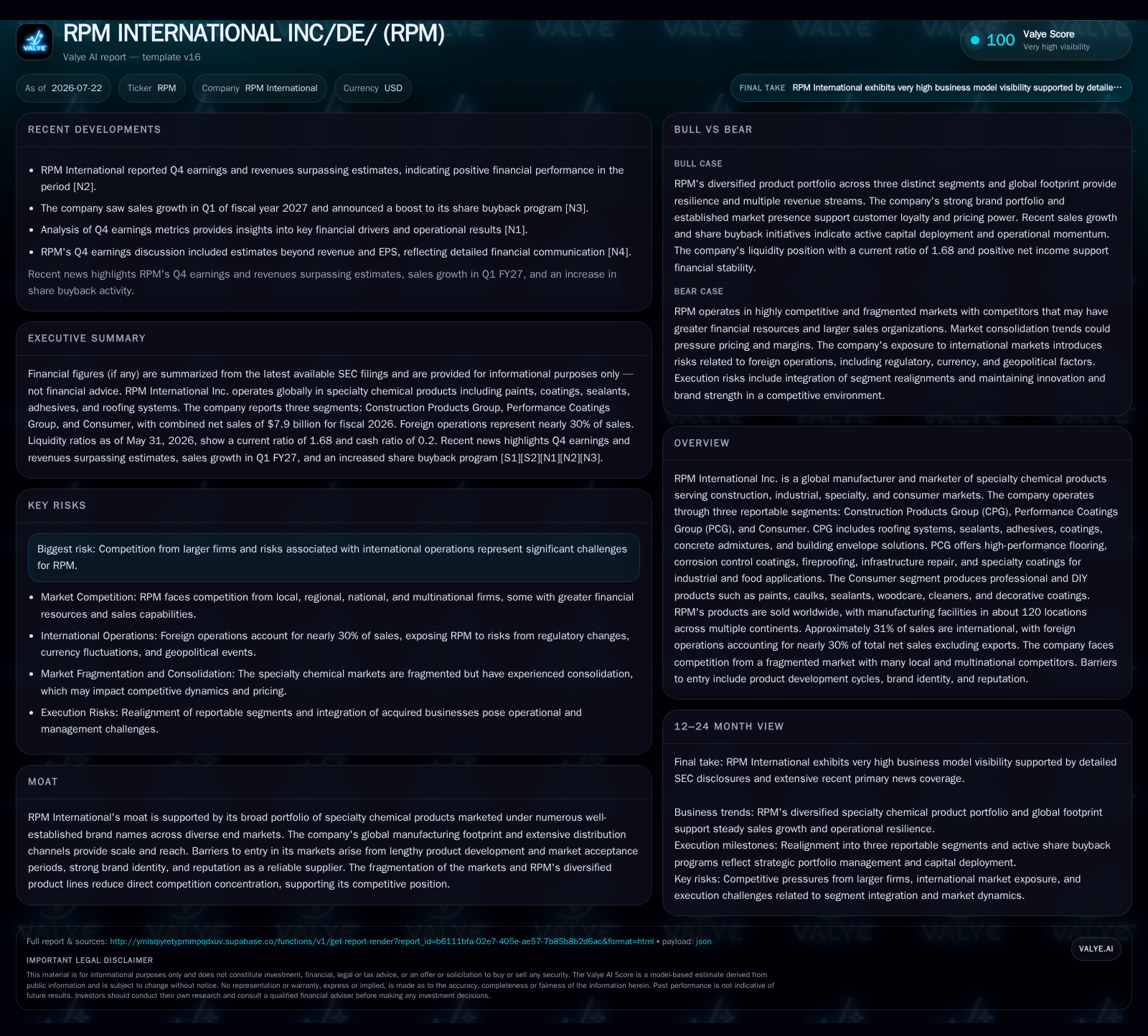
RPM International’s latest quarterly filing reveals continued sales expansion driven by its three-segment structure: Construction Products Group, Performance Coatings Group, and Consumer. The company has restructured reporting segments to better align management with business focus areas, enhancing channel strategies in construction and industrial markets. Recent leadership appointment reflects a sharpened emphasis on operational oversight and corporate development. While raw material cost pressures and international risks persist, RPM’s broad brand portfolio, global manufacturing footprint, and ongoing restructuring programs aim to sustain margin improvement and growth.
Recent Operating Update
ational synchronization across its key business units.
Business Model Analysis
RPM International operates as a specialty chemicals manufacturer and marketer targeting multiple industrial verticals through three primary reportable segments: Construction Products Group (CPG), Performance Coatings Group (PCG), and Consumer [S1]. The product lineup includes specialty coatings; sealants and adhesives; roofing systems; concrete admixtures; corrosion control coatings; fireproofing systems; professional-grade DIY paints; and related maintenance chemicals. Sales are generated predominantly through B2B channels via distributors serving construction firms and industrial operators alongside retail outlets catering to professional contractors and consumers.
The restructuring effective June 2025 consolidated prior reporting groups into the current tri-segment framework to better reflect how resources are allocated and performance is measured internally. For example, Legend Brands transferred into CPG reflects construction applications while Industrial Coatings shifted into PCG highlights maintenance-focused formulations tailored for infrastructure repair [S1]. This realignment enhances clarity around customer buying behaviors—contractors sourcing CPG products through project bids versus industrial clients ordering PCG corrosion solutions under service contracts.
Revenue mechanics rely heavily on volume growth tied to construction cycles and industrial maintenance demands, along with price/mix improvements stemming from differentiated specialty formulations commanding premium pricing power. The international component generates about 31% of sales spanning over 167 countries with localized manufacturing at approximately 120 sites to reduce freight costs and serve region-specific regulations [S1]. This breadth enables RPM to mitigate geographic concentration risk but increases exposure to currency fluctuations and trade policies.
Brand strength supports customer retention with marquee names like Rust-Oleum (consumer coatings), Tremco (roofing membranes), Stonhard (industrial flooring), DAP (caulks/sealants), among others contributing to deep portfolio diversification that lessens dependency on any single market segment or geography [S1]. Market fragmentation in specialty chemicals favors RPM's multi-brand approach enabling tailored offerings for niche applications across end-users.
Industry Structure and Competitive Position
The specialty chemicals industry is characterized by high R&D intensity to develop innovative formulations meeting strict performance and environmental standards. Firms compete extensively on brand reputation, product quality, distribution reach, technical service support, and sustained innovation pipelines. Peers include Sherwin-Williams known for coatings/paints, Axalta in industrial coatings, H.B. Fuller specializing in adhesives/sealants, and PPG Industries covering broad specialty chemicals portfolios.
RPM’s competitive moat derives from its broad portfolio marketed under many well-known brands alongside an extensive global manufacturing footprint enabling scale advantages. Product development cycles typically extend over years due to rigorous testing requirements ensuring reliability in demanding conditions such as exposure to corrosive environments or building envelope protection.
Distribution channels encompass both direct sales forces targeting large industrial accounts as well as networked distributors servicing smaller contractors—a dual approach enhancing market penetration. Customer relationships benefit from switching costs embedded in product qualification processes essential for compliance-heavy sectors like food processing or infrastructure maintenance.
Challenges arise from intensifying competition among large conglomerates possessing broader raw materials integration or capital resources that enable aggressive pricing or capacity expansion. Maintaining technological differentiation through R&D spending remains critical for RPM’s long-term positioning.
Growth Drivers
Several structural demand themes underpin RPM’s growth prospects:
- Infrastructure Rehabilitation: Aging global infrastructure drives refurbishment projects utilizing construction chemicals such as sealants, protective coatings, fireproofing systems included in CPG and PCG segments.
- Industrial Maintenance Expansion: Increasing complexity of industrial assets requires specialty products for corrosion protection and floor coating solutions promoting PCG growth.
- Consumer Market Growth: Rising DIY trends coupled with professional end-users reinforce consumption of paints, woodcare products, caulks under the Consumer segment.
- International Market Penetration: Emerging economies present expanding construction/development opportunities where localized products tailored through joint ventures or licensing agreements facilitate access.
- Innovation & Sustainability Focus: Development of environmentally friendlier formulations responding to tightening regulations offers potential new revenue streams.
- Margin Improvement Programs: Ongoing restructuring initiatives aim at streamlining operations while optimizing pricing/mix contribute positively toward profitability enhancement [S18]
Risks / Watchpoints / Constraints
Key risk factors affecting RPM include raw material price volatility which can compress gross margins absent successful cost pass-throughs given the commodity-sensitive nature of inputs like resins or solvents. Despite strong brand portfolios mitigating intensity somewhat, competition from larger firms owning upstream capabilities can pressure pricing power.
International operations expose RPM to currency translation risks as well as geopolitical issues including tariffs or trade restrictions complicating supply chains [S1]. Regulatory compliance costs remain non-trivial especially in chemicals subject to evolving environmental laws requiring reformulation or certification processes.
Integration risks stem from acquisitions or joint ventures integral to portfolio expansion strategies; failure here could impair expected synergies. Furthermore technological obsolescence poses threats if RPM does not continually innovate versus niche startups or global peers accelerating product advancements.
Demand cycles linked closely to construction activity make certain segments vulnerable during economic downturns. Also increased raw material costs during inflationary periods may delay customer purchasing decisions impacting volume trajectories temporarily.
What to Watch Next
Among upcoming milestones:
- Monitoring execution under the extended Margin Achievement Plan will show if targeted operating efficiencies translate into sustainable margin gains beyond temporary restructuring charges [S18].
- Earnings updates focusing on segment-level revenue trends will indicate relative health between construction-driven CPG versus industrial PCG segments amid macroeconomic uncertainties.
- Progress on international expansion strategies particularly within emerging markets will provide early indications of market acceptance leveraging local manufacturing advantages.
- Changes under Mr. Dennsteadt’s operational leadership may crystallize through shifts in capital allocation priorities or accelerated strategic development moves disclosed in forthcoming reports [S3].
- Adjustments in R&D expenditure aligned with new product launches aiming at sustainable formulations may be a key driver going forward.
Financial Profile Discussion
As of May 31, 2026, RPM’s balance sheet shows total debt of approximately $2.13 billion with cash and equivalents near $315 million, resulting in net debt around $1.81 billion. The company maintains a current ratio of 1.68, indicating adequate liquidity coverage of short-term obligations [F1], [S2]. Interest expense has increased modestly in line with leverage but remains manageable within cash flow generation capabilities [S2].
Capital deployment continues to balance organic investments, including R&D initiatives aimed at innovation, with selective acquisitions to reinforce brand portfolio breadth. Margins have benefited recently from disciplined pricing actions helping offset cost inflationary pressures, though risks remain around input cost volatility impacting near-term earnings stability [S2], [S18].
Overall, RPM’s financial flexibility combined with recurring free cash flow supports resilience amid cyclical market conditions inherent in the specialty chemicals manufacturing sector.
This analysis synthesizes publicly available information as of July 2026 without offering investment advice or forecasts. Readers should consider company filings directly alongside broader industry dynamics when forming their own assessments.
Disclaimer: This is research-only, informational analysis and not investment advice. It may include AI-generated interpretation and general industry context. Always verify important details using primary sources.

Comments