
Red Robin’s Latest Quarter Highlights Debt Challenge and Brand Revitalization Efforts
Q1 2026 results reveal cash flow strain from debt obligations while the company advances a turnaround plan targeting traffic and operational efficiency.
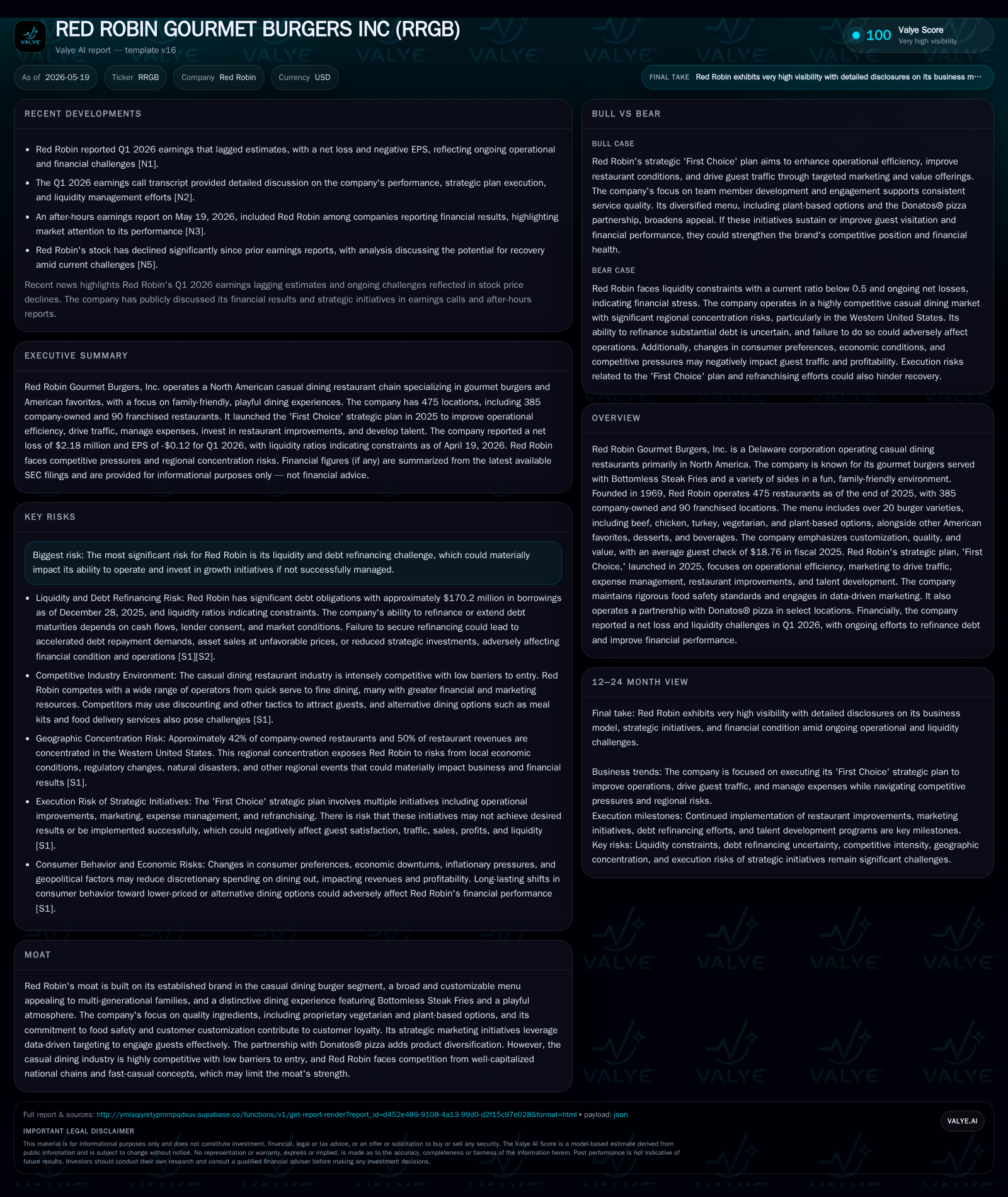
Red Robin Gourmet Burgers reported first quarter fiscal 2026 results that fell short of earnings expectations amid ongoing liquidity pressures driven by substantial debt and a low current ratio. The company is executing its strategic 'First Choice' plan, launched mid-2025, focusing on operational improvements, marketing to drive guest traffic, expense reduction including refranchising, and renovating physical locations. While the casual dining burger segment remains competitive, Red Robin leverages its brand strength with customizable gourmet offerings including Bottomless Steak Fries®, appealing to multigenerational families. However, significant refinancing needs loom with credit facilities maturing in September 2027. Close attention is warranted on refinancing progress, margin improvement efforts, and guest traffic trends as the company seeks to balance debt service demands with growth investments.
Recent Quarterly Operating Results: Key Insights from Q1 2026 Filing
Red Robin’s fiscal first quarter ending April 19, 2026, highlighted a continuation of operational challenges manifested in softer-than-expected guest traffic and earnings that lagged market consensus [S2][N1]. Management's discussion emphasized that while revenues remained stable compared to prior quarters, high fixed costs and ongoing investments under the strategic turnaround pressured margins. Expense control efforts are underway but offset by inflationary rises in labor and commodity input costs. The filing underscored cautious optimism about upcoming marketing initiatives designed to lift trial and repeat visitation but flagged the ongoing strain on free cash flow due to substantial debt servicing requirements.
This near-term operating update reinforces the delicate balancing act Red Robin faces between maintaining service quality and funding strategic initiatives within a tight liquidity window.
Business Model and Gastronomic Differentiation in Casual Dining Burgers
Red Robin Gourmet Burgers operates a midscale casual dining restaurant chain focused primarily on gourmet burgers served alongside trademarked Bottomless Steak Fries®. The culinary offering spans over twenty burger varieties covering traditional beef to chicken, turkey, vegetarian, and proprietary plant-based choices. This broad menu variety caters effectively to diverse consumer preferences across age groups.
The company’s revenue model depends on customer payments for dine-in or carryout meals with an average guest check of approximately $18.76 as reported for fiscal year 2025 [S1]. A large majority of locations—385 out of the total 475 restaurants—are company-owned, enabling direct control over operations and quality consistency but also exposing the business to greater fixed cost leverage risks. In contrast, the franchised restaurants generate royalty income based on franchise agreements.
Red Robin’s emphasis on customization drives switching costs by fostering guest loyalty through personalized dining experiences. Value perception combined with family-friendly atmosphere further supports repeat visitation across generations.
Competitive Context: Market Position and Peer Dynamics in Casual Dining
The casual dining sector remains intensely competitive with numerous national chains competing for overlapping consumer segments. Red Robin’s brand recognition as a burger specialist strengthens its position but is challenged by fast-casual burger concepts that often operate with greater scale efficiencies or more contemporary formats.
Industry barriers to entry remain modest given relatively standard restaurant infrastructure requirements; consequently, competitors range from legacy chains operating broad casual dining menus to niche players innovating around menu customization or delivery models.
Pricing power for Red Robin shows modest resilience through menu innovation but is pressured by general inflation and wage cost escalations [S1]. While brand loyalty favors Red Robin thanks to its differentiated product like Bottomless Steak Fries®, the presence of larger-cap peers with deeper marketing resources limits scope for dominant market share gains
The First Choice Strategy: Revitalizing Brand and Operational Initiatives
In mid-2025 Red Robin launched "First Choice," a comprehensive multi-pillar strategy designed to restore growth momentum and operational health [S1]. The pillars consist of:
- Hold Serve: Enhancing operational effectiveness including consistent food quality and expense discipline.
- Drive Traffic: Addressing barriers limiting trial visits through targeted marketing campaigns emphasizing value propositions.
- Find Money: Expense reduction systemwide complemented by tactical refranchising efforts aimed at lowering fixed costs and generating capital.
- Fix Restaurants: Capital investment focused on deferred maintenance to upgrade the physical dining experience.
- Win Together: Cultivating a high-performance team culture aligned with strategy delivery.
Although early signs indicate process implementation is underway, external economic challenges could delay tangible uplift in same-store sales or margin expansion beyond initial projections.
Growth Catalysts: Traffic Drivers, Menu Innovation, and Marketing Tactics
Among growth levers are menu innovations aiming to capture evolving consumer tastes including additional plant-based burger variants which appeal to health-conscious diners—a growing demographic segment within casual dining [S1].
Marketing emphasis under the First Choice plan employs data-driven techniques to inspire repeat visits by reducing trial friction through value offerings that resonate broadly with families. Partnership integration such as co-branding opportunities with Donatos® pizza adds potential cross-sell options enhancing foot traffic.
Selective refranchising serves dual purposes—unlocking capital tied up in company-operated stores while potentially improving local market performance by transferring operational risk to experienced franchisees.
Success in these areas depends heavily on execution speed balanced against preserving brand equity amidst promotional activity.
Risks and Constraints: Liquidity Concerns, Debt Refinancing, and Industry Headwinds
The most pressing risk hangs over Red Robin’s indebtedness profile with net leverage hovering around $178 million after accounting for cash inventories near $24 million as of April-end 2026; notably, the current ratio sits at approximately 0.47 illustrating limited short-term asset coverage against liabilities [F1]
Credit agreements previously amended extend maturity timelines only through September 3, 2027, leaving less than two years to secure longer-duration refinancing or deleveraging paths that avoid covenant default triggers or lender acceleration rights [S4]. Failure to refinance on acceptable terms would force disruptive measures including distress asset sales or curtailment of growth projects reducing competitiveness over time.
Additional concerns relate to macroeconomic factors constraining discretionary spending patterns within casual dining categories and input cost inflation diminishing margin resilience despite targeted expense management [S11]
Execution risk on planned refranchising may also constrain anticipated free cash flow improvements if franchise partners prove slower or less profitable than projected.
Forward-Looking Considerations: Milestones to Monitor for Execution Success
Near-term key milestones will revolve around:
- Successful refinancing or extension arrangements of credit facilities ahead of fall 2027 deadlines,
- Monthly tracking of guest traffic patterns post-Q1 softness as marketing efforts ramp,
- Operational KPIs such as restaurant-level profitability improvements,
- Evidence of stable or improved EBITDA margins relative to interest burden,
- Progress updates from tactical refranchising activities,
- Retention metrics under talent development aspects of First Choice plan,
- Transparent guidance updates reflecting adjusted assumptions on growth trajectory [S2][N2][S3]
Monitoring these signals will be crucial for stakeholders assessing whether turnaround initiatives offset inherent financial risks.
Financial Overview: Current Liquidity and Capital Structure Snapshot
Financially, the latest available data shows cash and equivalents at about $24.3 million as of April 19, 2026, with current assets totaling approximately $86.1 million and current liabilities near $184.7 million, resulting in a current ratio of roughly 0.47 [F1]. Total debt figures from earlier periods remain elevated, indicating ongoing leverage considerations [F1].
Debt maturities scheduled for September 2027 require proactive refinancing efforts; management acknowledges reliance on improved cash flows plus refranchising proceeds to mitigate interest expenses within tight covenant frameworks [S2]. Free cash flow generation thus remains highly sensitive both operationally and financially during this critical window.
Overall operating income trails behind earnings benchmarks reflecting margin pressure linked partly to elevated interest charges alongside normalized restaurant operating trends.
This analysis synthesizes current filing disclosures capturing Red Robin's strategic positioning within an intensely competitive casual dining burger market while highlighting material financial constraints shaping near-term outlooks. Continued execution discipline across brand revitalization efforts paired with prudent financial management remain essential amid uncertain macroeconomic conditions.
Diversification through menu breadth including plant-based innovations sustains relevance yet does not materially insulate against sector-wide pricing pressures or capacity overheads inherent in largely company-operated store counts. Investors should monitor refinancing milestones closely alongside traffic momentum indicators as proxy measures for durable recovery potential.
Disclaimer: This analysis is provided solely for informational purposes without any research view or advice regarding securities transactions.
Disclaimer: This is research-only, informational analysis and not investment advice. It may include AI-generated interpretation and general industry context. Always verify important details using primary sources.

Comments