Research Solutions Inc: Navigating Scientific Content Delivery Amid Profitability and Concentration Risks
Research Solutions Inc operates a specialized platform for rapid access to scientific research articles, relying on extensive content publisher agreements and a concentrated customer base.
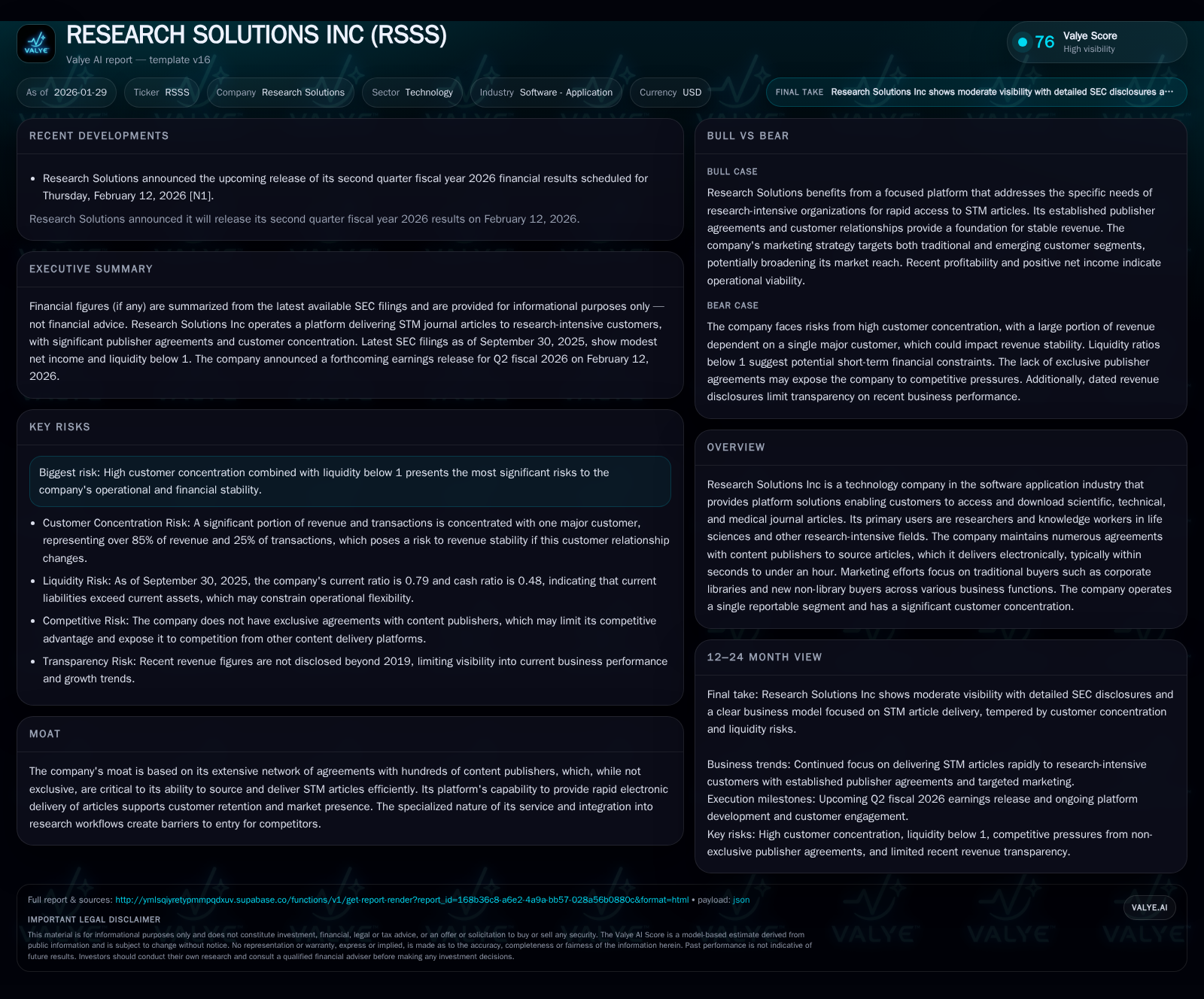
Research Solutions Inc provides a digital platform enabling instant delivery of scientific, technical, and medical journal articles, primarily serving researchers and corporate libraries. The company’s moat is anchored in its broad network of publisher agreements and integration into research workflows, though these agreements are non-exclusive. Recent results show a break-even operational performance, yet liquidity challenges and customer concentration pose notable risks. Industry dynamics hinge on content licensing complexities and technological innovation in research workflows, making competitive positioning and operational execution critical.
What Changed Recently
Research Solutions Inc announced its second quarter fiscal 2026 results scheduled for February 12, 2026, with prior reports indicating break-even earnings for Q3 and meeting earnings estimates, signaling operational stability after a period of losses [N1][N2][N5]. The company continues to promote its Scite platform, which integrates AI-driven approaches to transform research workflows, aiming to enhance value beyond traditional article delivery [N7][N8][N9]. However, liquidity remains constrained with current liabilities exceeding current assets, reflected in a current ratio below 1, according to the latest SEC-derived financial snapshot [S13][S14]. This liquidity pressure, alongside high customer concentration, remains a critical risk factor flagged by market commentators [N10].
Business Model as a System
Research Solutions operates a technology platform focused on providing rapid, electronic delivery of single STM journal articles to researchers and knowledge workers. The core service is "single article delivery" whereby end-users or organizational proxies request individual articles, which the platform sources from a network of content publishers and delivers digitally, often in seconds, but generally within an hour [S2].
The company maintains agreements with hundreds of content publishers, which are essential but non-exclusive, allowing access to a broad catalog of scientific literature critical to client research needs [S1]. This network of licensing agreements underpins the platform's value proposition by enabling comprehensive content availability. The platform also supports vertical integration and channel relationships to broaden reach beyond traditional corporate libraries into non-library functions within research and development organizations [S1].
Research Solutions’ revenue derives from per-transaction sales of content access, relying on high volume and repeat usage by researchers embedded in knowledge-intensive workflows [S2]. The platform achieves customer retention through rapid delivery times and integration into research processes, creating operational stickiness. The company invests materially in technology and product development to enhance the platform, including AI capabilities introduced via Scite, aiming to differentiate the user experience and expand the platform’s role in research workflow transformation [S16].
Industry Map & Competitive Battlefield
The Scientific, Technical, and Medical (STM) content delivery market is characterized by complex content licensing ecosystems and technologically evolving customer demands. Research Solutions occupies a niche focused on single article delivery, sitting between traditional print and electronic journal subscriptions and broader digital research tools.
Customers include corporate libraries, academic institutions, pharmaceutical and biotech R&D teams, and other knowledge workers requiring timely access to peer-reviewed literature. Traditional competitors include other document delivery services and aggregators who maintain publisher agreements, but these players face barriers in matching Research Solutions’ extensive publisher network and delivery speed.
Emerging competition arises from AI-driven platforms that seek to embed content discovery, relevance scoring, and citation context directly into researcher workflows—domains where Research Solutions has begun to innovate via its Scite platform [N7][N9]. This technology-driven competition emphasizes integration and workflow transformation over transactional delivery alone.
Market dynamics are also influenced by publisher strategies around open access, paywalls, and licensing models, which can impact content availability and pricing structures. Research Solutions’ ability to negotiate and maintain broad licensing deals is thus central to competitive advantage.
Where the Economics Become Real
The economics of Research Solutions hinge on balancing content acquisition costs, platform development expenses, and transaction-driven revenue. Content licenses are not exclusive and typically involve fees based on usage or negotiated agreements, making cost control vital. The company reported operating losses historically but has recently approached profitability with reported break-even earnings in Q3 fiscal 2026 [N2].
The company’s financial snapshot reveals cash and cash equivalents of approximately $12 million against current liabilities nearing $25 million, resulting in a current ratio of 0.79, indicating liquidity constraints that could pressure operational flexibility [S13].
Margins depend heavily on transaction volumes; the platform must sustain high throughput of article requests to cover fixed costs in technology, licensing, and personnel. Investments in AI and product enhancements such as Scite entail upfront costs but offer potential to increase platform stickiness and expand customer wallet share.
Customer concentration is pronounced, with key clients representing a substantial share of revenue, elevating counterparty risk. Diversification efforts through non-library buyers and new business function penetration are underway but the pace and scale of these efforts are not fully disclosed [S1].
Technology and product development expenses are significant, with over $5.6 million invested recently, reflecting commitment to platform innovation [S16]. These investments must yield improved customer retention and expansion to justify spending.
Diligence Questions / Disconfirming Signals
- What are the renewal terms, duration, and exclusivity clauses (if any) in the publisher agreements? How secure is continued access to key STM content?
- How effectively is the Scite AI platform gaining adoption among research users? Are there measurable impacts on customer retention or transaction volumes?
- What is the company’s plan to address current liquidity shortfalls and improve the current ratio? Are there upcoming financing events or cost containment measures?
- How concentrated is revenue by customer? What mitigation strategies exist to reduce dependency on top clients?
- What competitive threats exist from open access content growth and other AI research platforms?
- How scalable is the platform technically and operationally to handle volume growth without proportional cost increases?
- Are there regulatory or litigation risks related to content licensing that could impact operations?
- What is the trajectory of gross margins given content cost pressures and technology investment needs?
This analysis is based on publicly available information and is intended for informational purposes only. It does not constitute investment advice or a recommendation to buy or sell securities. Readers should conduct their own due diligence before making financial decisions.
Disclaimer: This is research-only, informational analysis and not investment advice. It may include AI-generated interpretation and general industry context. Always verify important details using primary sources.

Comments