
Renatus Tactical Acquisition Corp I's Crucial Year: IPO Proceeds, Liquidity Risks, and Business Combination Timeline
A detailed assessment of Renatus Tactical Acquisition Corp I’s IPO capital, liquidity challenges, and impending deadlines frames its SPAC execution risks.
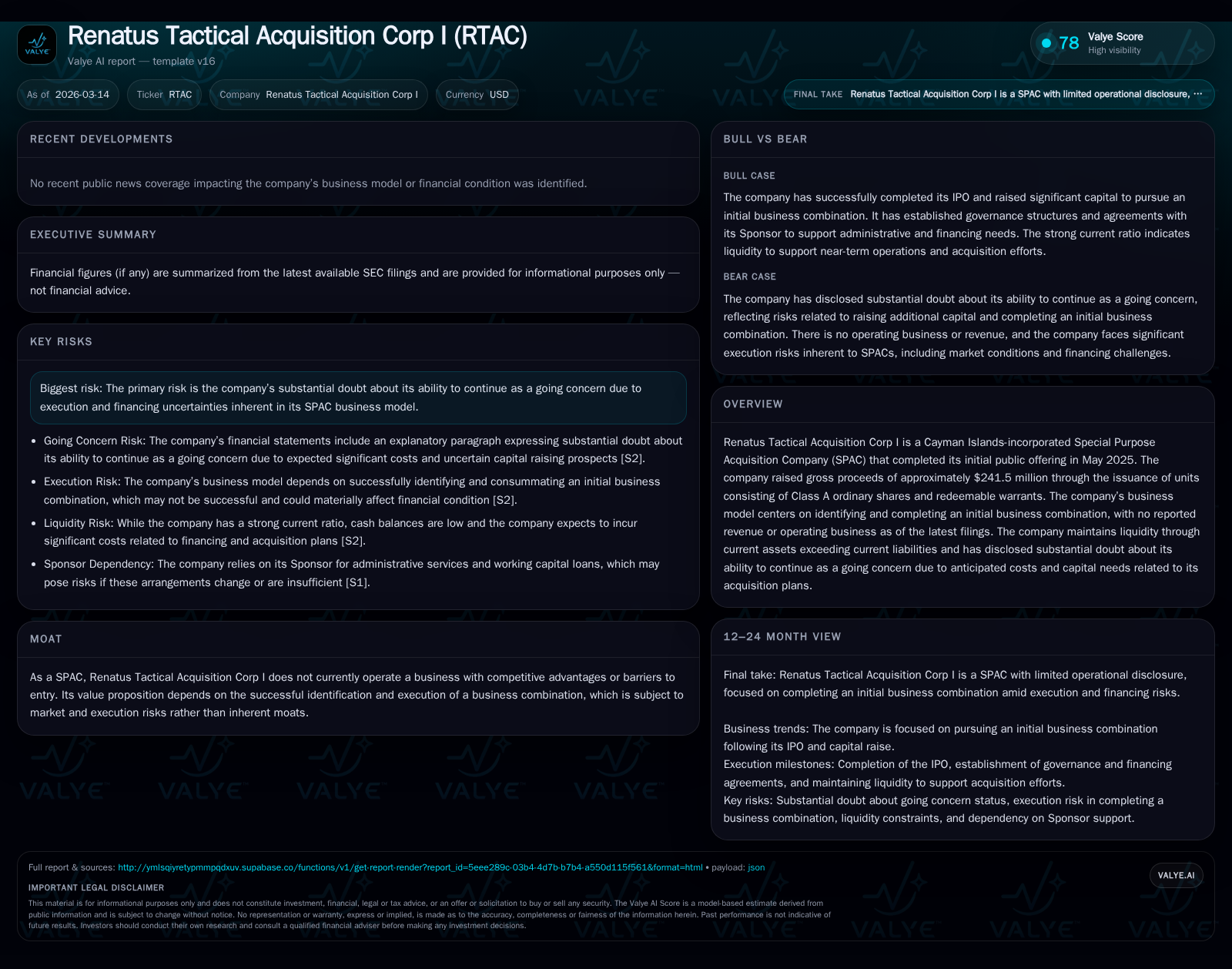
Renatus Tactical Acquisition Corp I (RTAC), a Cayman Islands-based SPAC launched in May 2025, raised approximately $241.5 million through units combining Class A ordinary shares and redeemable warrants. Despite strong initial capital formation held mostly in trust, the company faces acute liquidity constraints with minimal working capital outside the trust account, alongside explicit substantial doubt disclosed regarding its ability to continue as a going concern. Execution risk is heightened given the limited timeline to complete an initial business combination within 24 months (extendable up to 30). Capital allocation currently centers on preserving funds to complete a transaction; no dividends or buybacks have been declared. The upcoming year is pivotal for RTAC’s transition from a shell vehicle to an operating entity.
IPO Milestones and Capital Raise Overview
Renatus Tactical Acquisition Corp I completed its initial public offering on May 16, 2025. The company sold approximately 24.15 million units at $10 per unit, inclusive of a full exercise of the underwriters' over-allotment option which contributed 3.15 million units to total issuance [S7][S10][S11]. Each unit contained one Class A ordinary share (par value $0.0001) alongside one-half of one redeemable warrant—meaning two units grant one full warrant exercisable into one share at an exercise price initially set at $11.50 per share subject to adjustment [S7][S10].
Simultaneous with the IPO, RTAC executed a private placement offering over 3.8 million private placement warrants priced at $1 each sold exclusively to the Sponsor entity International SPAC Management Group I LLC. These private placement warrants are comparable in exercise rights but are subject to transfer restrictions until after consummation of the initial business combination [S11][S15].
Gross proceeds including these offerings amounted to roughly $245.3 million before underwriting discounts and commissions. Net proceeds totaling about $242.1 million (after estimated $8.45 million deferred underwriting discounts) were placed into a trust account held by Odyssey Transfer and Trust Company acting as trustee with restricted use governed by SPAC regulatory framework [S18][S19].
The trust funds are earmarked exclusively for acquisition purposes or refunding investors should no deal be consummated within stipulated timeframes.
Liquidity Status and Financial Health Insights
While the trust account holds significant capital backing RTAC’s transaction ambitions, the company’s liquidity outside this account is precarious. As of September 30, 2025, RTAC reported only about $97,362 in cash not held in trust and working capital approximating $601,011 [S2][S5]. This represents minimal available resources for covering administrative costs such as legal fees, due diligence expenses related to target evaluation, or corporate overhead.
Current liabilities at this date were modest—$40,100—providing a current ratio near 10.68 which superficially suggests high short-term solvency but fails to offset concerns that ongoing acquisition-related expenses may rapidly consume these limited funds absent additional funding sources external to the trust [F1].
Such financial constraints typify early-stage SPACs prior to closing a business combination but highlight operational runway fragility.
Risks to Continuity: Going Concern Considerations
RTAC management has openly disclosed "substantial doubt about our ability to continue as a going concern" predicated on potential timing slippage in executing its initial business combination and uncertainty surrounding additional financing efforts needed for transaction-related expenditures [S2][S3][S4][S8]. The company’s lack of operating revenues compounds inherent risks tied solely to pursuit of a merger.
Management's discussion points out expected significant costs ahead while stressing that plans for raising further capital may not materialize successfully — factors collectively increasing existential uncertainty until a definitive acquisition occurs or liquidating event transpires.
This level of disclosure is consistent with SEC requirements signaling investor caution amid typical SPAC financial profiles where operational trading is non-existent.
Mechanics and Implications of Business Combination Deadline
Regulatory parameters enforce that Renatus Tactical Acquisition Corp I must consummate an initial business combination within 24 months following its IPO closing date, i.e., by May 16, 2027. The company may extend this deadline by up to six additional months (to max 30 months) if shareholders approve such extension within prescribed rules [S14].
Failure to close a qualifying merger by these deadlines mandates liquidation proceedings whereby trust account funds are returned pro-rata to public shareholders after paying liquidation expenses. Such outcomes typically result in losses relative to original unit pricing due to underwriting costs deducted upfront.
Shareholders also hold redemption rights allowing them to redeem shares for their portion of trust proceeds if dissatisfied with announced combinations.
These strict timelines emphasize pressure on management teams underlying SPACs like RTAC who operate under ticking clocks with limited operational budgets.
Capital Allocation Framework and Stakeholder Returns
To date, RTAC has maintained a conservative allocation posture focused entirely on funding its forthcoming business combination transaction with no declarations or payments of dividends or share repurchase programs typical for entities with operating cash flows [S7][S10][S11][S12][S13].
Sponsor agreements include administrative service contracts for office space ($25K monthly pre-combination), loans up to approximately $639K under convertible notes for operational needs without accruing interest—illustrating incremental structural financing tools supporting short-term operations ahead of deal close [S16][S17][S20].
Financial Snapshot: Current Assets, Liabilities, and Profitability Metrics
Historical performance (annual)
| FY |
|---|
| 2025 |
Source: SEC companyfacts cache [F1].
This table summarizes RTAC’s latest fiscal snapshot reflecting net income attributable principally to management fees or non-operational items rather than trading profits given absence of revenue streams characteristic in early-stage SPACs [F1]. The considerable current ratio stems primarily from nominal liabilities against modest liquid assets excluding trust holdings.
ROE magnitude negative near -21% underscores equity dilution pressures combined with ongoing expenses absent operational earning capacity.
Outlook: Critical Triggers Ahead for RTAC’s Next Phase
Looking ahead through this pivotal juncture before scheduled merger deadlines, key indicators include timing and substance of any announced initial business combination which will transform RTAC from a passive shell into an active operating entity.
Given that warrants trade separately as "RTACW" post June 2025 separation from Units along with shares trading as "RTAC", close attention must be paid both to dilution dynamics upon warrant exercises above $11.50 strike prices and potential capital raises impacting shareholder equity stakes.
Overall this coming year will define whether Renatus Tactical Acquisition Corp I successfully fulfills its mandate or triggers liquidation scenarios reflective of unmet SPAC execution goals.
This analysis is informational and does not constitute investment advice or recommendations regarding securities mentioned herein.
Disclaimer: This is research-only, informational analysis and not investment advice. It may include AI-generated interpretation and general industry context. Always verify important details using primary sources.

Comments