RTX CORP: Navigating Aerospace and Defense Complexity in 2026
RTX CORP operates a diversified aerospace and defense portfolio anchored by Pratt & Whitney, Raytheon, and Collins Aerospace Systems, balancing commercial and government demand amid geopolitical and operational pressures.
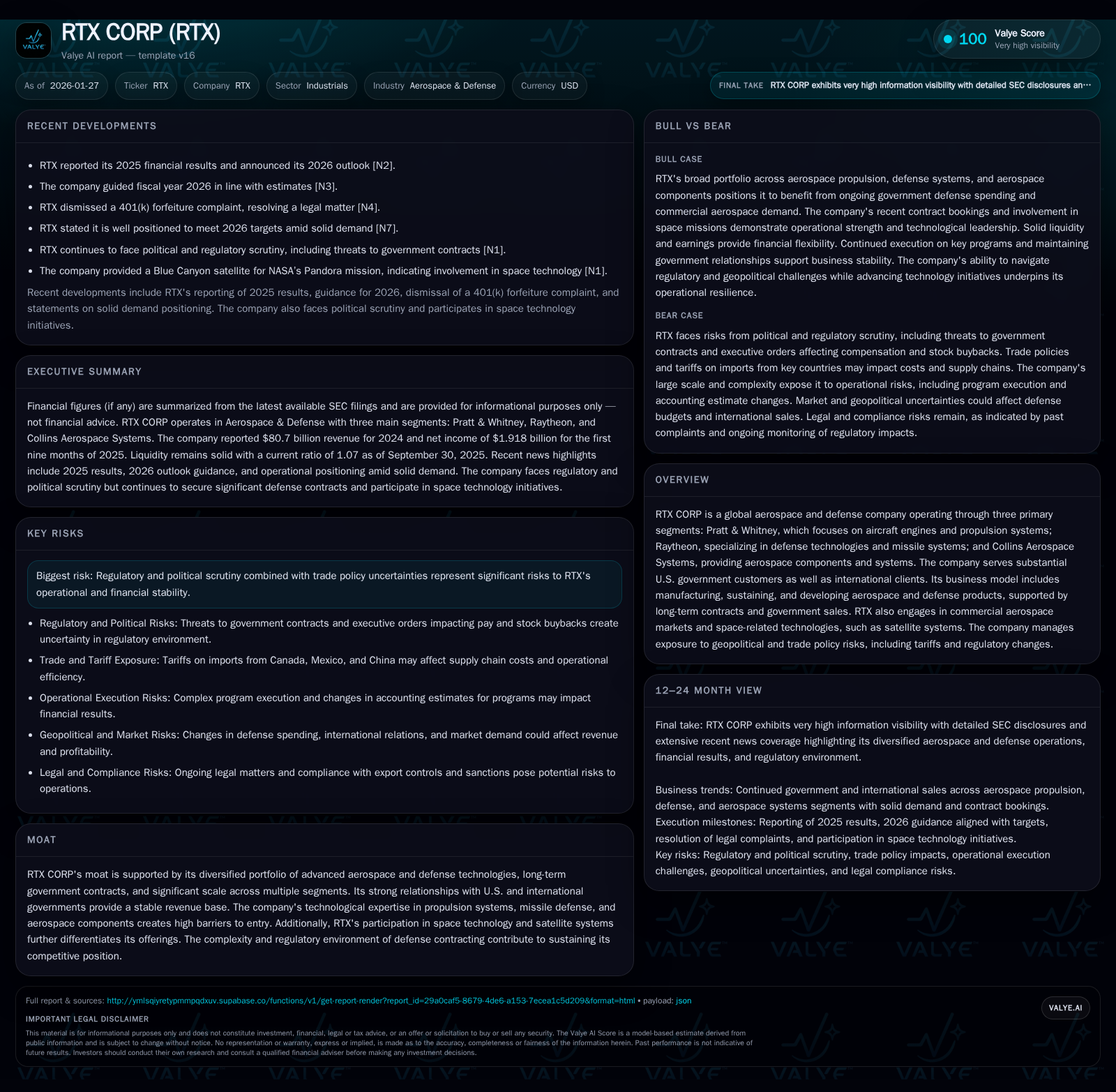
RTX CORP reported solid 2025 results and a stable outlook for 2026, supported by resilient government contracts and commercial aerospace demand. The firm manages complex supply chains and regulatory risks across propulsion, defense systems, and aerospace components. Recent geopolitical tensions and regulatory scrutiny underscore operational risks, but the company's scale, integrated segments, and technological expertise sustain its competitive positioning within a challenging industry landscape.
What Changed Recently
RTX CORP reported its full-year 2025 financial results on January 27, 2026, confirming a performance in line with expectations and providing an outlook for 2026 that anticipates solid demand across its major segments [N1, N5, N6, N7]. Despite political headwinds, including criticism from former President Trump and subsequent regulatory scrutiny on defense contractors' pay and stock buybacks, RTX has chosen a more reserved engagement stance to avoid further controversy [N3, N12]. Meanwhile, Pratt & Whitney has experienced delays in engine deliveries for Airbus aircraft, which has impacted customer relations and stock performance temporarily [N11]. On the commercial aerospace front, RTX’s Blue Canyon satellite successfully launched with NASA’s Pandora mission, highlighting ongoing involvement in space and satellite technologies [N10, N13].
Business Model as a System
RTX CORP’s operations span three primary segments, each with distinct but complementary roles within aerospace and defense. Pratt & Whitney focuses on aircraft engines and propulsion systems, producing powerplants for both commercial and military aircraft. Raytheon specializes in defense technologies, including missile systems and advanced electronics, primarily serving U.S. government and allied military customers. Collins Aerospace Systems delivers aerospace components and integrated systems, spanning avionics, interiors, and mechanical systems for aircraft [S1].
The company’s business model relies heavily on long-term contracts, especially with the U.S. Department of Defense, which account for a substantial portion of sales across all segments. These contracts, often multi-year with performance and cost milestones, provide revenue visibility and underpin capital allocation decisions [S2]. International sales form a significant and growing part of revenue, especially in allied defense markets and commercial aerospace, diversifying geographic exposure [S1, S8].
RTX also invests continuously in R&D to maintain technology leadership in propulsion efficiency, missile defense capabilities, and aerospace systems integration. This investment is crucial to compete for new platforms and sustain existing programs, especially given the high barriers to entry created by regulatory, technological, and scale requirements [S16, S17].
Supply chain and manufacturing complexity is a core operational challenge. RTX manages a broad set of suppliers and sub-tier vendors across multiple geographies. Tariffs and trade policy unpredictability, such as the 2025 U.S. tariffs on imports from Canada, Mexico, and China, impose cost pressures and necessitate agile procurement and sourcing strategies [S3]. Contracting with governments also entails compliance with stringent regulations, cybersecurity requirements, and export controls, layering operational risks.
Industry Map & Competitive Battlefield
The aerospace and defense industry is dominated by a few large players with diversified portfolios, including Lockheed Martin, Boeing, Northrop Grumman, General Dynamics, and RTX. Competition occurs along multiple vectors: technological innovation, program execution capability, political relationships, and price competitiveness.
RTX’s unique positioning stems from its integrated capabilities across propulsion (Pratt & Whitney), missile and defense systems (Raytheon), and broad aerospace systems (Collins Aerospace). This breadth offers cross-segment synergies, enabling RTX to bid competitively on large government platforms and commercial aircraft programs [S22].
The commercial aerospace market is cyclical and sensitive to airline capital spending and global economic conditions, while defense spending is generally more stable but subject to political and budgetary shifts. RTX’s balance across these sectors mitigates volatility but requires constant adaptation to changing government priorities and commercial trends.
Space-related technology is an emerging battleground, with RTX participating via satellite systems and related technologies, competing alongside specialized aerospace firms and new entrants in the commercial space sector [N10, N13].
Where the Economics Become Real
RTX’s unit economics are shaped by high fixed costs associated with manufacturing facilities, R&D expenditures, and long program development cycles. Operating margins vary by segment, with defense businesses typically achieving higher margins due to specialized products and long-term contracts, while commercial aerospace can be more margin sensitive due to competitive pricing and delivery challenges [S10, S16, S17].
Cost of sales includes raw materials, labor, and overhead, heavily influenced by supply chain stability. Delays or quality issues can lead to penalties or increased costs, as seen with Pratt & Whitney’s engine delivery delays [N11]. Collaborative programs often share costs with partners or customers, adding complexity to cost accounting and cash flow timing.
Liquidity is supported by approximately $6 billion in cash and equivalents as of late 2025, with a current ratio near 1.07, suggesting adequate short-term asset coverage against liabilities [XBRL snapshot]. However, the company carries significant long-term debt with coupon rates in the 5-6% range, requiring disciplined cash flow management to service obligations [S14, S15].
Capital allocation is constrained by the need to invest in advanced technologies and maintain competitive positioning, while managing shareholder expectations on dividends and buybacks amid regulatory pressures [N12].
Diligence Questions / Disconfirming Signals
- How effectively is RTX managing its supply chain risks related to geopolitical tensions and tariffs? Are alternative sourcing strategies mitigating potential cost inflation?
- What is the impact of Pratt & Whitney’s delayed engine deliveries on customer relationships and future order momentum? How is RTX addressing production bottlenecks?
- Given recent political and regulatory scrutiny on defense contractors’ pay and capital returns, how might this affect RTX’s operational flexibility and talent retention?
- What are the integration risks and expected synergies from recent acquisitions or divestitures, particularly regarding Collins Aerospace’s businesses?
- How exposed is RTX to fluctuations in defense budgets, especially with shifting U.S. government priorities and international arms sales policies?
- Are there any contingencies or liabilities related to aerospace litigation or regulatory investigations that could affect financials materially?
Conclusion
RTX CORP stands as a diversified aerospace and defense powerhouse with a multi-faceted business model addressing critical government and commercial markets. Its scale, technological depth, and longstanding government contracts provide a substantial moat. Nonetheless, evolving geopolitical dynamics, regulatory scrutiny, and operational execution challenges—especially in propulsion and supply chain—require vigilant management. The company’s continued success hinges on balancing investment in innovation with disciplined cost control and responsiveness to the complex global defense and aerospace environment.
This analysis summarizes publicly available information and industry context as of early 2026. It is intended for informational purposes and does not constitute investment advice or recommendations.
Disclaimer: This is research-only, informational analysis and not investment advice. It may include AI-generated interpretation and general industry context. Always verify important details using primary sources.

Comments