
Recursion Pharmaceuticals Charts AI-Driven R&D Evolution with Growing Losses
Recursion harnesses its proprietary AI platform to redefine drug discovery amid steep financial losses and capital demands.
Recursion Pharmaceuticals integrates advanced AI with multimodal biological data in its proprietary Recursion Operating System, aiming to accelerate drug development and reduce failure rates. Despite technological innovation and strategic partnerships, the company’s operating and net losses have deepened significantly from 2022 through 2025, reflecting heavy investment in R&D and clinical programs without generating commercial revenues. Sustained negative cash flow and reliance on equity financing highlight the funding challenges faced while advancing an early-stage clinical pipeline under complex regulatory scrutiny. Monitoring clinical milestones, partnership outcomes, and cash burn will be critical for assessing Recursion’s balance between scientific promise and financial sustainability.
Recursion’s AI-Native Platform: Revolutionizing Drug Discovery
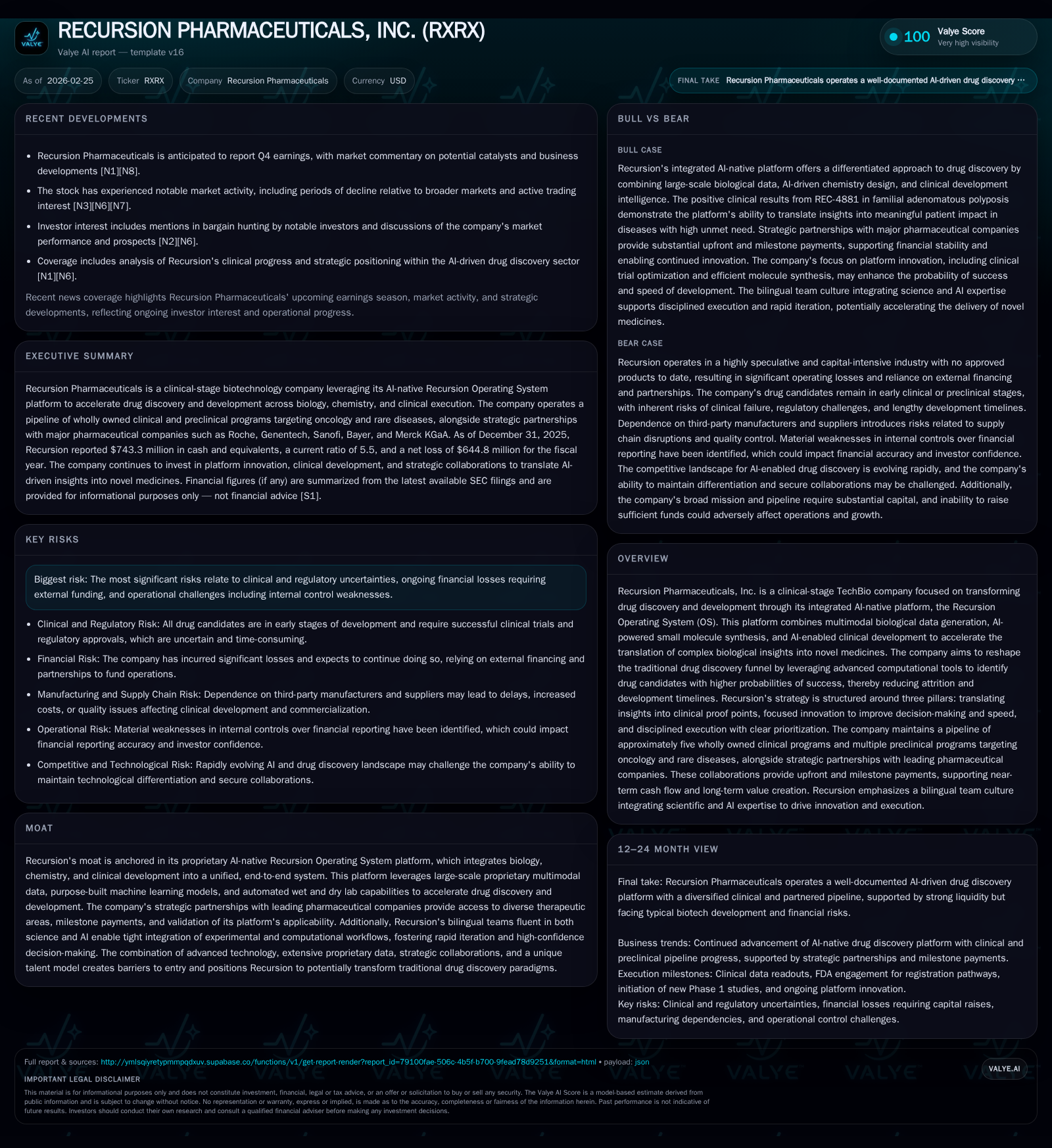
Recursion Pharmaceuticals positions itself at the forefront of TechBio convergence by deploying its integrated AI-native framework—the Recursion Operating System (OS)—to transform traditional drug R&D paradigms. This unified platform melds expansive multimodal biological data generation (including imaging-based cellular assays), AI-powered small molecule synthesis automation, and AI-enabled clinical development workflows [S1]. The system’s architecture is designed to compress the historically "V-shaped" drug discovery funnel—characterized by broad screening succeeded by narrow clinical candidate progression—into a more targeted "T-shaped" model prioritizing early attrition of low-probability candidates. By leveraging purpose-built machine learning models trained on proprietary datasets spanning biology and chemistry domains along with automated wet-lab capabilities, Recursion seeks to boost productivity by accelerating candidate identification with higher confidence [S1].
This approach taps into an industry-wide surge in applying advanced AI/ML techniques across drug target identification, molecular design, chemical synthesis, and clinical trial optimization—a multi-billion-dollar annual investment space underscored by regulatory engagement around AI deployment in biopharma [S1]. Through bilingual teams fluent in both computational science and biomedicine, Recursion integrates experimental insights tightly with computational predictions fostering rapid iteration cycles that are not only efficient but designed to elevate decision-making quality [S1]. These specialized capabilities represent a substantial moat that differentiates Recursion from peers relying on narrower toolsets.
Financial Trajectory: Rising Losses Amid Platform Expansion
From FY2022 through FY2025, Recursion’s financials reveal a trajectory characterized by escalating operating and net losses concomitant with intensifying R&D outlays as the company advances its drug discovery technology and pipeline. Operating income eroded from -$246 million in 2022 to -$648 million in 2025—a compounded annual deterioration roughly at -35.3% year-over-year [F1]. Net income followed a similar path from -$239 million to -$645 million across the same time span (-39.1% YoY latest). Such trends illustrate the capital-intensive nature of advancing early-stage biotech platforms where clinical validation cycles extend several years without product-derived cash flow.
Operating cash flows remained deeply negative at -$372 million in FY2025 compared to -$83 million in FY2022—a marked increase aligned with scaling research activities [F1]. However, capital expenditures have significantly receded—from $37 million in 2022 down to $6.5 million in 2025—indicating investment focus shifting strongly toward intangible asset formation such as platform software and biological datasets rather than physical infrastructure [F1]. The balance sheet shows a robust liquidity position with cash & equivalents near $743 million end-FY25 against moderate current liabilities of ~$148 million yielding a comfortable current ratio ~5.5x [F1]. Stockholders’ equity has also grown substantially driven largely by equity financing rounds increasing from $486 million in 2022 to over $1.13 billion in 2025 reflecting ongoing dilution risk [F1].
Historical performance (annual)
| FY | Net ($mm) | CFO ($mm) | OpInc ($mm) | Capex ($mm) | Net YoY |
|---|---|---|---|---|---|
| 2025 | -645 | -372 | -648 | 6 | -39.1% |
| 2024 | -464 | -359 | -479 | 14 | -41.3% |
| 2023 | -328 | -288 | -350 | 12 | -37.0% |
| 2022 | -239 | -84 | -246 | 37 |
Note: Omitted columns lack sufficient annual XBRL coverage in the provided tags (need ≥2 annual points): Rev, Div, Buybacks. Source: SEC companyfacts cache [F1].
Capital returns and efficiency (annual)
| FY | FCF ($mm) | ROE% |
|---|---|---|
| 2025 | -378 | -57.0 |
| 2024 | -373 | -44.8 |
| 2023 | -300 | -70.8 |
| 2022 | -121 | -49.3 |
Source: SEC companyfacts cache [F1].
Note: No revenues or dividend/buyback data available due to clinical-stage status.
Revenue Model and Capital Structure: No Product Sales Yet, Heavy R&D Investment
Consistent with its pre-commercial stage status, Recursion reports no product sales revenue; all funding sources derive primarily from equity offerings complemented by income from milestone payments under strategic partnerships [S1][N3]. This pattern aligns with biotech sector norms where sustained R&D investments precede regulatory approvals often spanning multiple years [S1]. Milestone payments are typically non-dilutive supplements contingent upon advancing drug candidates through predefined development phases negotiated with pharmaceutical collaborators allowing some offsetting of operating expenses without ownership dilution [N3]. Equity fundraising efforts have led to significant stock issuance increasing shareholders’ equity notably over recent years despite material accumulated deficits exceeding $2 billion as of end-2025 [S1][F1].
Strategic Partnerships and Their Role in Growth Drivers
Recursion leverages partnerships with established pharmaceutical companies as critical vectors for validation of its AI-enabled platform across multiple therapeutic domains [S1]. Such collaborations serve dual purposes: generating milestone payment streams that materially support development cost absorption while simultaneously providing external endorsement of platform versatility through jointly developed programs spanning diverse indications [S1]. These alliances effectively anchor the early innovation pipeline reducing sole dependency on internally funded discovery programs and enhance prospects for license fees or royalties contingent on successful commercialization downstream.
By integrating corporate partners’ domain expertise with Recursion’s data-driven discovery engine, these partnerships accelerate iterative cycles of biological hypothesis testing-to-medical translation exemplifying synergistic R&D models increasingly prevalent among TechBio innovators [S1]. For buy-side analysts evaluating risk-adjusted opportunity sets, partnership progress updates constitute meaningful signals of de-risking.
Clinical Pipeline Milestones and Future Growth Constraints
Recursion’s portfolio spans programs at early discovery through preclinical stages into initial clinical trials without any candidates yet approved for commercial sale or advanced pivotal trials reported [N3][S1][S4]. This status highlights typical biotech challenges including:
- Navigating regulatory approval complexity especially amid evolving FDA frameworks for AI-based methodologies,
- Scientific uncertainty inherent in validating novel targets identified via computational means,
- Intensive capital consumption driven by high-cost clinical studies,
- Imperative need for generating robust clinical proof points to justify further investment and valuation uplift [N3][S4].
The company acknowledges the unpredictable timelines associated with these hurdles alongside risks posed by attrition rates characteristic for novel modality biopharma firms lacking historical revenue stability or track record of late-stage approvals [S1][S4]. Management emphasizes disciplined prioritization focusing resources on programs demonstrating highest probability for success per their T-shaped funnel strategy enhancing pipeline quality despite quantity constraints.
Capital Allocation Patterns: Operating Cash Flow and Equity Funding
Financial analysis confirms persistent negative net operating cash flows escalating from approximately -$83 million in FY22 to nearly -$372 million by FY25 reflecting elevated spend scale aligned with expanding R&D scope [F1]. In contrast capital expenditures declined significantly post-FY22 indicating reduced investments in physical assets consistent with technology-heavy platform spending predominantly represented as intangible investments not capitalized as PP&E [F1].
The absence of dividends or share repurchase programs underscores reinvestment priority focused squarely on sustaining innovation momentum given no positive free cash flow generation (calculated FCF ~-$378M FY25 from CFO minus Capex) [F1]. Deteriorating ROE approximated at around negative 57% mirrors ongoing operational losses borne disproportionately by equity holders highlighting financing sustainability risks absent product commercialization or breakthrough milestones [F1].
Regulatory Environment and Risks Impacting Advancement
Recursion operates within a densely regulated environment facing multifaceted compliance challenges spanning FDA oversight of drug development intertwined increasingly with scrutiny over use of AI/ML technologies across discovery pipelines [S4][S6][S7][S13]. The evolving regulatory landscape encompasses:
- Interpretations impacting validation requirements for AI-related data outputs,
- Healthcare pricing reforms including state-level drug price transparency initiatives,
- Data privacy mandates affecting multinational patient data utilization,
- Potential for increased enforcement actions related to healthcare fraud/abuse laws given complex collaboration structures,
- Post-marketing commitments imposing additional expenditure burdens following any approval receipt .
Changes like the recent Supreme Court rulings introducing unpredictability around agency deference add layers of uncertainty potentially delaying go-to-market timelines or impacting reimbursement frameworks internationally [S6][S7]. Regulatory risks thus remain salient factors constraining forecast precision.
Innovation vs. Sustainability: Balancing Tech Promise with Financial Realities
While Recursion stands as an exemplar tech-enabled transformation player applying cutting-edge AI toward reducing drug development attrition rates—historically entrenched at sub-4% success per conventional estimations—the pathway to realizing commercial returns involves navigating protracted validation cycles amid intensified financial burn rates [S1][N4][N6]. Market commentary underscores skepticism toward sustained operating losses coupled with uncertain timelines for pivotal trial data releases contributing to share price volatility amid broader biotech sector headwinds [N6][N10][N13].[N4]
The tension between aggressively advancing technology innovation versus securing long-term financial sustainability encapsulates central operational challenges confronting management teams within emerging TechBio enterprises reliant heavily on external capital infusions until product commercialization milestones mature.
Investment Outlook: Key Metrics to Monitor for Clinical and Financial Progress
Absent explicit forward guidance beyond qualitative commentary available within public filings and recent earnings previews [N3][S3], prudent analytical frameworks suggest close monitoring of several high-impact indicators including but not limited to:
- Timing and outcomes of planned pivotal or proof-of-concept trials across key pipeline candidates,
- Achievement status within partner milestone frameworks triggering material non-dilutive financing inflows,
- Quarterly cash burn rate trajectory vis-à-vis existing liquidity reserves signifying runway sufficiency,
- Equity financing announcements delineating dilution magnitude or alternative funding mechanisms,
- Regulatory dialogue updates regarding acceptance criteria for AI-assisted discovery methods underscoring approval feasibility assumptions.
Such metrics collectively form the basis for forward-looking assessments blending technological validation potential against imperatives imposed by financial resource management within a nascent commercial environment.
Disclaimer: This report is prepared exclusively for informative purposes summarizing publicly available financial statements, filings, and news without providing investment advice or recommendations.
Disclaimer: This is research-only, informational analysis and not investment advice. It may include AI-generated interpretation and general industry context. Always verify important details using primary sources.

Comments