
SentinelOne Inc: Navigating AI-Driven Cybersecurity in a Competitive Landscape
SentinelOne leverages advanced AI to deliver integrated endpoint and cloud security solutions but faces profitability challenges and intense competition amid rapid market evolution.
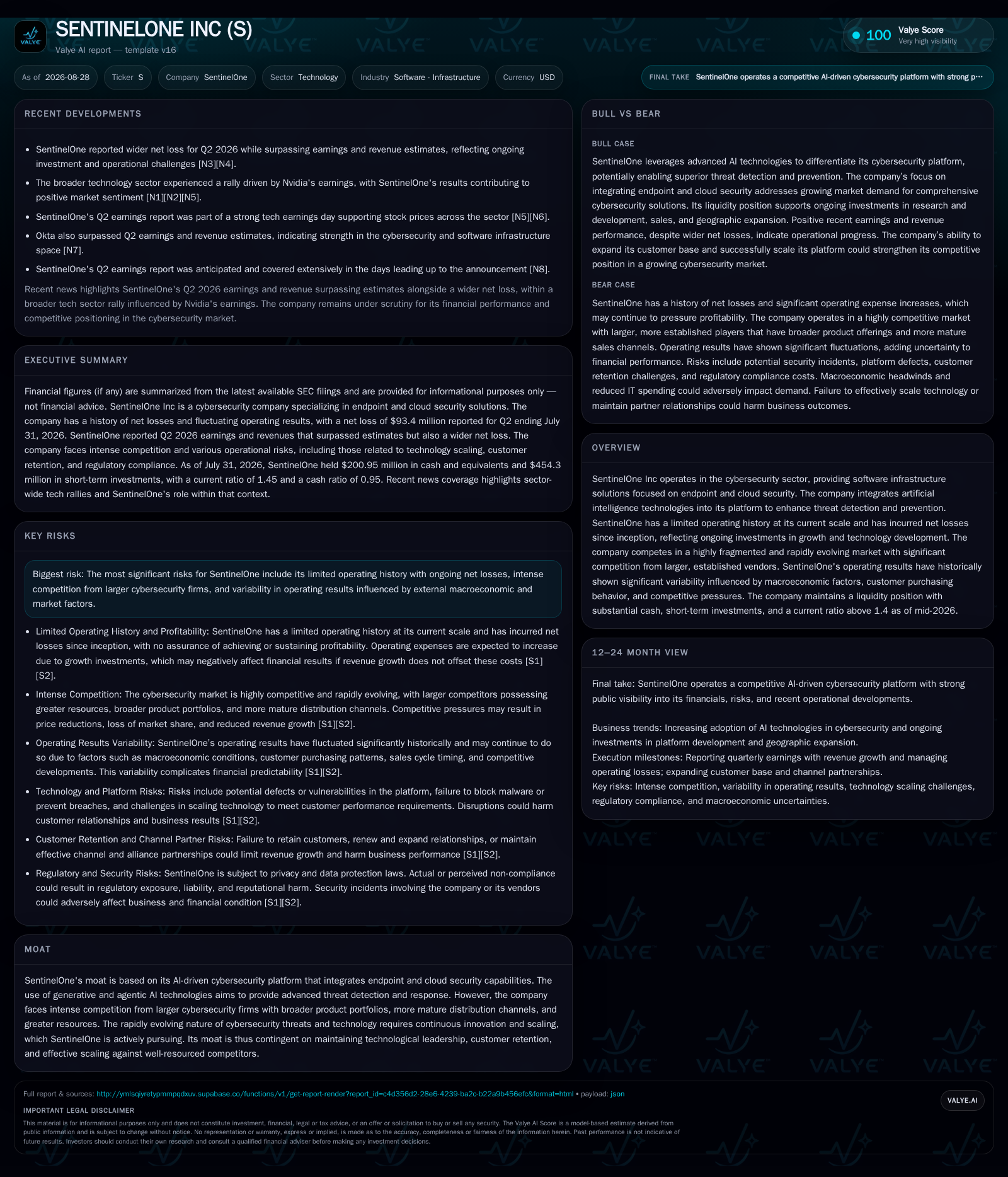
SentinelOne’s AI-centric cybersecurity platform addresses growing demand for comprehensive threat prevention across endpoints and cloud environments. Despite recent revenue growth surpassing estimates, the company continues to report substantial net losses driven by heavy investment in R&D, sales, and expansion. Its competitive moat hinges on technological innovation in generative and agentic AI, balanced against pressure from larger, established cybersecurity vendors with broader portfolios and mature distribution. SentinelOne’s path to sustainable profitability depends on scaling its platform effectively, retaining and expanding its customer base, and navigating macroeconomic and regulatory headwinds.
SentinelOne Inc operates at the intersection of cybersecurity innovation and market competition, employing advanced AI technologies to deliver integrated endpoint and cloud security solutions. The company’s Q2 2026 results demonstrated revenue growth exceeding estimates, yet net losses widened, underscoring persistent investment demands and operational volatility. Positioned in a rapidly evolving market crowded with larger incumbents, SentinelOne’s future hinges on its ability to scale technology, deepen customer relationships, and leverage its AI capabilities to differentiate. Understanding SentinelOne’s business model economics, competitive moat, and key risks provides insight into its trajectory amid ongoing sectoral shifts and economic uncertainties.
Latest Operating Snapshot
SentinelOne reported Q2 2026 results with revenues and earnings surpassing analyst estimates, signaling operational progress despite a wider net loss of $93.4 million for the quarter ending July 31, 2026 [S2][N3][N4]. This juxtaposition illustrates the company’s current phase of aggressive investment in growth and technology development amid scaling challenges.
The company’s liquidity position remains robust, with $200.95 million in cash and equivalents and $454.3 million in short-term investments, yielding a current ratio of 1.45 and a cash ratio of 0.95 as of late July 2026 [S2]. This cash buffer supports ongoing expenditures in research and development, sales and marketing, and geographic expansion, crucial to maintaining competitive momentum.
Business Model and Unit Economics
SentinelOne generates revenue primarily through sales of cybersecurity software solutions focused on endpoint and cloud protection. Pricing likely involves a mix of subscription and license fees, potentially tiered by features or customer scale, combined with professional services. The integration of AI technologies adds differentiation but also requires significant upfront R&D investment with a long horizon before unit-level profitability.
Operating expenses are heavily weighted toward fixed costs—especially R&D and sales and marketing—with variable costs linked to cloud infrastructure and service delivery. This cost structure creates potential operating leverage as revenues scale, but the company’s history of net losses and expenditure growth indicates that realizing leverage depends on rapid customer acquisition and efficient scaling. Capital intensity arises from continuous innovation cycles and expanding geographic reach, requiring sustained investment before margin expansion.
Moat, Competition and Counterforces
SentinelOne’s moat centers on its AI-driven cybersecurity platform, utilizing generative and agentic AI for advanced threat detection, response automation, and unified endpoint and cloud security coverage. This technological edge could provide differentiation if it translates into superior efficacy, faster detection, and reduced manual intervention, fostering customer retention and pricing power.
However, the cybersecurity market is highly fragmented and intensely competitive, with large incumbents possessing broader product portfolios, mature sales channels, and deep customer relationships. These competitors can exert pricing pressure and bundle offerings. Furthermore, rapid threat evolution demands continuous innovation, raising the risk of platform obsolescence or customer churn if SentinelOne cannot maintain technological leadership and scale operations effectively.
Bull Case
In a favorable scenario, SentinelOne capitalizes on its AI capabilities to develop a cybersecurity platform that outperforms legacy solutions in detection accuracy, response speed, and operational efficiency. This drives accelerated customer adoption across enterprise segments seeking integrated endpoint and cloud protection, expanding the company’s addressable market and revenue growth.
Sustained liquidity supports ongoing investment in R&D and global expansion, enabling SentinelOne to scale its platform and sales efforts effectively. Improvement in gross margins and operating leverage leads to narrowing net losses and eventual profitability. Confirming evidence would include consistent revenue growth outpacing expense increases, rising customer retention and expansions, and positive feedback on AI effectiveness. Falsification would be persistent margin compression, stagnant customer acquisition, or competitive displacement.
Base Case
Under the base case, SentinelOne continues to grow revenues modestly above industry averages while maintaining high investment levels in technology and sales to sustain competitive positioning. Net losses persist but stabilize as the company gains operating efficiencies. The platform’s AI features provide incremental differentiation, though competitive pressures limit pricing power and margin expansion.
Cash reserves fund growth initiatives, but fluctuations in operating results continue due to macroeconomic cycles and sales execution variability. Customer retention remains stable but without significant expansion of wallet share. Confirming signs include steady revenue growth aligned with sector trends, controlled expense growth, and stable customer metrics. Contradictory evidence would be abrupt revenue slowdowns or escalating losses due to failed investments.
Bear Case
In a downside scenario, SentinelOne’s technology fails to sufficiently differentiate or scale, resulting in slower customer acquisition and high churn amid competitive encroachment by larger incumbents with more comprehensive offerings and entrenched distribution. Operating expenses continue to rise faster than revenues, exacerbating net losses and cash burn.
Macroeconomic headwinds reduce IT budgets, intensifying pricing pressure and elongating sales cycles. Regulatory compliance costs and cybersecurity incidents impose additional burdens. Liquidity deteriorates, forcing cutbacks on R&D and expansion, further weakening competitive positioning. Confirmation would be declining revenues, worsening retention, or liquidity shortfalls. Falsification would be unexpected large customer wins or partnership breakthroughs improving scale.
What Matters Next
Key performance indicators to watch include: quarterly revenue growth rates and bookings trends to gauge demand momentum; gross and operating margins to assess scalability; customer retention and net expansion rates to measure platform stickiness; R&D and sales & marketing expense trajectories for investment intensity; cash flow and liquidity metrics to monitor potential financial flexibility; and adoption or efficacy metrics for AI-driven threat detection to validate technology leadership.
Milestones such as successful geographic expansion, new product launches or integrations, and major partnership agreements will be important signals of growth potential. External conditions like macroeconomic environment, IT spending trends, and regulatory developments related to cybersecurity and data privacy will also materially influence SentinelOne’s outlook.
Disclaimer: This is research-only, informational analysis and not investment advice. It may include AI-generated interpretation and general industry context. Always verify important details using primary sources.

Comments