
Starbucks Corp: Navigating Growth and Margin Pressures Amid Operational Shifts
Starbucks continues its global expansion and strategic transformation while managing inflationary challenges and operational complexities in its specialty coffee retail business.
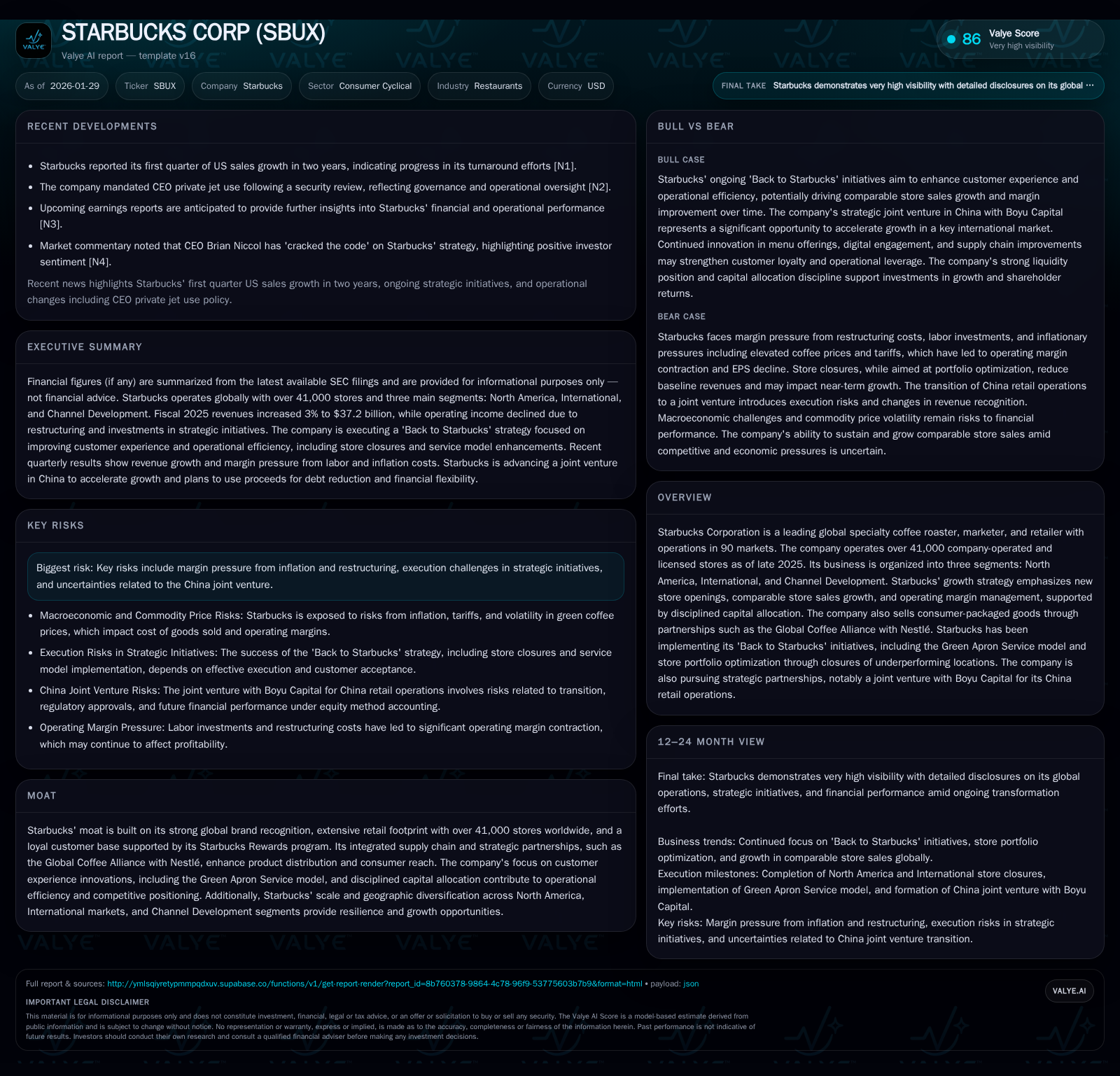
Starbucks posted its first US comparable sales growth in two years, driven by strategic initiatives including the Green Apron Service model and ongoing store portfolio optimization. Despite revenue gains from new store openings and expanded consumer packaged goods channels, margin pressures arising from labor investments and commodity inflation have compressed operating income. The company’s global footprint, segmented operational model, and partnerships such as the Global Coffee Alliance underpin its resilience, yet execution risks and uncertainties related to its China joint venture remain critical to watch.
What Changed Recently
Starbucks reported its fiscal first quarter results for 2026, marking the first instance of US comparable store sales growth in two years, highlighting progress in its turnaround efforts [N1]. Consolidated net revenues increased 6% year-over-year to approximately $9.9 billion, driven primarily by a 4% rise in global comparable store sales and incremental revenue from new store openings [S2]. The US market saw a 4% comparable sales increase, with a 3% rise in comparable transactions and a 1% increase in average ticket, largely due to beverage modifications favored by consumers [S2]. These figures reflect the successful early impact of Starbucks’ "Back to Starbucks" initiatives, which include the Green Apron Service standard aimed at enhancing the in-store customer experience.
However, operating margins declined notably. North America operating income fell 27% to $867 million from the prior year quarter, with operating margin contracting 480 basis points to 11.9% [S3]. The margin compression was attributed primarily to labor cost inflation supporting the service model rollout and inflationary pressures, including tariffs and higher coffee raw material prices [S3]. This indicates that while top-line metrics are improving, cost pressures are weighing on profitability.
In parallel, Starbucks is actively optimizing its store portfolio, closing underperforming locations to focus on higher-return units and customer experience, balancing growth with efficiency [Valye report excerpt]. Internationally, the company is advancing its joint venture with Boyu Capital for its China retail operations, a critical growth market but one fraught with regulatory and execution uncertainties [Valye report excerpt]. Additionally, the company recently mandated private jet use for its CEO following a security review, signaling a heightened focus on executive security protocols [N3].
Business Model as a System
Starbucks operates as a vertically integrated specialty coffee roaster, marketer, and retailer with a presence spanning 90 markets globally and a retail footprint exceeding 41,000 company-operated and licensed stores [S1]. Its business is organized into three reportable segments: North America (U.S. and Canada), International (China, Japan, Asia Pacific, Europe, Middle East, Africa, Latin America, Caribbean), and Channel Development (consumer packaged goods and other channels) [S1].
The company’s growth strategy centers on three pillars: new store openings, comparable store sales growth, and operating margin management, supported by disciplined capital allocation [S1]. Comparable store sales include stores open for over 13 months and exclude foreign currency impacts, ensuring an apples-to-apples measurement of organic growth [S1].
Starbucks supplements its retail store revenues with sales from consumer-packaged goods, primarily through the Global Coffee Alliance with Nestlé, which expands its distribution footprint beyond stores to grocery and convenience retail channels [S1]. This alliance leverages Starbucks’ brand strength and Nestlé’s global distribution capabilities, enhancing consumer reach and revenue diversification.
Operationally, Starbucks invests heavily in customer experience innovations such as the Green Apron Service model, which emphasizes a more personalized, barista-led service standard. This initiative is part of the broader "Back to Starbucks" program, which also includes menu innovation to align with current consumer trends and targeted consumer marketing to deepen loyalty [S2].
Financially, the company’s operating margin is sensitive to labor costs, commodity price volatility (notably coffee beans), tariffs, and store-level efficiency. Labor investments to support enhanced service models have recently added approximately 260 basis points of margin pressure, while inflationary costs contributed roughly 150 basis points [S3].
Industry Map & Competitive Battlefield
Starbucks operates in the global specialty coffee retail and consumer packaged goods industry, a competitive landscape characterized by several layers:
Global and Regional Coffee Chains: Starbucks is the largest player globally, competing with chains like Dunkin’ Brands, McDonald's McCafé, Costa Coffee (JDE Peet’s), and various regional specialty coffee shops. Competition is intense on brand experience, product innovation, and location density.
Independent Coffee Shops: Local independent cafes compete on unique offerings and community engagement, appealing to niche consumer segments.
Consumer Packaged Goods (CPG): Through its Global Coffee Alliance, Starbucks competes in the retail coffee segment with brands like Keurig, Folgers (J.M. Smucker), and Nestlé’s Nescafé, among others.
Digital & Delivery Platforms: The rise of mobile ordering, delivery services, and loyalty programs adds complexity. Starbucks’ proprietary mobile app and rewards program are key competitive assets that drive repeat customer engagement and data collection.
Supply Chain & Raw Materials: Starbucks sources coffee globally, competing for quality beans amid fluctuating commodity markets influenced by climate change, geopolitical factors, and tariffs.
Scale, brand recognition, geographic diversification, and integrated supply chain partnerships create a significant moat for Starbucks. However, the industry faces growing challenges from rising input costs, changing consumer preferences toward sustainability and health, and the need for continuous service innovation.
Where the Economics Become Real
Unit economics at Starbucks hinge on several factors:
Store-Level Economics: New store openings contribute incremental revenue, but profitability depends on location, foot traffic, operational efficiency, and labor costs. Starbucks’ strategic closures of underperforming stores aim to optimize overall portfolio returns.
Comparable Store Sales: Growth here reflects effective marketing, menu innovation, and customer experience. The recent 4% global comparable sales increase suggests positive consumer response but must offset inflationary pressures.
Labor Costs: Labor investments for enhanced service models and wage inflation materially affect margins, as seen with a 260 basis point drag in North America [S3]. Managing labor productivity while maintaining service quality is critical.
Commodity Prices: Coffee bean costs, tariffs, and related supply chain expenses impact gross margins. Elevated coffee pricing contributed approximately 150 basis points of margin pressure recently [S3].
Channel Development: Consumer-packaged goods sales via the Nestlé alliance add a lower-margin, but scalable revenue stream, diversifying away from store-based sales.
Capital Allocation: Disciplined capital deployment toward high-return initiatives and efficient store rollouts supports long-term sustainable growth [S1].
Tax and Regulatory Costs: The significant increase in effective tax rate in Q1 2026 (to 61.7%) was due primarily to discrete impacts related to China operations classification, which affects net income realization and cash flow [S5].
Diligence Questions / Disconfirming Signals
How sustainable is the recent comparable store sales growth, particularly in the US, considering macroeconomic headwinds and consumer spending patterns?
Can Starbucks effectively manage ongoing labor inflation and commodity price volatility without further compressing operating margins?
What are the execution risks and regulatory challenges associated with the China joint venture with Boyu Capital, and how might these impact international segment profitability?
How does Starbucks plan to balance store portfolio optimization, including closures, with growth ambitions in mature and emerging markets?
To what extent can the Global Coffee Alliance continue to drive incremental revenue and margin improvement amid competitive pressure in the consumer-packaged goods channel?
Are there any operational risks or cost escalations associated with the implementation of the Green Apron Service model at scale?
How might evolving consumer preferences, including sustainability demands and health trends, impact menu innovation and supply chain decisions?
What is the outlook for Starbucks’ capital expenditure and investment pace given the current inflationary environment?
This analysis is based on publicly available information and recent news reports. It is intended to provide a detailed understanding of Starbucks Corporation’s business dynamics without making investment recommendations. Investors should conduct their own due diligence before making decisions.
Disclaimer: This is research-only, informational analysis and not investment advice. It may include AI-generated interpretation and general industry context. Always verify important details using primary sources.

Comments