
Scilex Holding Co Faces Liquidity Constraints While Advancing Non-Opioid Pain Portfolio
Latest quarterly filing highlights operational progress alongside significant liquidity challenges impacting strategic execution.
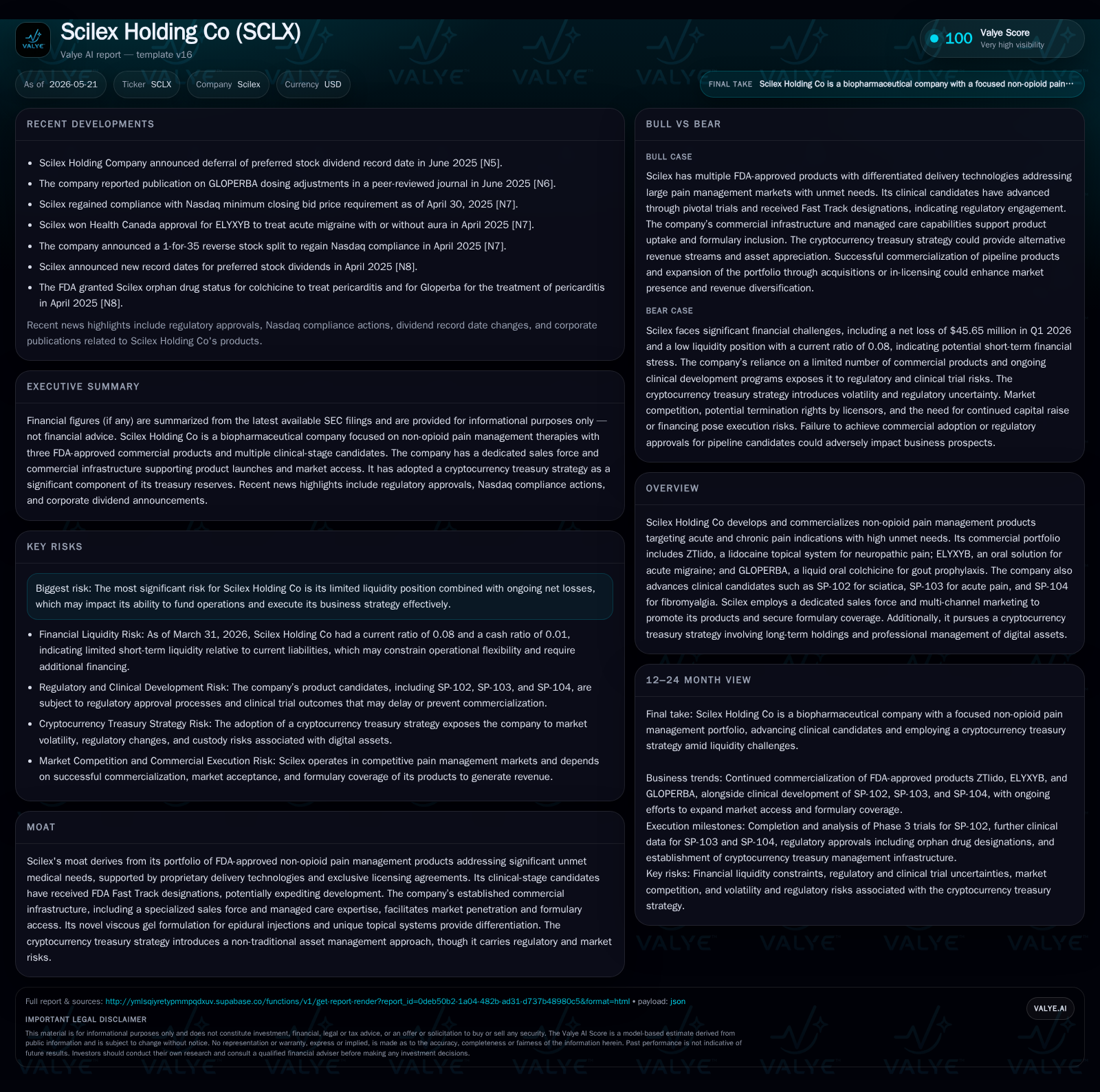
Scilex Holding Co reported continued development and commercialization of its non-opioid pain management products but faces substantial liquidity constraints as reflected in a current ratio of 0.08, raising concerns about its ability to sustain operations without additional funding. The company’s portfolio includes FDA-approved products targeting neuropathic pain, migraine, and gout, supported by a sales force focused on managed care formulary access. Its cryptocurrency treasury strategy introduces an unconventional element to its balance sheet but also regulatory risk. Core growth depends on advancing late-stage clinical candidates while managing reimbursement and pricing pressures in a competitive specialty pharmaceutical market.
Recent Operating Update
Scilex Holding Co's latest quarterly filing dated May 20, 2026 ([S2]) presents a critical view of the company's near-term financial operating landscape. The filing reveals a pressing liquidity issue signaled by cash and equivalents of approximately $3.35 million against current liabilities exceeding $501 million as of March 31, 2026 ([F1]), resulting in a distressed current ratio of roughly 0.08. This imbalance underscores a severe short-term financial constraint that could impede ongoing operations and strategic initiatives if not remedied swiftly.
Operationally, the company continues to commercialize its non-opioid pain management suite including FDA-approved products such as ZTlido (a lidocaine topical patch targeting neuropathic postherpetic neuralgia pain), ELYXYB (an oral solution for acute migraine attacks), and the recently launched GLOPERBA (a liquid formulation of colchicine for gout flare prophylaxis) ([S1]). This portfolio targets acute and chronic pain segments with significant unmet needs where opioid alternatives are increasingly demanded.
The company also highlights clinical-stage development progress on promising candidates like SP-102—a viscous dexamethasone gel formulated for epidural injection in sciatica—and SP-104 aimed at fibromyalgia treatment ([S1]). Both candidates benefit from FDA Fast Track designations, potentially accelerating market entry if efficacy signals mature favorably.
Another unusual dimension noted is Scilex’s cryptocurrency treasury policy which allocates part of its reserves into Bitcoin, Ethereum, BNB, and Dogecoin as long-term treasury assets ([S1]). While this innovative approach may provide upside via asset appreciation, it introduces distinct volatility risks compounded by tightening U.S. regulatory scrutiny highlighted by recent governmental frameworks regulating digital assets ([S14],[S15]).
Business Model
Scilex generates revenue primarily through the sale of prescription pharmaceutical products designed to manage pain without opioids. The model relies on prescription volume driven by specialist physicians treating neuropathic pain conditions, migraines, and gout patients seeking safer alternatives. Revenue streams depend heavily on insurance reimbursements governed by managed care formularies; thus engagement with payors to obtain favorable coverage/reimbursement terms forms an integral element of the sales cycle ([S1],[S6]).
Price realization is influenced by federal programs (Medicare/Medicaid) alongside private insurers who typically align coverage policies. However, variability remains across plans especially given ongoing drug pricing reforms which may cap prices or introduce rebate demands related to inflation adjustments ([S19]).
Margins are subject to pressure from cost-intensive R&D investments supporting the advancement of pipeline candidates like SP-102 and SP-104. Additionally, marketing expenses are elevated due to the need for specialized sales forces targeting physician prescribers within niche therapeutic segments requiring education on non-opioid alternatives ([S1]).
The cryptocurrency treasury strategy represents an ancillary component whereby market appreciation of digital assets could supplement liquidity but is not core profit driver from product sales. Regulatory changes posing classification or reporting requirements could adversely affect this non-traditional asset base ([S14],[S15]).
Industry Structure and Competitive Position
Scilex operates within the specialty pharmaceutical segment focusing on non-opioid pain therapies—a subspace growing due to heightened regulatory scrutiny on opioids and escalating demand for safer analgesics. Competitors range from large pharma firms investing heavily in non-opioid analgesics to smaller biotech innovators developing novel delivery mechanisms or molecules addressing similar indications.
Its competitive advantages lie in:
- A portfolio of FDA-approved products featuring unique delivery systems (e.g., lidocaine topical patches) that address specific patient populations underserved by current treatments.
- Clinical pipeline candidates benefiting from Fast Track status enhancing investor confidence in accelerated development timelines.
- An established sales force tailored to navigating complex managed care dynamics critical for securing formulary placements.
Yet Scilex is challenged by entrenched prescribing habits favoring opioids for acute/chronic pain despite known risks, along with competition from other branded or generic non-opioid meds offering overlapping efficacy profiles. Market penetration hinges on physicians’ willingness to switch prescribing practices backed by compelling efficacy-safety data often demonstrated only over time.
Additionally, reimbursement pressures create hurdles as payors increasingly scrutinize drug value propositions amidst wider cost containment programs—this industry-wide trend could constrain pricing power absent clear differentiation ([S19],[S16]).
Growth Drivers
Growth prospects rest upon several reachable milestones:
- Commercial Adoption Expansion: Uptake acceleration of ZTlido, ELYXYB, and GLOPERBA aided by expanding prescriber awareness campaigns and managed care formulary inclusions.
- Pipeline Progression: Advancement through pivotal Phase 3 studies for SP-102 specifically targeting lumbosacral radicular pain could unlock significant market opportunities given limited effective treatments.
- Market Diversification: Potential extension into related chronic pain indications via SP-104 or SP-103 may broaden addressable market size beyond initial niches.
- Pricing Environment Adaptation: Navigating evolving pricing regulations with real-world evidence generation substantiating cost-effectiveness may defend reimbursement status particularly in Medicare/Medicaid channels.
- Capital Management: Successful treasury management including cryptocurrency holdings might provide supplemental liquidity or yield enhancements aiding funding runway amidst operating losses.
Emphasis on clinician education regarding product safety profiles relative to opioid therapies coupled with patient-centric outcomes data can further stimulate demand sustainably.
Risks / Watchpoints / Growth Constraints
Key vulnerabilities include:
- Liquidity Shortfall: The stark imbalance between current assets ($41.97 million) versus liabilities ($501.75 million) places Scilex under acute financial pressure potentially threatening operational continuity unless mitigated via capital raises or cost rationalizations [F1][S2].
- Net Losses: Persistent operating deficits highlight underlying challenges achieving profitable scalability given R&D expenditures and commercial overheads [F1].
- Regulatory & Pricing Risks: Legislative trends including Medicare price negotiation mandates and inflation-linked rebates introduce margin compression risks [S19].
- Cryptocurrency Volatility & Regulation: The treasury's crypto exposure subjects the balance sheet to valuation swings plus uncertain regulatory frameworks that could impose compliance burdens or limit strategy execution [S14].
- Market Competition & Adoption Dynamics: Changing prescribing practices face inertia; competitive therapeutics from larger entities may erode market share or pressure pricing.
- Legal Exposure: Enforcement risks under healthcare fraud statutes related to marketing or reimbursement practices could impose penalties detrimental to finances [S6],[S11].
Continuous monitoring of cash burn rates alongside clinical milestones will be critical indicators informing ongoing viability.
What to Watch Next
Important upcoming markers include:
- Quarterly cash flow disclosures to assess liquidity trajectory and capital raise plans—any signs of improved working capital would alleviate immediate solvency concerns ([S2],[F1]).
- Clinical trial announcements affirming efficacy/safety endpoints especially for SP-102 Phase 3 results potentially catalyzing licensing deals or additional investment ([S1]).
- Expanded formulary access reports reflecting managed care acceptance needed to boost product volume.
- Regulatory developments impacting drug pricing reforms or cryptocurrency regulations that might materially alter cost structure or asset values respectively ([S15],[S14]).
- Dividend declarations or stock issuance updates reflecting corporate finance activities addressing capital needs ([S3],[S13]).
Execution reliability across these dimensions will be decisive for Scilex’s capacity to transition from a developmental specialty pharma firm into a sustained commercial entity.
Financial Profile Summary
While Scilex remains debt-free as per data available up to end 2022 ([F1]), its balance sheet shows substantial mismatch between liquid assets ($3.35 million cash plus $41.97 million current assets) versus current liabilities totaling $501.75 million as of March 31, 2026 ([F1]). This produces an alarmingly low current ratio near 0.08 indicating severe short-term solvency challenges requiring urgent financing solutions.[F1]
The latest full-year revenue figure reported was approximately $30.25 million in 2025 alongside net losses exceeding $374 million indicating negative operating leverage reflective of high R&D spending coupled with nascent commercial scale [F1]
Operating income remains deeply negative consistent with an emerging growth stage profile focused on product launches and late-stage development rather than profitability [F1]
In sum, the financials reinforce operational risks tied closely to strategic execution success balanced against urgent liquidity imperatives [F1]
This analysis is based solely on public disclosures including SEC filings up to May 20, 2026 and does not constitute investment advice or research views.
Disclaimer: This is research-only, informational analysis and not investment advice. It may include AI-generated interpretation and general industry context. Always verify important details using primary sources.

Comments