
Origin Agritech Ltd: Navigating Hybrid Seed Innovation Amid Financial and Regulatory Challenges
Origin Agritech operates hybrid crop seed development and production in China under complex VIE structures, facing liquidity and control risks.
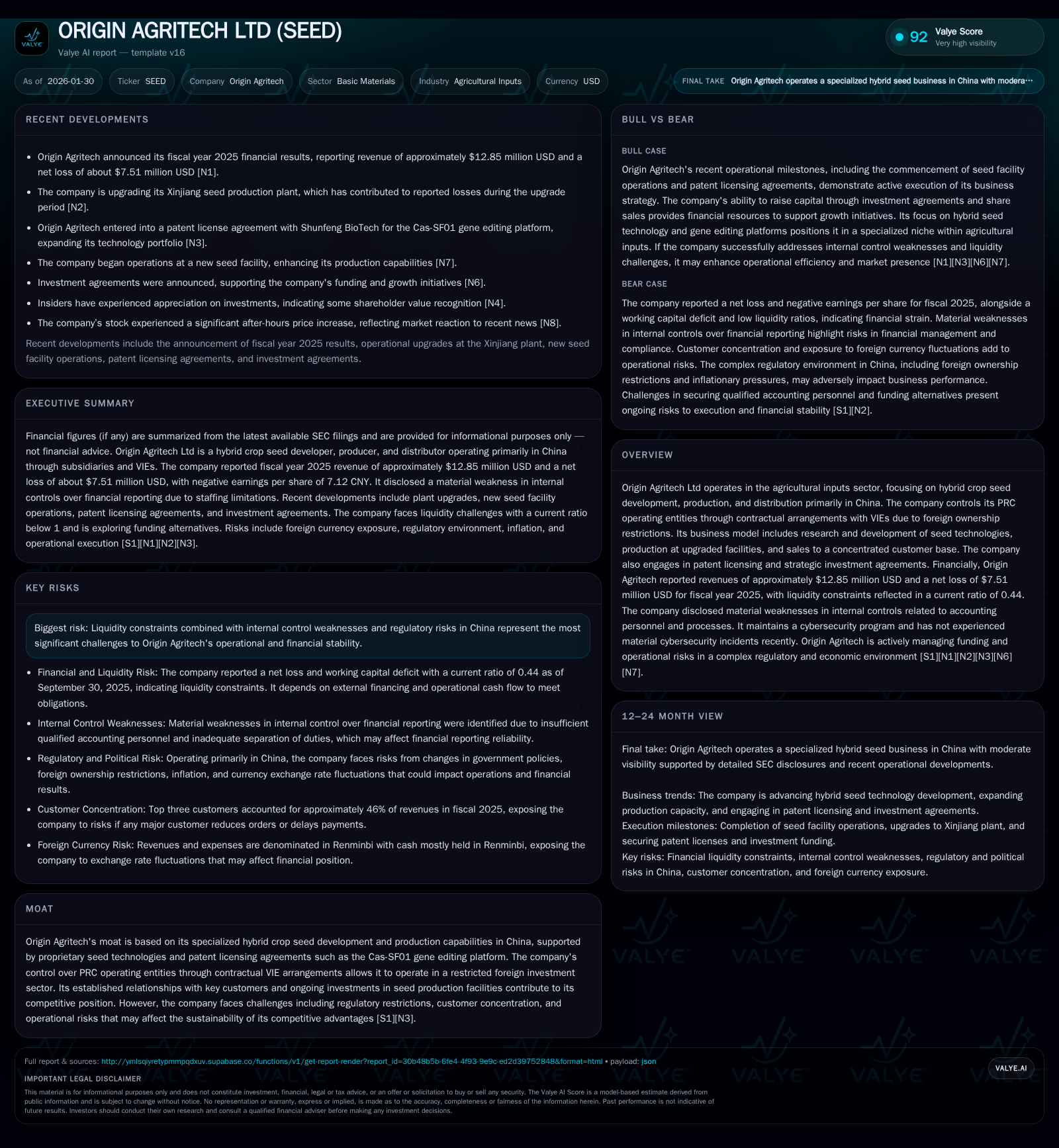
Origin Agritech Ltd specializes in hybrid crop seed development, production, and distribution in China through variable interest entities (VIEs), navigating foreign ownership restrictions. The company recently reported a $7.5 million net loss on $12.85 million revenue for fiscal 2025 amid upgrading its Xinjiang seed facility and entering a patent licensing agreement for gene editing technology. Despite proprietary technologies and strategic partnerships, Origin Agritech faces liquidity constraints, internal control weaknesses, and regulatory uncertainties that cloud its operational and financial outlook.
What Changed Recently
Origin Agritech announced its fiscal year 2025 results showing revenues of approximately $12.85 million USD alongside a net loss of $7.51 million USD [N1][N2]. The company highlighted the startup of its upgraded seed production facility in Xinjiang, a strategic move to increase in-house production capacity and improve operational scale [N3][N6]. Concurrently, Origin Agritech entered a patent license agreement with Shunfeng BioTech for the Cas-SF01 gene editing platform, signaling a strategic investment in advanced gene-editing technologies that could differentiate its hybrid seed offerings [N4]. These developments contributed to a notable stock price surge after hours, reflecting market enthusiasm about the company's innovation pipeline despite financial headwinds [N8].
However, the report also disclosed ongoing liquidity constraints, with a current ratio of 0.44 and working capital deficits underscoring tight short-term financial flexibility [N1][S9]. The company faces material weaknesses in internal controls, primarily related to accounting personnel and processes, which may impair accurate financial oversight [N1].
Business Model as a System
Origin Agritech operates primarily in the hybrid crop seed development, production, and distribution sector in China, where foreign ownership restrictions limit direct equity stakes to 49% [S1][S4]. To operate legally and maintain control, the company employs a Variable Interest Entity (VIE) structure. This involves contractual arrangements with Chinese shareholders who nominally own the PRC operating entities, while Origin Agritech's wholly-owned subsidiaries hold contractual rights to control the VIEs’ economic benefits and losses [S4].
The company’s operating subsidiaries and VIEs include Xinjiang Originbo Seed Company Limited (70.52% ownership through contracts), Xuzhou Origin Agriculture Limited, Anhui Origin Agriculture Limited, and others, principally engaged in seed development and distribution [S1][S3]. These are supported by upstream investment holding companies like Origin Biotechnology and State Harvest Holdings, which consolidate the financial results under U.S. GAAP.
Revenue is generated from the sale of hybrid seeds to a customer base that is somewhat concentrated and includes related parties and companies controlled by directors and shareholders, reflecting intertwined commercial relationships [S5][S10]. Control over pricing and inventory risk positions Origin Agritech as the principal in its sales contracts [S7].
The company invests heavily in R&D for proprietary seed technologies, including gene editing, and maintains patent licenses (e.g., with Shunfeng BioTech) that provide competitive differentiation [N4][S6]. Revenue streams also include licensing agreements and strategic investments, intended to leverage its intellectual property portfolio.
Financially, Origin Agritech has sustained operating losses due to high operating expenses—particularly in research, administrative overhead, and impairment charges—exceeding gross profits derived from seed sales [S8]. Capital expenditures focus on upgrading seed production facilities, reflecting a strategy to internalize production and improve margins over time [N3][S13].
Industry Map & Competitive Battlefield
The hybrid seed industry in China is characterized by stringent foreign investment rules, requiring local partnerships or VIE structures for foreign entities. The market is dominated by a few large domestic players and state-backed entities that benefit from policy support, extensive distribution networks, and established farmer relationships.
Origin Agritech competes by focusing on specialized hybrid seed technologies, incorporating gene editing platforms like Cas-SF01 to enhance crop traits. This technological edge is crucial in a sector where yield improvement, pest resistance, and adaptability to regional climates dictate farmer adoption.
However, the company must contend with regulatory uncertainties inherent in the VIE structure, which remains vulnerable to enforcement risk and government policy changes [S15]. Additionally, customer concentration, with related parties constituting a meaningful portion of sales, may limit bargaining power and expose the company to operational risk.
Strategic partnerships and patent licensing agreements aim to mitigate these competitive pressures by expanding technological capabilities and market access [N4][N7]. The industry’s capital intensity and the long breeding cycles also mean that competitors with deeper pockets and scale advantages may out-invest Origin Agritech in R&D and production capacity.
Where the Economics Become Real
At the unit economics level, Origin Agritech recognizes revenues on a gross basis and bears inventory risk, indicating direct responsibility for seed quality and delivery [S7]. Gross margins have compressed in fiscal 2025, with revenues of $12.85 million and gross profit of about $0.9 million, reflecting cost pressures from production upgrades and R&D [S8].
Operating expenses remain high, with general and administrative costs and R&D expenses constituting the bulk of operating outflows, which undermines near-term profitability [S8]. Impairment charges against intangible assets and fixed assets further weigh on earnings.
Liquidity constraints are a key bottleneck. The company’s current assets of roughly $9.3 million USD fall well short of current liabilities at $21 million USD, yielding a low current ratio of 0.44, signaling potential short-term solvency issues [S9]. Cash and equivalents stand at $2.2 million USD, insufficient to cover operating cash burn, which was negative $22.9 million RMB (approx. $3.2 million USD) in fiscal 2025 [S9][S12].
The company relies on external financing, government subsidies, and strategic investments to fund operations and capital expenditures. Government grants recognized as other income have increased, providing some buffer [S7]. Capital expenditures have focused on expanding and modernizing seed production facilities, including the new Xinjiang plant [N3][N6][S13].
Intercompany transactions and related party dealings are material, with sales and purchases from entities controlled by directors and shareholders, forming an integrated but potentially opaque commercial system [S5][S10]. The company's ability to monetize intellectual property through licensing agreements is a critical lever for future margin improvement.
Diligence Questions / Disconfirming Signals
- What is the enforceability and stability of the VIE contractual arrangements amid evolving PRC regulatory scrutiny, and how might this affect control and financial consolidation?
- How sustainable is the company’s liquidity position given the low current ratio and persistent operating losses? Are there committed external financing sources?
- What are the specific internal control weaknesses identified, and what remediation plans are in place to ensure reliable financial reporting?
- How dependent is Origin Agritech on related party transactions, and what risks do these pose to operating cash flows and earnings quality?
- Can the newly commissioned Xinjiang facility improve gross margins materially, or will it increase operational complexity and costs in the short term?
- What is the commercial potential and exclusivity scope of the Cas-SF01 gene editing platform license? How does it compare technologically to competitors’ offerings?
- How diversified is the customer base, and what is the risk of revenue concentration impacting cash collections and repeat orders?
- Given the accumulated deficit exceeding $89 million USD, what concrete plans exist to return to profitability or attract significant new capital?
- Are there geopolitical or trade risks affecting Origin Agritech’s access to foreign capital markets and technology partners?
Origin Agritech presents as a company embedded in China’s complex hybrid seed industry landscape, balancing promising technological advances against considerable financial and regulatory headwinds. Its evolution will depend heavily on operational execution, capital management, and navigating the opaque but pivotal VIE structure.
This analysis is based on publicly available information as of January 30, 2026, including company announcements, news reports, and regulatory filings. It does not constitute investment advice or a recommendation to buy or sell securities.
Disclaimer: This is research-only, informational analysis and not investment advice. It may include AI-generated interpretation and general industry context. Always verify important details using primary sources.

Comments