
Seer, Inc.’s Path through Early Commercialization: Technology Potential Meets Financial Headwinds
Seer advances proteomics research with its Proteograph platform while managing losses and regulatory uncertainties.
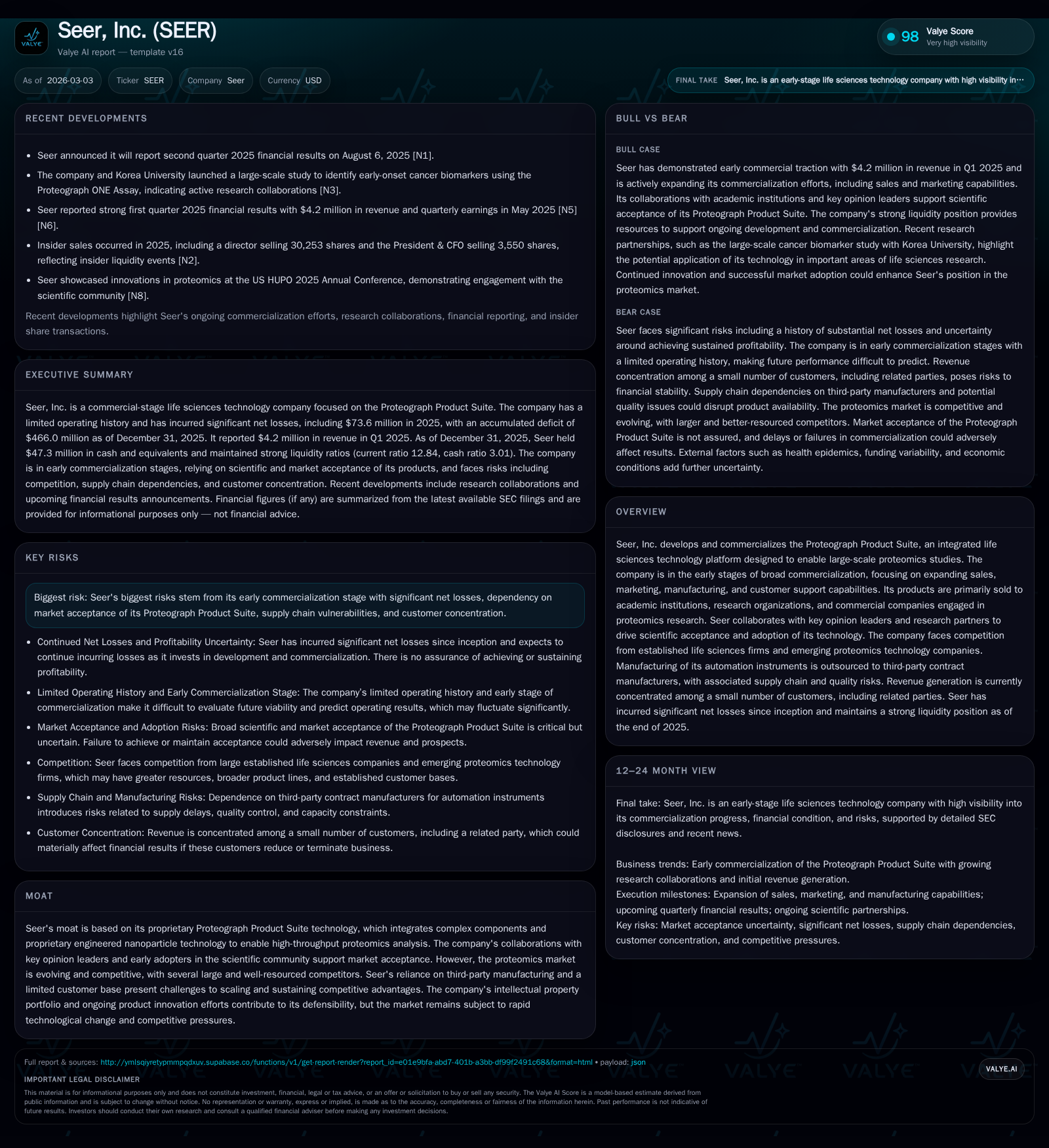
Seer, Inc. is pioneering large-scale proteomics studies with its proprietary Proteograph Product Suite but remains in early commercialization marked by persistent net losses and an evolving regulatory landscape. The company's financials reveal steady operating losses coupled with improving operating income trends and decreasing capital expenditures, underscoring the balance between investment and cash flow management. Looking ahead, Seer's growth hinges on expanding market adoption in academia and commercial sectors amid competitive pressures and regulatory risks tied to FDA oversight of research use only (RUO) products.
Historical Financial Performance and Commercial Growth Trajectory
Since its inception, Seer has operated as a commercial-stage life sciences technology company focused on the development and marketing of its Proteograph Product Suite. Over the four-year period from fiscal year (FY) 2022 through FY2025, the company has consistently reported net losses, reflecting substantial investments in R&D, sales infrastructure expansion, and commercialization efforts [F1][S1]. Despite ongoing deficits, there is a notable improvement trend: operating income loss narrowed by approximately 22.1% in FY2025 compared to FY2024.
Operating cash flow also shows a marginal improvement with a 3.6% reduction in negative cash flow year-over-year for the same period. Of particular interest is a nearly 50% reduction in capital expenditures by FY2025, pointing toward a more conservative investment approach or completion of heavy front-loaded asset purchases [F1].
The company's equity declined from $447 million in FY2022 to $259 million by FY2025 due to accumulated deficits. The resultant approximate return on equity (ROE) stands at around -28.4%, reflective of Seer's current unprofitable status but typical of early-stage life sciences firms investing heavily in product commercialization.
Historical performance (annual)
| FY | Net ($mm) | CFO ($mm) | OpInc ($mm) | Capex ($mm) | Net YoY |
|---|---|---|---|---|---|
| 2025 | -74 | -44 | -78 | 2 | +15.0% |
| 2024 | -87 | -46 | -100 | 4 | -0.4% |
| 2023 | -86 | -59 | -103 | 7 | +7.2% |
| 2022 | -93 | -61 | -97 | 10 |
Source: SEC companyfacts cache [F1].
Capital returns and efficiency (annual)
| FY | Buybacks ($) | FCF ($mm) | ROE% |
|---|---|---|---|
| 2025 | -46 | -28.4 | |
| 2024 | 0 | -50 | -26.4 |
| 2023 | 13000 | -66 | -21.7 |
| 2022 | 20000 | -71 | -20.8 |
Source: SEC companyfacts cache [F1].
The table summarizes key annual financial metrics illustrating persistent losses alongside signs of operational improvement and capital expenditure moderation.
Technology Overview and Unique Market Position in Proteomics
At the core of Seer's offering is its integrated Proteograph Product Suite—a pioneering life sciences platform that leverages proprietary engineered nanoparticles to enable multiplexed, high-throughput proteomic analyses across complex biological samples . This integration facilitates large-scale protein discovery and quantitation compatible with downstream mass spectrometry workflows.
Seer's approach represents a significant technological advancement by combining patented nanoparticle chemistries with automation instruments designed for scalable throughput—a key bottleneck historically limiting clinical-grade proteomics studies.
The uniqueness of Seer's moat stems from multiple facets: its robust intellectual property portfolio around engineered nanoparticles, collaborations with key opinion leaders (KOLs) in academia who serve as early adopters validating scientific merit, and the integrated platform design that synchronizes sample preparation throughput with analytical sensitivity requirements .
By addressing sampling depth limitations typical of traditional proteomics via nanoparticle-based enrichment workflows, Seer positions itself as an enabler of next-generation biomarker discovery studies aimed at both fundamental research and translational medicine fields.
Commercialization Progress and Market Adoption Challenges
Currently operating in the early stages of commercial adoption, Seer faces multiple hurdles common among nascent life sciences instrument companies [S1][S2]. Its customer base is heavily concentrated within academic institutions and research organizations—sectors characterized by long adoption cycles tethered closely to scientific validation rather than immediate commercial demand.
Sales growth depends on scaling marketing outreach while reinforcing scientific acceptance through collaborative research partnerships—a strategy intended to bolster credibility via independent publications demonstrating Proteograph's utility.
Operationally, Seer outsources manufacturing of automation instruments to third-party contract manufacturers which introduces supply chain dependencies and quality control risks that may impact delivery schedules or product performance consistency.
Moreover, customer concentration risk persists given early reliance on few institutional buyers; broadening to diversified commercial entities will be critical for sustainable revenue generation.
Such challenges translate into fluctuating quarterly results typical for companies transitioning from development-driven spending toward steady product revenue streams.
Regulatory Landscape Impacts on Product Deployment and Future Risk
Seer's Proteograph is currently marketed under RUO (Research Use Only) labeling as it is not intended for clinical diagnostics or therapeutic decision-making [S4][S5][S7][S8]. This regulatory positioning exempts it from FDA clearance or approval but carries inherent ambiguity:
- The FDA scrutinizes the totality of circumstances surrounding RUO device marketing; mere labeling is insufficient if promotional activities or technical support imply clinical diagnostic use.
- Legislative initiatives such as the VALID Act propose expanding FDA oversight over Laboratory Developed Tests (LDTs), impacting products used clinically even if marketed as RUO.
- Recent Supreme Court rulings curtail deference traditionally granted to FDA interpretations (Chevron doctrine), increasing regulatory uncertainty.
- Instances where customers independently deploy RUO instruments within clinical LDT frameworks could expose Seer to unexpected regulatory scrutiny requiring costly clearances or confining market opportunities.
- International regulators may interpret RUO uses differently compounding compliance complexity.
As Seer contemplates expanding product applications beyond research domains or adding new functionalities potentially qualifying as medical devices, it will need robust regulatory strategy execution to navigate variable requirements efficiently without disrupting commercialization momentum.
Capital Allocation Strategy and Shareholder Return Profile
Seer's capital allocation focus remains centered on funding vigorous R&D for platform enhancements alongside building out sales channels essential for scaling commercialization efforts [F1][S6]. Despite history of net losses exceeding $70 million annually recently, cash management appears disciplined:
- Operating cash flow deficits have shown modest improvement while capital expenditures were reduced nearly by half in recent years indicating a shift toward sustaining existing asset bases over heavy new investments.
- As of end-FY2025, Seer maintains a strong current ratio (~12.8), supported by $47 million in cash equivalents relative to low current liabilities ($15.7 million), providing a comfortable liquidity buffer for ongoing operations.
- The Board authorized a $25 million share repurchase program commencing May 2024; actual repurchases are minimal thus far reflecting prudent capital preservation during early commercialization phases.
- Dividends have not been paid historically nor are planned given reinvestment priorities amid continued unprofitability.
This fiscal discipline aligns with common patterns observed among emerging life sciences companies where shareholder returns are contingent largely upon long-term value creation driven by technological adoption rather than immediate income distribution.
Competitive Dynamics in High-Throughput Proteomics Platforms
Seer operates within an increasingly competitive proteomics technology sector where established instrument manufacturers coexist alongside specialized startups innovating nanoparticle chemistries and analytical workflows .
Competitive advantages pivot on:
- Depth of intellectual property protection covering engineered nanoparticle formulations tailored for multiplex protein capture,
- Integrated automation instruments harmonized with standard mass spectrometry pipelines enabling seamless higher throughput analyses,
- Strategic collaborations with KOLs underpinning scientific credibility,
- Agility in innovation cycles addressing emergent academic and commercial researcher needs rapidly.
Nonetheless, competition embodies risks from larger incumbents leveraging broader commercial relationships or alternative technologies potentially offering faster processing times or other value propositions.
Therefore, maintaining rapid feature evolution pace combined with effective customer engagement remains critical for defending market share amidst accelerating innovations within proteomics tools ecosystems.
Future Outlook: Innovation Trajectories and Commercial Milestones
Looking forward, Seer's growth trajectory hinges on several interconnected factors:
- Successfully scaling sales infrastructure beyond current academic concentrations into diversified commercial research markets,
- Continuing product development advances enhancing sensitivity, throughput capacity, user experience features,
- Managing supply chain resilience given third-party manufacturing reliance,
- Navigating evolving regulatory landscapes effectively including potential FDA reclassifications or global compliance expansions,
- Defending intellectual property positions amid post-grant reviews challenging patent validity claims,
- Monitoring legislative developments impacting LDT regulation dictating permissible application scopes,
- Sustained scientific endorsement from KOL partnerships fostering peer-reviewed publications securing broader market acceptance.
Achieving these milestones could progressively reduce cash burn rates while catalyzing revenue growth trends necessary for eventual profitability transition.
Absent explicit investor guidance statements within reports reviewed [N#]/[S#], close attention should be paid to quarterly performance metrics evidencing demand traction and operational scalability signaling inflection points toward commercial viability.
Investment Risks and Opportunities: Balancing Potential Against Operational Realities
Operating as an early-stage profiler within a disruptive segment of the life sciences industry inevitably entails material risks:
- Persistent net losses underscore uncertain timelines on achievement of self-sustaining profitability;
- Customer concentration creates vulnerability regarding order variability impacting revenue predictability;
- Dependence on outsourced manufacturing amplifies exposure to supply chain interruptions or quality issues;
- Regulatory uncertainty surrounding RUO usage labels necessitates careful monitoring lest unforeseen compliance costs emerge;
- Patent disputes could weaken defensibility diminishing competitive moats uniquely held currently;
- Geopolitical factors including international trade restrictions or import/export laws amplify operational complexities especially given global customer footprint deployments;
- Data privacy regulations increasing scrutiny over handling proprietary scientific data require ongoing investment preventing reputational damage or fines;
- Conversely, if Seer successfully converts scientific validation into widespread adoption leveraging its advanced nanoparticle-enabled high-throughput workflows it holds potential for significant impact across biomedical research sectors fundamentally advancing proteomic capabilities at scale.
Balancing these vectors will shape Seer's ability to translate technology breakthroughs into durable commercial success over forthcoming years.
This analysis synthesizes available SEC filings [F1], risk disclosures [S1–S29], company excerpts , without extrapolating unverified projections or issuing investment advice.
Disclaimer: This is research-only, informational analysis and not investment advice. It may include AI-generated interpretation and general industry context. Always verify important details using primary sources.

Comments