
abrdn Gold ETF Trust’s Surging Returns and Physical Bullion Strategy
SGOL’s physical gold holdings underpin its substantial financial gains, shaped by gold price dynamics and ETF structural features.
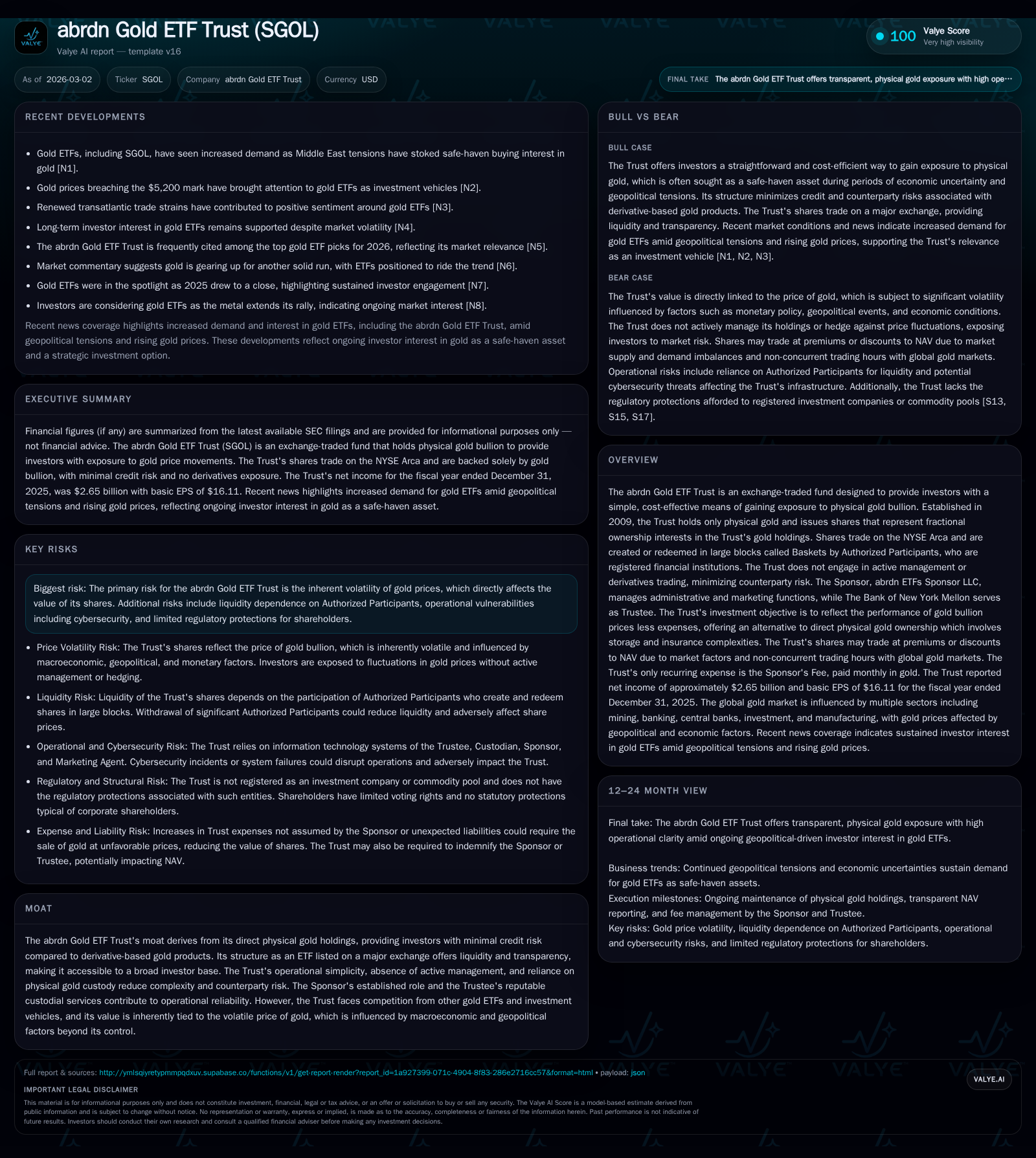
The abrdn Gold ETF Trust (SGOL) leverages direct physical bullion ownership to offer investors transparent, minimal-counterparty risk exposure to gold. From 2022 through 2025, the Trust exhibited a remarkable growth trajectory marked by a nearly tripling of net income and doubling of equity, driven primarily by gold price appreciation and increased investor inflows. While SGOL benefits from operational simplicity and the liquidity afforded by its NYSE Arca listing, key risks remain tied to gold price volatility and reliance on Authorized Participants for share liquidity. Emerging geopolitical tensions and inflation concerns provide potential catalysts for sustained interest in physical gold ETFs like SGOL.
Strong Growth Trajectory Supported by Physical Gold Holdings
Since its founding in 2009, the abrdn Gold ETF Trust (ticker: SGOL) has steadily augmented its scale as an effective vehicle for investors seeking direct exposure to physical gold bullion without the logistical burden of storage. Over the four-year window ending in fiscal year 2025, SGOL’s financials epitomize the benefit of owning literal bullion against the backdrop of rising gold prices and growing investor interest.
According to company filings [F1][S1], net income soared from a modest loss of approximately -$17 million in 2022 to a robust $2.65 billion in 2025—a staggering 273% year-over-year increase comparing 2024 to 2025. This surge mirrors both the appreciation in spot gold prices over this time and expansion of shares outstanding from roughly 150.7 million to 178.6 million shares.
Equity values nearly doubled (+95%), shifting from $3.76 billion at end-2024 to $7.33 billion by end-2025 [F1]. This reflects increased NAV per share coupled with issuance growth driven by new inflows.
Historical performance (annual)
| FY | Net ($bn) | Net YoY |
|---|---|---|
| 2025 | 2.7 | +273.4% |
| 2024 | 0.7 | +105.5% |
| 2023 | 0.3 | +2090.8% |
| 2022 | -0.0 |
Source: SEC companyfacts cache [F1].
Capital returns and efficiency (annual)
| FY | ROE% |
|---|---|
| 2025 | 36.2 |
| 2024 | 18.9 |
| 2023 | 12.2 |
| 2022 | -0.7 |
Source: SEC companyfacts cache [F1].
Notably, SGOL reports zero operating cash flow annually due to its passive trust structure focused solely on holding physical bullion [F1].
Gold Market Dynamics Driving Fund Performance
SGOL’s returns are closely linked to macroeconomic forces shaping global gold prices—a historically volatile but vital asset class often sought as a hedge during economic uncertainty. Recent geopolitical frictions—particularly intensified Middle Eastern conflicts and renewed transatlantic trade tensions—have spurred significant safe-haven demand for tangible gold assets [N1][N3].
Inflation expectations remain elevated globally amid tightened monetary policies post-pandemic recovery efforts [S11], underpinning demand as investors seek protection against real-value erosion. Central banks’ gross purchases or sales directly influence supply-demand balances upstream [S13]. Currency exchange rate volatility also affects dollar-denominated gold pricing dynamics.
This confluence led gold prices to breach critical milestones above $5,200 per troy ounce early in calendar year 2026 [N2], sustaining momentum into SGOL’s latest reporting period and driving NAV growth alongside share issuance.
Risks Rooted in Price Volatility and Structural Constraints
While direct physical backing mitigates significant counterparty risks common with derivative-laden competitors [S15], SGOL remains vulnerable primarily through volatility in underlying gold prices [S1][S3][S8]. Factors capable of precipitating sharp price declines include hedging actions by producers increasing forward selling pressure or speculative withdrawals due to shifts in investor sentiment.
Operationally, liquidity depends heavily on a subset of Authorized Participants—registered institutions capable of creating or redeeming Shares only in Baskets of 100,000 units [S6][S9]. Reliance on these participants introduces concentration risk; attrition or reduced participation could impair secondary market liquidity [S20]. Cybersecurity threats affecting trading platforms or custodial operations pose additional operational hazards.
Moreover, shareholders do not receive dividends nor have typical corporate voting rights except in limited circumstances such as Trust termination requiring approval by holders representing at least 75% of outstanding Shares [S4]. Distributions occur only upon termination if residual proceeds remain after liabilities settlement.
Capital Structure: Share Issuance and Authorized Participants Dynamics
Creation and redemption activities form the backbone of SGOL's liquidity mechanics: only Authorized Participants meeting stringent regulatory registration criteria may engage directly with the Trust exchanging physical bullion for share Baskets [S6][S7][S9]. The Basket size is fixed at 100,000 Shares since late 2019—enhancing transactional efficiency but raising entry thresholds.
Retail investors gain exposure indirectly through NYSE Arca trading where SGOL is listed [S15]. Individual shareholders cannot redeem shares piecemeal; they must transact through AP intermediaries who hold obligations under agreements with Sponsor and Trustee.
The Bank of New York Mellon serves as Trustee responsible for daily administration including custody oversight; significant account activities occur through unallocated accounts where pooled gold is managed though allocated accounts track specific bars meeting LBMA "Good Delivery" standards [S25][S28]. These processes underpin fiduciary responsibility while enabling seamless transfers during creation/redemption cycles.
Capital Allocation: Fee Structure and Shareholder Rights
SGOL's fee structure consists predominantly of an annual Sponsor Fee paid in-kind via physical gold deliveries—resulting in slight decrements to total bullion holdings reflected as NAV reductions rather than explicit cash expenses [S6][S22]. There are no cash dividends or share repurchases authorized; shareholder value accrues principally through appreciation in underlying gold prices net of fees.
Shareholders have limited rights compared with typical equity holders: voting is reserved for extraordinary matters such as Trust termination requiring majority approval by holders representing at least 75% outstanding Shares [S4]. No conversion rights or redemption outside AP mechanisms exist.
Tax-wise the Trust qualifies as a “grantor trust,” whereby income and expenses flow through shareholders who face taxable events especially upon receipt of fee-related distributions delivered physically rather than cash payments [S27][S28].
Outlook Amid Global Economic Uncertainty
Looking forward into calendar year 2026 and beyond—geopolitical tensions centered on Middle Eastern hostilities and ongoing transatlantic trade frictions amplify protective allocations into tangible precious metals including SGOL shares [N1][N3]. This environment favors funds grounded solely in physical bullion custody providing transparency plus minimal credit risk relative to swap-based alternatives.
Monitoring Authorized Participant activity remains critical as it influences spreads between market price and NAV plus potential liquidity fluctuations [S20]. Macroeconomic indicators such as inflation trends and central bank policy pivots stand as key determinants for sustained gold price strength underpinning future growth prospects for SGOL's assets under management.
Disclaimer
This report is based solely on publicly available data and filings without any recommendation to buy or sell securities. Investors should conduct independent due diligence considering their own financial situations before making investment decisions.
Disclaimer: This is research-only, informational analysis and not investment advice. It may include AI-generated interpretation and general industry context. Always verify important details using primary sources.

Comments