
SHF Holdings Faces Litigation Headwinds Amid Pressures on Cannabis Banking Revenues
SHF Holdings' latest quarter reveals escalating litigation risks alongside persistent revenue pressures tied to the cannabis financial services niche.
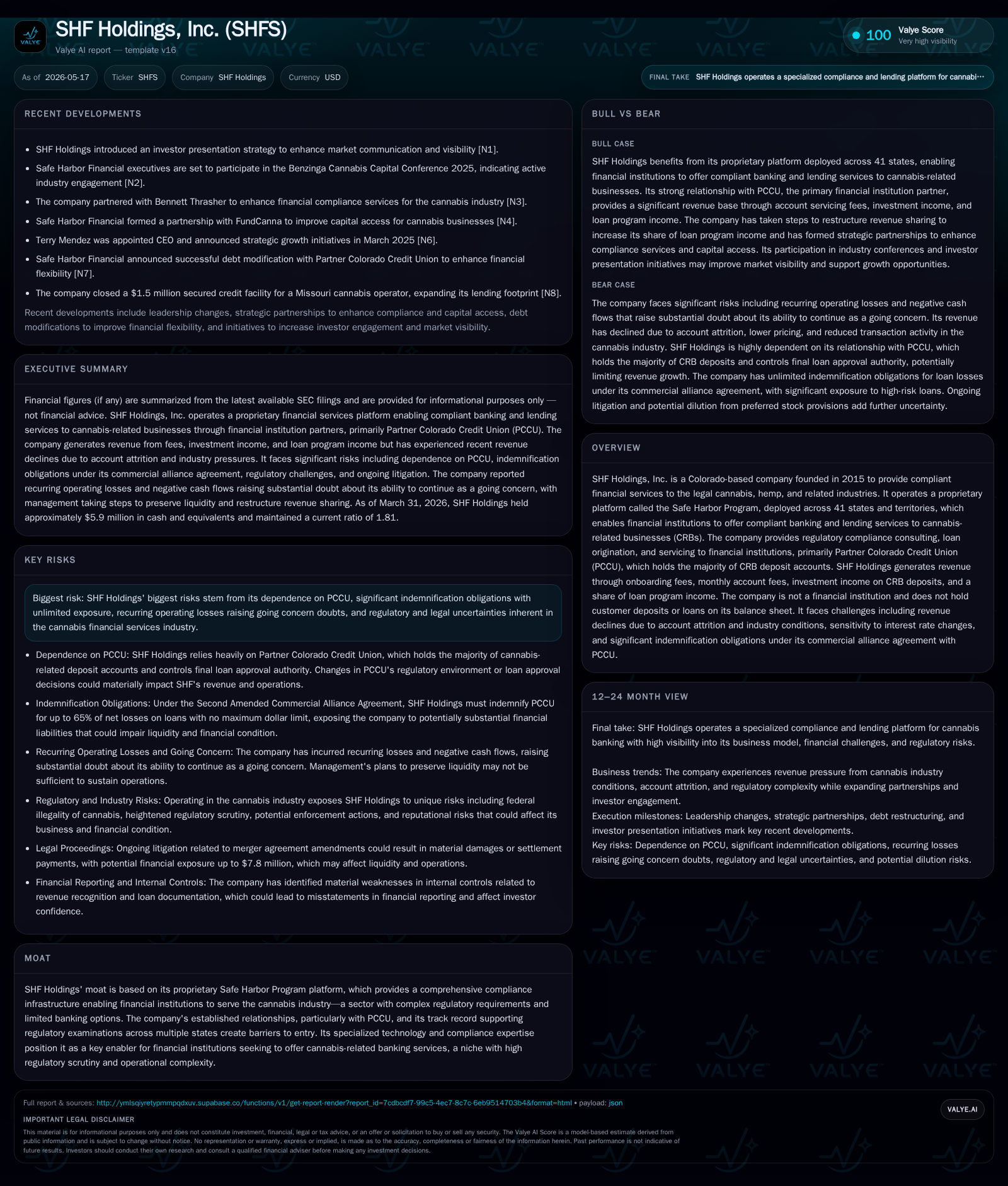
In its most recent 10-Q filed in May 2026, SHF Holdings detailed a summary judgment ruling unfavorable to the company related to longstanding shareholder litigation, with key trial dates set for August 2026. This legal backdrop coincides with ongoing revenue declines driven by account attrition, pricing pressure, and broader cannabis industry headwinds. The company's proprietary Safe Harbor compliance platform remains central but is challenged by dependence on its primary partner, PCCU, and evolving regulatory complexities. Liquidity constraints heighten risks amid indefinite indemnification obligations and persistent operating losses. Monitoring the litigation outcomes and deposit/account trends will be critical near-term.
Legal Developments Reshape SHF Holdings’ Near-Term Outlook
The company publicly confirms it plans vigorous defense efforts but acknowledges potential non-prevail outcomes could significantly impair its financial position, cash flows, Nasdaq listing compliance status, and ultimately business continuity [S2][S7]. The sizeable legal overhang introduces acute uncertainty around prospective damages or settlement costs which may adversely affect both operational flexibility and investor confidence.
Business Model Built Around Compliant Cannabis Financial Services
Founded in Colorado in 2015 by Partner Colorado Credit Union (PCCU), SHF Holdings provides specialized financial services tailored exclusively for cannabis-related businesses (CRBs) operating within complex state-legal environments while navigating conflicting federal statutes [S1]. Its proprietary Safe Harbor Program platform—deployed across 41 states and territories—acts as a regulatory compliance backbone enabling participating financial institutions (primarily PCCU) to offer a comprehensive suite of banking services that include business checking/savings accounts, commercial lending origination, ACH and wire payments processing, remote deposit capture, and courier logistics through third-party arrangements [S1].
The company itself is not a financial institution; it neither holds deposits nor loans on its balance sheet but instead positions itself as an indispensable intermediary by providing KYC/AML/BSA compliance consulting, technology tools, onboarding & program management services needed to satisfy high regulatory scrutiny [S1].
Revenue generation is multifaceted: onboarding fees charged when CRBs or ancillary service providers open accounts via partner FIs; recurring monthly fees tied to account size/type/transaction volume; investment income derived from deposit balances maintained at PCCU; and a percentage share of loan program income from cannabis-focused lending operations [S1]. This layered fee structure hinges heavily on volume of active CRB clients on the network alongside transactional activity levels.
Industry Framework: Niche Regulatory Complexity and Competitive Moat
SHF operates within a niche at the confluence of evolving cannabis legality landscapes and stringent financial regulatory frameworks — namely Anti-Money Laundering (AML), Bank Secrecy Act (BSA), Know Your Customer (KYC) mandates plus ongoing Federal Reserve policy considerations [S1]. The absence of traditional banking access for most CRBs due to federal prohibition fosters strong demand for platforms like SHF's Safe Harbor Program that systematically reduce compliance risk exposure for financial institutions.
The competitive moat arises from proprietary technology combining compliance analytics with operational expertise plus an entrenched exclusive partnership with PCCU—the primary credit union holding the majority of CRB accounts serviced through the platform [S1]. Given high switching costs associated with regulatory certification burdens and audit examination histories cultivated jointly by SHF and PCCU across multiple states, disruptive entrants face steep barriers.
However, this relationship also concentrates counterparty risk; any deterioration in PCCU partnership or adverse regulatory actions affecting partner institutions could rapidly destabilize SHF’s core value proposition.
Key Growth Drivers and Strategic Market Penetration Opportunities
According to recent disclosures and press releases [S4][N1], emerging opportunities exist as more U.S. states progressively regulate cannabis markets expanding the addressable client base. Nationally reported deposit balances have risen approximately 29% year-over-year through early 2026 in emerging markets segments [S4], contributing modestly (+4.5%) to overall average deposit growth despite challenging macroeconomic conditions.
Growth prospects hinge substantially on broadening geographic footprint aligned with new legalization initiatives coupled with deepening wallet share penetration within existing partner FIs. Product innovation initiatives—including recently introduced money market accounts that share earned interest with depositors—aim to enhance competitiveness but simultaneously reduce average revenue per account due to shared yields impacting investment income margins [S1].
Additional vectors include expanding cannabis lending solutions tailored for operator growth needs launched in April 2026 alongside increased regulatory clarity potentially easing compliance costs over time [S26]. However, macroeconomic strain on cannabis sector liquidity dampens transaction volume growth limiting upside near term.
Risks and Constraints: Litigation, Revenue Pressures, and Indemnification Exposure
The protracted shareholder litigation challenging the validity of critical acquisition amendments and associated payment obligations constitutes a paramount risk factor [S2][S20]. Failure to maintain liquidity certifications risks defaulting covenants jeopardizing operations.
Operationally, consistent declines in revenue arise from CRB account attrition driven by reduced wholesale pricing pressures within the cannabis sector coupled with decreased transaction frequency; compounded by pricing compression stemming from competitive demands including shared-interest accounts launched recently [S1]. These factors contribute ongoing operating losses intensifying going-concern doubts [S13][F1]. The customer concentration risk implicit in reliance on PCCU amplifies vulnerability if institutional partner dynamics shift.
Other pertinent risks include potential cybersecurity breaches impacting proprietary compliance platforms handling sensitive financial data [S20], fluctuating Federal Reserve interest rates influencing investment income streams unpredictably [S1], plus overarching regulatory flux across cannabis banking domains challenging operational adaptability.
Milestones and Indicators to Monitor for Execution and Financial Stability
Crucial forthcoming events center on August 10-11th trial dates where additional counterclaims will be adjudicated potentially influencing material payout requirements or contract enforceability clarifications [S2][S7]. Quarterly filings revealing updates on liquidity certification adherence alongside changes in active CRB account counts will serve as barometers for business health.
Tracking deposit volume trends—especially within expanding state markets—and average account balances will illuminate revenue trajectory prospects given direct linkage between assets under management-like metrics and recurring fee/income generation [S4]. Interest rate environment developments should be monitored closely given sensitivity of investment returns earned on CRB deposits at PCCU.
Additional strategic execution markers include uptake rates of newly introduced financing products aimed at growth-stage cannabis operators announced April 2026 [S26], plus progress toward diversifying institutional partnerships beyond PCCU if disclosed.
Latest Financial Snapshot: Liquidity, Leverage, and Profitability
Financially, SHF exhibits moderate short-term liquidity resilience with a current ratio near 1.81 supported by just under $5.9 million cash reserves against current liabilities approximately $6.85 million at quarter end March 31st [F1]. However, significant total debt approximating $10.75 million implies material net debt (~$4.85 million), exerting leverage pressures reflective of ongoing structural cash burn from operating losses exceeding $5 million annually (calendar year-end 2025) [F1][S13].
These indicators reinforce constraints affecting SHF’s ability to absorb unexpected legal or indemnification settlements without external capital or operational cutbacks. Persistent negative profitability underscores imperative for either scale-driven margin improvement or corrective strategic pivots.
Disclaimer: This analysis is based solely on information available as of May 17th, 2026 from public SEC filings and verified news sources without offering investment advice or recommendations concerning SHF Holdings’ securities. It aims to provide an informed perspective on business model dynamics, competitive positioning, litigation developments, risks profiles, growth drivers and directional financial context subject to change with future disclosures.
Disclaimer: This is research-only, informational analysis and not investment advice. It may include AI-generated interpretation and general industry context. Always verify important details using primary sources.

Comments