
Signet Jewelers Advances Brand-Centric Growth Amid Store Optimization and Strong Liquidity
Q1 Fiscal 2027 results highlight strategic progress in brand differentiation and operational efficiency within a cautious consumer environment.
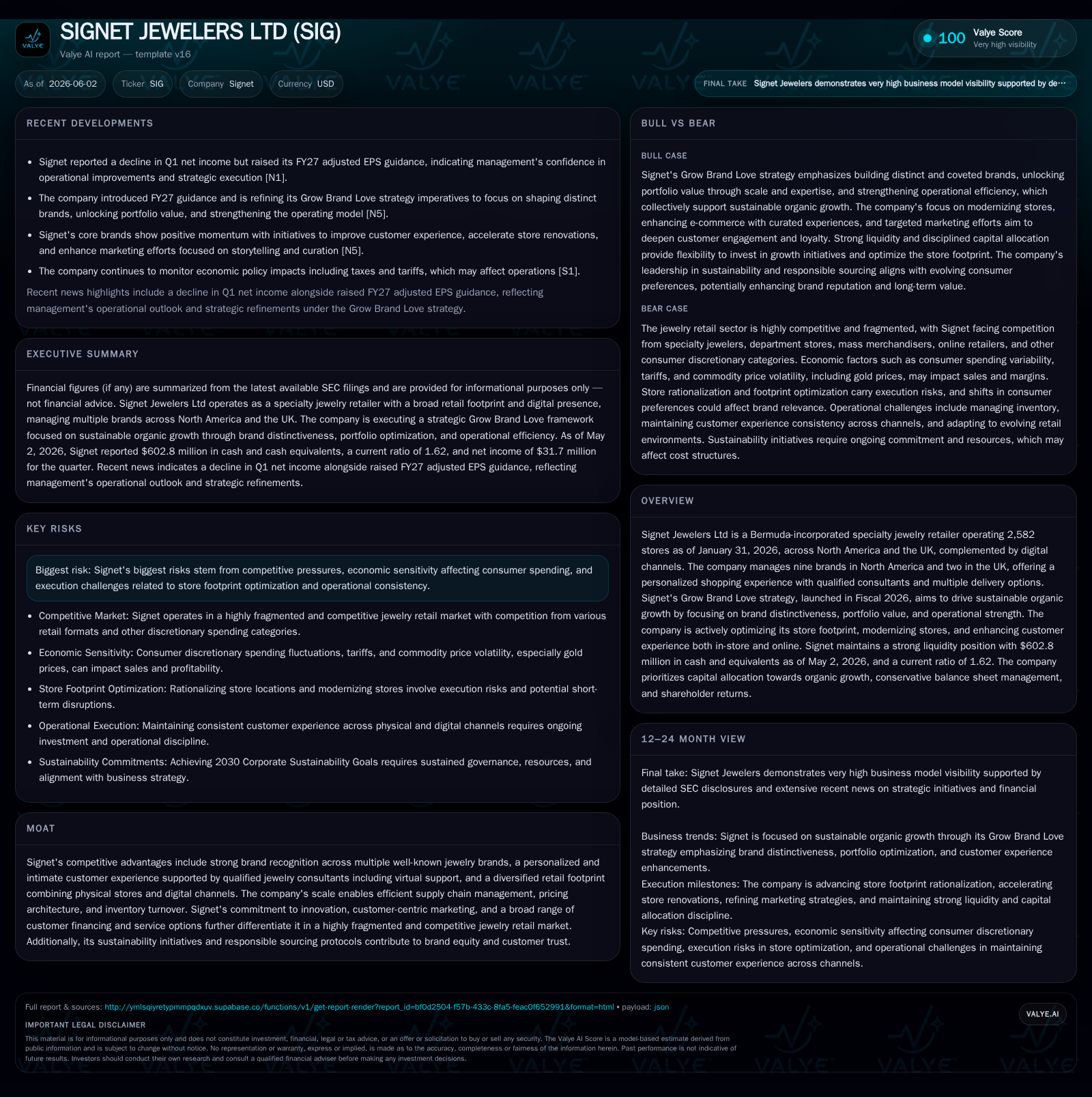
Signet Jewelers Ltd reported solid first-quarter fiscal 2027 results characterized by improved net income driven by pricing power and product mix, despite modest same-store sales softness. The company’s Grow Brand Love strategy is reshaping its retail footprint, focusing on distinct brand experiences, portfolio value extraction, and operational discipline. With a robust liquidity position, no outstanding debt, and ongoing capital allocation toward modernization and digital enhancement, Signet aims to sustain organic growth amid a competitive and economically sensitive specialty jewelry landscape.
Recent Operating Update
Signet Jewelers’ 10-Q filing dated June 2, 2026 ([S2]) reveals that despite a marginal decline in same-store sales by 0.7% in North America during Q1 Fiscal 2027 (ending May 2, 2026), the company delivered a significant net income increase to $294 million compared to $61 million year-over-year. This profit acceleration stems largely from higher average unit retail (AUR) pricing—rising by +5.6% in North America—and an optimized product mix featuring a greater focus on lab-grown diamonds and fashion pieces. Service sales also showed mid-single-digit percentage gains, driven by growth in extended service plans.
The company ended the quarter with $602.8 million in cash and equivalents and no outstanding debt ([F1]), reflecting its conservative balance sheet posture during volatile commodity costs and economic uncertainty.
Business Model Analysis
Signet operates as a specialty jewelry retailer managing over 2,500 stores across North America and the UK alongside digital channels ([S1]). Its revenue predominantly derives from the sale of merchandise—including diamonds, precious metals, LGDs, watches—and related services such as repairs and extended warranties ([S14]). Customers engage via omnichannel experiences combining physical showroom visits supported by expert consultants with e-commerce platforms optimized for discovery and conversion.
Central to Signet’s model is the "Grow Brand Love" initiative introduced in Fiscal 2026 ([S1]), which transforms the company’s approach from banner-based operations toward cultivating discrete brand identities that resonate emotionally with target demographics. This involves meticulous assortment curation emphasizing innovative styling and LGD prominence alongside classic natural diamond offerings to appeal both on style and value criteria.
Pricing power is enhanced through Signet’s differentiated SKU mix supported by efficient sourcing practices aimed at mitigating raw material cost volatility including tariffs on precious metals. Inventory turnover improvements and scrap recycling further bolster gross margins, enabling Signet to sustain near-40% gross margin even during inflationary pressures ([S7], [S14]).
Furthermore, Signet leverages its scale to maintain competitive pricing structures while offering flexible customer financing options outsourced to third parties for risk mitigation and rapid cash flow realization ([S21]). Personalized customer service enabled by knowledgeable consultants—available in-store or virtually—creates high switching costs benefiting retention rates.
Industry Structure & Competitive Position
The specialty jewelry sector remains highly fragmented with numerous regional players alongside pure-play DTC brands increasingly pressuring margins through aggressive discounting. Signet’s scale—encompassing nine North American brands such as Kay Jewelers, Jared, Zales—and two UK brands confers advantages in supply chain efficiency, brand recognition, category-specific expertise, and coordinated marketing ([S1]).
Its strategic emphasis on augmenting brand distinctiveness through tailored store designs and curated assortments differentiates it versus competitors who often rely more heavily on broad price promotions ([S1]). This bespoke positioning aligns well with shifting consumer preferences favoring authentic storytelling and sustainable sourcing credentials—areas where Signet actively invests ().
Inventory management sophistication reduces aging merchandise risks common in fashion-sensitive categories while expanded service offerings create ancillary revenue streams less exposed to cyclical downturns ([S14], [S17]).
Peers like Movado (MOV) have recently reported earnings beats driven partly by premium watch segments ([N4]), but Signet’s divestiture of its UK prestige watch business refocuses it squarely on accessible luxury jewelry where mid-market demand remains steadier ([S24]).
Growth Drivers
Brand Elevation & Product Innovation
Grow Brand Love's centerpiece lies in evolving brand perception from merely transactional banners into coveted lifestyle statements that command premium pricing. New marketing campaigns emphasize style leadership particularly around LGDs—a category growing structurally given sustainability concerns—and exclusive collaborations that refresh assortment appeal regularly.
Omnichannel Customer Experience
Investment in digital tools alongside physical store modernization aims at delivering seamless customer journeys with personalization embedded at multiple touchpoints. Digital initiatives include cloud infrastructure upgrades targeting faster fulfillment cycles and richer online curation ([S6]). These efforts target increased conversion rates and customer lifetime value extension.
Footprint Optimization
The company is actively pruning underperforming locations while repositioning stores away from less trafficked malls toward destinations better aligned with target clientele spending habits ([S1], [S6]). Approximately 74 net store closures occurred during Fiscal 2026 across North America and international segments balancing operational expenses against revenue generation potential.
Service Expansion
Extended service plans show resilience during economically uncertain periods offering customers insurance-like protection that drives repeat interactions with minimal capital intensity for Signet.
Risks and Constraints
The jewelry retail industry’s sensitivity to macroeconomic fluctuations represents a core vulnerability; discretionary spend cuts impact volume more than AUR increases can offset alone (, ). Intense competition from digital-native disruptors imposes pricing pressure particularly among younger consumers attracted by direct-to-consumer models. Execution risk remains notable with any missteps in store footprint realignment potentially eroding customer access or awareness. Additionally, elevated restructuring charges ($26.5 million reported for related Grow Brand Love initiatives) highlight transition-related cost burdens that could compress near-term profitability if prolonged ([S7]). Commodity price volatility—especially gold—can also squeeze margins if not counterbalanced promptly by strategic sourcing or pricing adjustments.
What To Watch Next
Investors should track quarterly metrics such as same-store sales trends versus product category splits (natural vs lab-grown diamonds), gross margin stability amidst commodity shifts, inventory turnover improvement rates, accrual of service plan adoption volumes, capital expenditure deployment effectiveness on store modernization impacts, and continued execution of real estate rationalization strategies. Guidance updates concerning adjusted EPS revisions or commentary on consumer demographic shifts will provide additional insight into the durability of current growth momentum.[N1], [N2]
Financial Profile Summary
As of May 2, 2026, Signet holds $602.8 million in cash without any outstanding debt markable for its conservative balance sheet policy supported by consistent free cash flow generation,[F1] notably with an adjusted net debt leverage ratio of just 0.3x at fiscal year-end January 31, 2026 ([S18]). Capital allocation prioritizes organic growth investments along with shareholder returns via dividends—which recently increased quarterly payouts—and share repurchases executed within authorized programs totaling over $200 million annualized.[S19] Overall operating income improved substantially to $393 million or 5.8% of sales driven by tighter cost controls despite headwinds from carryover restructuring expenses.[F1], [S7]
Disclaimer: This analysis is based solely on publicly available information as of June 2026 without provision of investment advice or research views. It reflects the author’s interpretation grounded strictly in disclosed corporate filings and reports.
Disclaimer: This is research-only, informational analysis and not investment advice. It may include AI-generated interpretation and general industry context. Always verify important details using primary sources.

Comments