
Silexion Therapeutics Advances SIL204 Clinical Stage with Manufacturing Scale-Up Amid Capital Raises
Silexion progresses its RNAi therapy SIL204 into Phase 2/3 clinical trials targeting KRAS-driven cancers while addressing near-term financing and operational ramp-up.
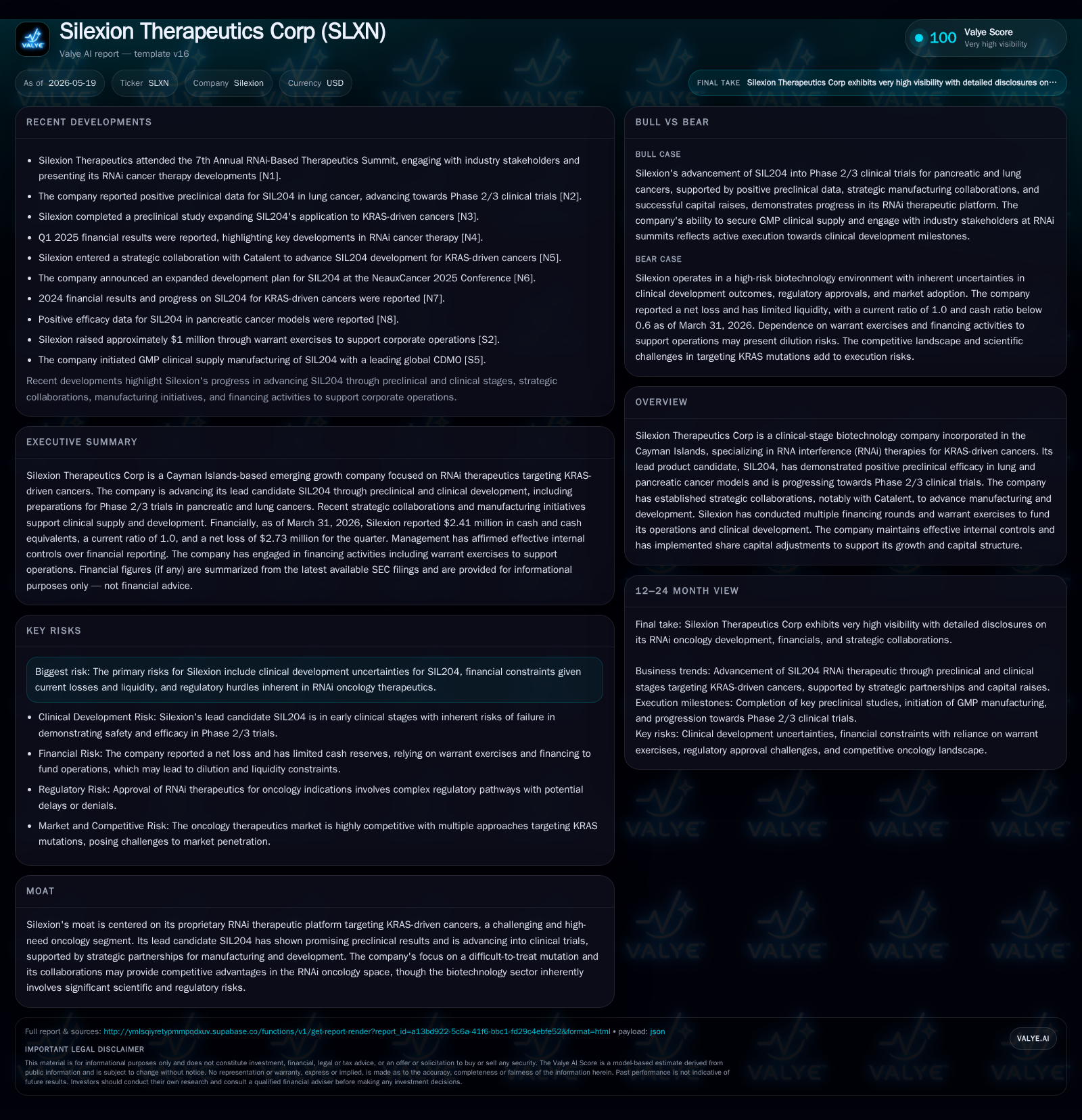
In its latest quarterly filing, Silexion Therapeutics Corp reported ongoing clinical progression of its lead RNAi therapy for KRAS-driven cancers, SIL204, moving closer to Phase 2/3 trials with regulatory approvals in multiple jurisdictions. The company has strengthened manufacturing capabilities via strategic partnerships and raised incremental capital through warrant exercises to fund operations. Despite operational advances, liquidity remains tight with a current ratio of approximately 1, underscoring continued funding dependency. Silexion’s proprietary RNAi platform targeting traditionally undruggable KRAS mutations positions it competitively in a high-unmet-need oncology segment, though clinical and regulatory risks persist. Key milestones include advancing trial enrollment and scaling GMP manufacturing.
Recent Operating Update
Silexion Therapeutics Corp's latest quarterly filing dated May 15, 2026 [S2] confirms the company’s continued advancement in its clinical-stage RNA interference (RNAi) oncology programs without any material changes in risk factors from prior disclosures. Notably, the quarter capped several key developments including securing regulatory approval from the Israeli Ministry of Health and Germany’s BfArM for initiating Phase 2/3 clinical trials of SIL204 in locally advanced pancreatic cancer [S16][S18]. These milestones advance SIL204 closer to demonstrating clinical efficacy in pivotal studies.
Building on clinical progress, Silexion announced initiation of GMP-compliant manufacturing supply production with a leading global contract development and manufacturing organization (CDMO) [S7][S8], critical for supporting late-stage trial requirements. Moreover, the company executed a share capital increase effective May 5, 2026 [S21], supplementing operations by raising roughly $1 million through recent warrant exercises [N1], thereby supporting planned R&D activities amidst a constrained liquidity environment.
These operating developments underscore Silexion's dual focus: advancing SIL204 through regulated clinical pathways while concurrently managing financial resources required to sustain this capital-intensive biotech stage.
Business Model
Silexion operates as a clinical-stage biopharmaceutical company pioneering RNAi therapeutics targeting KRAS-driven cancers—a traditionally challenging oncology segment characterized by mutations historically deemed undruggable. Its lead product candidate, SIL204, leverages gene-silencing technology to inhibit aberrant KRAS expression implicated in pancreatic and lung cancers.
Revenue-generation at this stage is externally nil owing to absence of marketed products; value creation centers on progressing clinical proof-of-concept data through regulated phases (Phase 1/2/3), enabling future licensing deals or eventual commercial sales contingent on regulatory approvals. The business model inherently involves lengthy R&D cycles funded primarily through equity financings and strategic collaborations rather than internal revenue streams.
Silexion’s strategic strength comes from its proprietary delivery platform that enhances cellular uptake and target specificity in RNAi therapeutics—an area rife with scientific hurdles such as stability, immune activation avoidance, and off-target effects. Production scalability via partnerships with established CDMOs mitigates risks associated with manufacturing complexity intrinsic to nucleic acid therapies.
Industry Structure and Competitive Position
The RNAi therapeutic sector is highly specialized and competitive but dominated by few entities capable of effectively targeting critical oncogenic drivers like KRAS. Competitors spanning biotech firms developing small-molecule KRAS inhibitors or alternative gene-editing modalities highlight a fragmented landscape featuring diverse approaches to treat these malignancies.
Within this context, Silexion occupies a niche due to its emphasis on RNA interference targeting precise KRAS mutations relevant for difficult-to-treat cancers such as pancreatic adenocarcinoma. Its early-stage pipeline differentiates it slightly from entities focused on downstream effectors or broader immuno-oncology frameworks.
Collaborations with global CDMOs reflect industry best practices stressing quality compliance essential for eventual commercial-scale production. However, the company's relatively limited financial resources compared to larger peers pose execution risks while emphasizing the need for successful milestone achievements that can attract partnership or acquisition interest.
Growth Drivers
Key growth drivers stem primarily from:
- Clinical Progress: Positive safety and efficacy data from completed or ongoing Phase 2/3 trials will be crucial for validating therapeutic potential.
- Regulatory Approvals: Gaining expeditious approvals across multiple jurisdictions broadens patient access opportunities allowing enrollment acceleration.
- Manufacturing Scale-Up: Establishing robust GMP production capacity ensures supply reliability imperative for trial continuity.
- Capital Raising Activities: Securing sufficient funding through equity issuances or partner collaborations sustains development operations.
- Strategic Partnerships: Collaborations augment technological capabilities and reduce development risk through shared expertise.
Success along these vectors could enhance Silexion’s prospects within an oncology therapeutic niche characterized by stiff barriers to entry but significant unmet medical needs.
Risks / Watchpoints / Growth Constraints
Monitoring these factors closely will be important to assess risk-adjusted development progress.
What to Watch Next
Upcoming operational checkpoints include:
- Updates from ongoing Phase 2/3 trial enrollment metrics across Israel, Germany and potentially other geographies.
- Clinical readouts pertaining specifically to safety/tolerability profiles and preliminary efficacy signals from pancreatic cancer patients treated with SIL204.
- Announcements related to CDMO manufacturing scale expansions or contract renewals indicating supply chain robustness.
- Capital market activities signaling follow-on financings or partnership agreements which may impact liquidity condition assessments.
Clear communication on these fronts may shape future sentiment regarding development momentum and commercial viability potentials.
Financial Profile Summary
As per the most recent quarterly snapshot ending March 31, 2026 [F1], Silexion held approximately $2.4 million in cash & equivalents paired against roughly $4.1 million in current assets versus $4.06 million in current liabilities resulting in a current ratio near 1. This indicates a tightly balanced short-term liquidity position poised precariously amid ongoing research investment demands.
Silexion continues leveraging warrant exercises recently raising incremental capital [N1] to partly offset burn rates; however, sustaining a multi-year pivotal study phase will necessitate further financing activities or alliance monetization strategies given current resource limits evidenced by filings [S2][S3].
This analysis synthesizes publicly available SEC filings and press releases up through May 19, 2026. It provides an operationally anchored overview without investment directions or research views. Future developments involving trial outcomes or financial restructurings can substantially alter the outlined contingencies herein.
Disclaimer: This is research-only, informational analysis and not investment advice. It may include AI-generated interpretation and general industry context. Always verify important details using primary sources.

Comments