
SmartStop Self Storage: Growth, Expansion, and Capital Strategy in the Evolving Self Storage Market
SmartStop’s 2025 marks a year of portfolio enlargement, Managed Platform scaling, and nuanced capital moves shaping its competitive positioning.
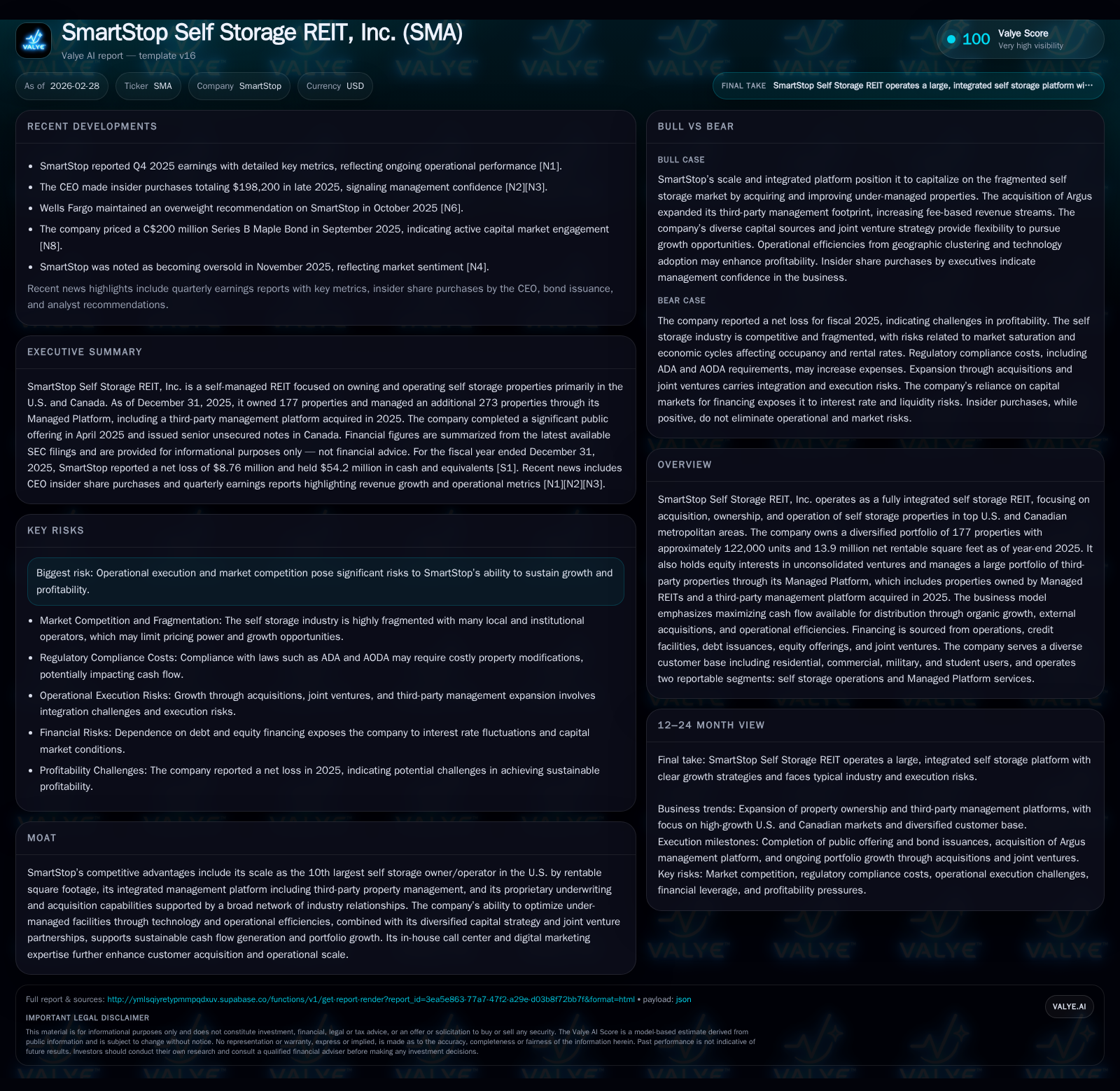
SmartStop Self Storage REIT, Inc. solidified its top-10 U.S. market position through an expanded owned portfolio totaling 177 properties encompassing 13.9 million rentable square feet, complemented by an enlarged Managed Platform following the acquisition of Argus Professional Storage Management. Revenue grew 9.4% year-over-year driven by organic rental rate increases and external acquisitions, while operating income declined due to rising operating expenses and integration costs. The firm sustained dividend payments aligned with a targeted $1.60 annualized per share and leveraged a diverse capital structure including a new $500 million revolving credit facility plus Canadian note issuances. Operationally, SmartStop’s in-house call center and digital marketing intensified tenant acquisition efficiencies amid a fragmented and competitive self storage landscape. Key risks remain in execution and regulatory compliance as the firm pursues organic growth and managed platform expansion.
Evolution of SmartStop’s Portfolio and Revenue Drivers through 2025
SmartStop Self Storage has strategically grown its footprint to become the tenth-largest owner/operator of self storage real estate in the United States by rentable square footage as of the end of 2025 [S1]. Its wholly-owned portfolio expanded to comprise 177 operating properties spread across 19 U.S. states, the District of Columbia, and Canada, totaling approximately 122,000 individual storage units with about 13.9 million net rentable square feet [F1][S1]. This growth trajectory reflects both acquisitive activity focused on under-managed or recently stabilized assets and organic expansion initiatives.
A pivotal development was the October 2025 acquisition of Argus Professional Storage Management LLC, a third-party management firm overseeing more than 221 properties encompassing roughly 100,000 units and nearly 16.6 million rentable square feet across 27 states [S14]. This addition dramatically broadened SmartStop's Managed Platform footprint from managing solely Strategic Storage Trust REITs’ portfolios to encompassing a total management count of 273 third-party properties with approximately 140,000 units spanning over 20 million rentable square feet [S1][F1]. By combining owned assets with this expansive management platform inclusive of managed REITs and Delaware statutory trusts (DSTs), SmartStop achieves considerable scale benefits underpinned by geographic diversification.
The company’s revenue base mirrored its portfolio expansion with top-line growth of approximately $328.9 million for fiscal year ended December 31, 2025—marking a 9.4% increase compared to prior year figures [F1][N1]. This lift was supported primarily by increased rental rates enabled by short-term lease structures that allow monthly rate resets—a common industry dynamic—and ancillary streams such as tenant protection programs (insurance offerings) which enhance per-unit revenue without proportional cost increments [S8][S9]. Geographic diversity also proved beneficial: residential demand in metropolitan clusters combined with commercial users leveraging flexible, secure logistics space bolstered consistent occupancy thresholds.
Operational Levers Behind SmartStop’s Business Model and Managed Platform Expansion
SmartStop operates through two distinct yet complementary business segments: (i) wholly-owned self storage operations generating revenues from direct unit rentals and ancillary services; (ii) the Managed Platform comprising property management fees earned from overseeing third-party owned portfolios including the Managed REITs and the newly acquired Argus platform contracts [S1][S8].
The firm's proprietary operational infrastructure fuels efficiency gains critical for margin enhancement amid industry fragmentation where non-institutional ownership dominates much inventory outside major metros [S8]. Centralizing tenant engagement via an in-house call center allows multi-channel customer interaction through phone calls, emails, web chats, and SMS text—enabling seamless lead conversion often critical with month-to-month leases vulnerable to churn yet offering rapid price reset opportunities aligned with market conditions [S15].
Digital marketing is tightly integrated leveraging portfolio-wide brand recognition at localized cluster levels to reduce customer acquisition costs—a classic example of operating leverage scalable within regional concentration strategies typical for self storage operators seeking cluster synergies that optimize personnel deployment along with overhead allocations [S15][S9]. Tenant protection program revenues provide additional high-margin revenue lines boosting overall profitability without sizeable incremental costs due to insurance premium fee sharing arrangements within managed portfolios.
Moreover, SmartStop employs a sophisticated proprietary underwriting methodology augmented by its broad network of relationships facilitating discerning asset-level evaluations targeting facilities ripe for NOI optimization post-acquisition—often facilities underserved by retail or smaller operators lacking technological platforms or professional operational capabilities [S16]. Through this targeted approach incorporating physical stabilization status assessment (lease up stages or certificate-of-occupancy ready), the REIT consistently identifies accretive investments aligned with long-term cash flow enhancement goals.
Analyzing Key Financials: Revenue Growth, Operating Income Decline, and Negative Net Income
While revenue expansion demonstrated robust momentum at +9.4% year-over-year increasing to approximately $328.9 million in FY2025 from prior levels [F1], operating income encountered headwinds manifesting as a -14.6% contraction down to roughly $59.1 million for the period under review [F1]. This divergence highlights margin pressure tied primarily to increased operating costs—including integration expenses following the late-2025 Argus acquisition—and elevated administrative overheads consistent with scaling efforts across distinct business lines (owned vs managed) alongside lease-up activities at newly acquired or developed facilities [N1][S1].
Net income flipped into negative territory at approximately -$8.8 million contrasted with positive prior years reflecting non-operational charges such as depreciation/amortization bumps from acquisitions or one-time transaction-related expenses not expensed previously [F1]. EBITDA pressure linked to these factors indicates margin compression despite underlying cash generation strength.
Contrastingly, operating cash flow remained healthy at nearly $85 million for FY2025 representing a +32.7% increase over prior year levels evidencing effective working capital management and robust core earnings before non-cash costs are considered—reinforcing earnings quality from operations despite accounting-driven net loss outcomes typical for capital-intensive REIT businesses undergoing growth phases involving significant acquisition-related goodwill amortization [F1].
Capital Allocation Strategy: Dividends, Share Structures, and Debt Overview
SmartStop maintains a disciplined dividend policy framed around a targeted annualized payout of $1.60 per share payable monthly as reaffirmed February 24, 2026, representing consistent distributions amounting to nearly $74.8 million paid during fiscal year ended December 31, 2025 [S3][F1]. Dividend coverage derives more from continued strong operating cash flows rather than net earnings given their recent volatility.
On the equity front, regulatory filings reveal corporate actions including a one-for-four reverse stock split executed March–April 2025 refining outstanding share counts for market liquidity optimization aligned with NYSE listing protocols while consolidating authorized shares under unclassified common stock ensuring simplified governance structures post-IPO transactions completed earlier in the year raising net proceeds near $875 million supporting balance sheet fortification initiatives [S4].
Debt financing encompasses diversified instruments balancing currency exposure given cross-border operations—the company closed a new senior unsecured revolving credit facility of $500 million USD maturing in February 2030 with optional one-year extension featuring interest rates indexed to SOFR plus credit-based spreads ranging from approximately 100-145 basis points depending on leverage thresholds until an investment grade credit rating is attained; this facility includes sublimits for letters of credit ($25M) and swingline loans ($50M) enhancing liquidity flexibility necessary for opportunistic acquisitions or capex initiatives [S5][S11][S16][S19]. Concurrently sizeable Canadian private placement notes totaling CAD $700 million split between maturities in mid-2028 (3.91%) and late-2030 (3.89%) strengthen cross-border funding capacity reflecting SmartStop’s commitment to maintaining low-cost fixed-rate debt profiles amenable for yield stability amid fluctuating interest rate environments typical in industrial real estate sectors [S13][F1].
Equity measured through shareholders’ equity ballooned significantly reaching over $1.18 billion driven largely by capital raises alongside revaluations related to acquired entities extending asset base certainty while reported Return on Equity hovered near negative -0.7%, indicative of transitional earnings post-acquisition periods longer than typical operating cycles but ameliorated by free cash flow positivity ensuring ongoing investor returns via distributions rather than reported profits alone [F1].
Future Growth Prospects and Risks in the Competitive Self Storage Sector
Strategically poised for future organic growth facilitated by inherent rent reset advantages granted by short-term lease structures prevalent in self storage—with many tenants renewing month-to-month—allowing landlords like SmartStop to dynamically adjust pricing responsive to inflationary or competitive pressures thereby mitigating revenue stagnation risk typically observed elsewhere in real estate asset classes requiring longer-term leases such as multifamily or office spaces [S9].
However, risks loom notably around operational execution complexity tied to integrating heterogeneous portfolios rapidly expanded by acquisition-driven Managed Platform scale notably following Argus consolidation—a process demanding synergy realization particularly around technology stack harmonization and employee base consolidation without disrupting tenant experience which directly impacts occupancy and renewal rates.
Competitive intensity remains elevated given highly fragmented industry composition comprising numerous small independent owners controlling majority supply outside institutional pockets meaning acquisition opportunities must be carefully vetted against pricing dynamics susceptible to local market saturation effects.
Additionally regulatory compliance costs represent a non-trivial consideration given federal mandates like ADA requirements in U.S., similar AODA regulations in Ontario affecting accessibility features necessitating potential retrofits imposing capex burdens beyond initial underwriting assumptions although currently not expected materially adverse according to company disclosures [S6][S10].
Environmental liabilities associated with property ownership related to toxic substances cleanup impose contingent exposures albeit acknowledged proactively within risk frameworks minimizing unexpected shocks but still warranting vigilance.
Investor Milestones to Monitor and Company Outlook
Market participants will find value tracking key performance indicators such as same-store rental rate trends which provide insights into organic pricing power especially relevant amid inflationary backdrops impacting tenants' discretionary budgets [N1].
Integration metrics around Argus—their efficiency improvements on operating expenses relative to property count—and retention or expansion rates within Managed REITs form another critical lens into scalability feasibility.
On the capital markets front monitoring issuance or retirements of equity/debt instruments including potential leverage adjustments remains prudent considering overall balance sheet strategy balancing growth ambitions against risk appetites.
Portfolio acquisition pipelines alongside joint venture developments particularly cross-border U.S.-Canada endeavors also merit scrutiny confirming sustained accretive deal flow consistent with stated investment objectives fostering long-term shareholder value appreciation.
Five-Year Financial Performance Snapshot
Historical performance (annual)
| FY | CFO ($mm) | OpInc ($mm) |
|---|---|---|
| 2025 | 85 | 59 |
| 2024 | 64 | 69 |
| 2023 | 73 | 71 |
| 2022 | 88 | 66 |
Source: SEC companyfacts cache [F1].
Capital returns and efficiency (annual)
| FY | Div ($mm) |
|---|---|
| 2025 | 75 |
| 2024 | 37 |
| 2023 | 41 |
| 2022 | 49 |
Source: SEC companyfacts cache [F1]. Table demonstrates revenue growth coupled with volatile profitability metrics underscoring transitional phase driven by acquisitions and scalable operations.
This analysis incorporates facts sourced from SmartStop's latest SEC filings including Form 10-K dated February 27, 2026 ([S1] et seq.) supplemented by contemporaneous news recaps ([N1]) along with structured financial data obtained from latest companyfacts cache ([F1]). No speculative assumptions have been introduced beyond disclosed financial statements or official corporate communications.
Disclaimer: This is research-only, informational analysis and not investment advice. It may include AI-generated interpretation and general industry context. Always verify important details using primary sources.

Comments