
NuScale Power Corp's Financial Volatility Tests Path to SMR Commercialization
NuScale Power balances landmark nuclear regulatory approvals against mounting operating losses and strategic dependency risks.
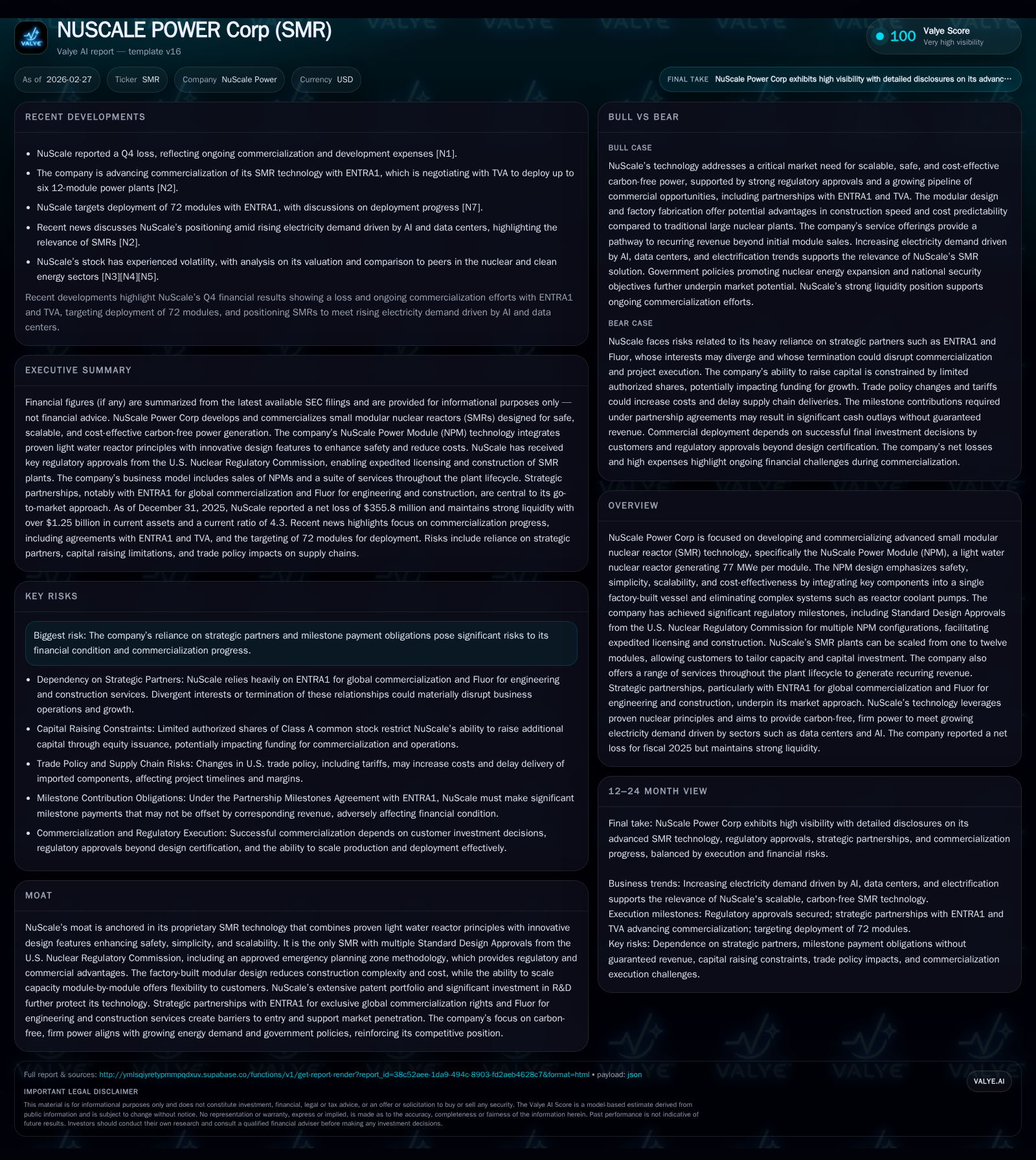
NuScale Power Corp has pioneered small modular reactor technology with multiple NRC Standard Design Approvals that position it for scalable commercial deployment. Despite technological milestones, the company faces steep and accelerated operating losses alongside heavy milestone payments to its global partner ENTRA1. Its capital structure exhibits strong liquidity but constrained equity authorization, while no dividends or buybacks have been made. Key growth prospects hinge on commercial plant agreements driven by exclusive partnerships, with ongoing risk from litigation, partner reliance, and regulatory uncertainties.
Recent Financial Performance Reflecting Growth Challenges
NuScale Power Corp’s financial trajectory through fiscal years 2022 to 2025 exhibits clear tension between ambitious commercialization aims and deepening financial strain. Operating income deteriorated sharply from a loss of approximately $230 million in FY2022 to a staggering $690 million loss in FY2025, representing a nearly 400% year-over-year increase in losses [F1]. Net income followed a similar pattern with losses swelling from $26 million in FY2022 to nearly $356 million negative in FY2025—a deterioration exceeding 160% YoY.
Operating cash flows further reflect this amplified cash burn, plunging from -$149 million in FY2022 to close to minus $460 million by 2025 [F1]. This deterioration stems largely from milestone payments under the Partnership Milestones Agreement (PMA) with ENTRA1, which includes substantial upfront fees to secure exclusive commercialization rights [S2]. Meanwhile, capital expenditures have remained strikingly low relative to overall spend—just over $508 thousand in FY2025—highlighting that most expenditure relates to development costs rather than asset investments.
This is emblematic of NuScale’s transition phase: moving aggressively from R&D toward commercial rollout has steep upfront costs amid still limited revenue generation [N1][S2], producing heavy negative free cash flow (approximately -$460 million after subtracting capex) [F1]. These stark financials underscore the high-stakes environment NuScale operates within as an emerging advanced nuclear technology firm.
Historical performance (annual)
| FY | Net ($mm) | CFO ($mm) | OpInc ($mm) | Capex ($mm) | Net YoY |
|---|---|---|---|---|---|
| 2025 | -356 | -460 | -690 | 1 | -160.4% |
| 2024 | -137 | -109 | -139 | 0 | -134.1% |
| 2023 | -58 | -183 | -276 | 2 | -125.2% |
| 2022 | -26 | -149 | -230 | 2 |
Source: SEC companyfacts cache [F1].
Capital returns and efficiency (annual)
| FY | Buybacks ($) | FCF ($mm) | ROE% |
|---|---|---|---|
| 2025 | -460 | -30.4 | |
| 2024 | 0 | -109 | -22.1 |
| 2023 | 0 | -185 | -62.4 |
| 2022 | 566000 | -151 | -22.6 |
Source: SEC companyfacts cache [F1].
Technological and Regulatory Milestones Empowering Scalability
At the core of NuScale's business is the NuScale Power Module™ (NPM), a light water reactor unit generating 77 MWe per module whose design principles leverage decades of proven nuclear technology with key innovations [S1][S2]. The design integrates the reactor core, steam generators, and pressurizer into a single factory-fabricated vessel that utilizes natural circulation for coolant flow — eliminating mechanical pumps altogether — thereby enhancing passive safety.
A significant competitive advantage stems from NuScale being the only SMR possessing multiple Standard Design Approvals (SDA) from the U.S. Nuclear Regulatory Commission (NRC), including for both the original twelve-module configuration and the newer six-module variant [S1][S2]. These approvals simplify licensing pathways allowing customers to pursue expedited construction and operating permits under NRC's Part 52 process.
Crucially, modular scalability allows installations ranging from one up to twelve NPMs per plant site, enabling customers to tailor capacity investment over time—from a single module commencing operation to scaling up incrementally as demand grows . This contrasts favorably against traditional large reactors requiring massive upfront capital spends for gigawatt scale plants, offering utilities enhanced financial flexibility.
Overall, NuScale’s design emphasizes safety enhancements — such as elimination of reactor coolant pumps decreasing mechanical failure points — operational simplicity that reduces staffing needs (e.g., three licensed operators for twelve modules without Shift Technical Advisor), and adaptability supporting diverse applications beyond electricity like hydrogen production and desalination [S26].
Strategic Partnerships Defining Commercialization Trajectory
NuScale’s commercialization progress is tightly interwoven with its Strategic Alliance Agreement signed May 7, 2025, granting ENTRA1 exclusive global rights for distribution, sales, development, and commercialization of NuScale SMR power plants worldwide [S2]. To facilitate this collaboration financially, the Partnership Milestones Agreement enacted August 27, 2025 outlines milestone contributions NuScale pays ENTRA1 per NPM delivered or anticipated in Energy Projects, reflecting substantial upfront capital transfer obligations embedded into operations [S2].
Simultaneously, Fluor Corporation—NuScale's largest stockholder—serves as engineering procurement & construction (EPC) contractor for manufacturing preparation and plant construction [S17]. Fluor's recent sale of approximately 71 million SMR shares for $1.35 billion injects liquidity but also introduces volatility perceptions due to its dual operational/stakeholder role [N12]. The interplay between Fluor’s EPC services, equity liquidations and NuScale's liquidity profile merits attention.
While these partnerships reduce market entry barriers—especially by leveraging Fluor’s nuclear EPC expertise—they introduce risk: dependency on strategic partners whose interests may diverge or who may not be easily replaced if relations sour [S18][S17]. Non-circumvention clauses restrict NuScale’s ability to pursue potential opportunities independent of ENTRA1 relationships.
Capital Structure, Cash Flow Profile, and Return Metrics
As of December 31, 2025, NuScale held cash and equivalents totaling $836 million complemented by short-term investments yielding a healthy current ratio above 4x ($1.27B current assets vs $296M current liabilities), reflecting a strong near-term liquidity buffer despite ongoing operating cash burn [F1][S6][S18]. Importantly though, the number of authorized shares remaining was approximately only 20 million Class A common stock shares available for issuance out of total authorized shares capped at about 332 million [S4]. This constrains the company's ability to pursue additional equity financings without stockholder approval—potentially a bottleneck given past reliance on ATM programs for capital raising since 2023.
Capital return metrics remain negative at this stage: no dividends have been declared or paid historically and only minimal share repurchases occurred years ago ($566K in FY2022), consistent with operational reinvestment priority [F1][S7]. Calculated ROE approximates negative 30% in FY2025 due primarily to mounting net losses versus equity base totaling nearly $1.17 billion by year-end—a marker typical for companies transitioning from development towards commercialization but signifying lack of positive earnings contribution presently [F1].
All told, while balance sheet strength underpins operational continuity through heavy R&D phases and milestone payments [F1], the limited equity capacity alongside absence of free cash flow constrains return enhancement potentials absent meaningful commercial contract wins.
Market Drivers and Constraints on Future Growth
Prospects for growth center on US deployment plans backed by significant partnership commitments: ENTRA1 targets delivering up to six power plants housing twelve-module NPM configurations each (translating roughly into a GW-scale aggregate capacity) primarily via negotiations with utilities such as Tennessee Valley Authority (TVA) covering their seven-state footprint [N9][S2]. This pipeline posits modular scalability coupled with incremental customer capital outlays as attractive value drivers amid growing electricity demand fueled by AI adoption trends increasing data center usage and grid load profiles [N4].
Additional growth vectors stem from industry expansion beyond electricity generation alone toward hydrogen production and clean water desalination applications leveraging process heat from SMRs—a diversification angle actively pursued by management via continuous R&D innovation efforts alongside patent portfolio expansions exceeding five hundred granted patents globally [S21].
However, constraints remain material: site licensing remains complex requiring lengthy regulatory reviews at both federal and state levels; foreign market penetration demands country-by-country approvals absent international nuclear certification reciprocity; embedding evolving environmental regulations mandates compliance contingencies; competitive pressure mounts as alternative SMR developers increase their technological capabilities; supply chain challenges could delay module manufacturing progress; finally uncertainties persist around long-term customer contracts due mostly to capital intensity and lead times intrinsic in nuclear construction projects [S11][S16].
Risk Factors and Litigation Impacting Investor Sentiment
Material risks derive significantly from dependency on strategic partners ENTRA1 and Fluor—should these alliances fray or diverge strategically, NuScale might face protracted disruptions or need less experienced replacements risking delays or quality compromises [S18][S17]. The PMA embeds heavy milestone payments creating cash flow stress when commercial order pace lags expectations.
Furthermore, ongoing legal proceedings include a purported securities class action alleging misleading disclosures concerning ENTRA1’s qualifications as developer—while denied by Company management—the materiality threshold if lost could impose substantial financial burdens [S4][S15]. Intellectual property suits pose another vector whereby potential invalidation or infringement claims might dilute patent strength or complicate licensing.
Regulatory instability also looms large given post-2024 U.S. Supreme Court decisions limiting deference afforded federal agencies like the NRC possibly prolonging rule-making or interpretation consistency impacting licensing timelines adversely [S16]. Export controls impose near-term constraints on international sales absent multi-jurisdiction approvals further curbing addressable markets physically outside the United States.
Collectively these factors contribute volatility pressures weighing on investor confidence rendering share price susceptible despite underlying technology advances.
Outlook: Key Catalysts and Metrics To Watch for 2026-2030
Absent explicit public earnings or revenue forecasts given nascent commercialization stages, market focus sharpens onto certain operational milestones aligned with partnership frameworks:
- First commercial NPM deliveries scheduled under PMA projects particularly those sited at Doicesti Romania power station advancing phase two front-end engineering design efforts will signal commercialization traction regionalized beyond US borders [S18];
- Commencement announcements of construction projects based on NRC-certified designs indicating licensure progress;
- Successful capital raises achieved within shareholder-authorized limits reflecting financing health;
- Major finalized contracts especially those firming volumes under ENTRA1 exclusivity;
- Legal case resolutions clarifying exposure footprints;
- Any dividend initiations would mark significant maturation but currently remain unlikely per management commentary [N14][S7][S2];
- Monitoring share count changes due to equity issuance activity will provide clues on dilution trends layering onto valuation dynamics.
As corporate milestones intertwine deeply with policy developments supporting carbon-free energy adoption alongside technological risk mitigations inherent in nuclear project fabrications—including modular construction benefits—the balance between technological promise versus financial endurance remains pivotal in evaluating NuScale's pathway forward.
This analysis is based solely on publicly available information as of February 27, 2026; it does not constitute investment advice but aims to provide comprehensive understanding of NuScale Power Corp's operational context within emerging advanced SMR industry dynamics.
Disclaimer: This is research-only, informational analysis and not investment advice. It may include AI-generated interpretation and general industry context. Always verify important details using primary sources.

Comments