
Solitron Devices Strengthens Military Semiconductor Edge with Strategic Acquisition
The latest quarterly filing and 2023 acquisition highlight Solitron Devices' deepening foothold in custom defense semiconductors amid concentration and manufacturing challenges.
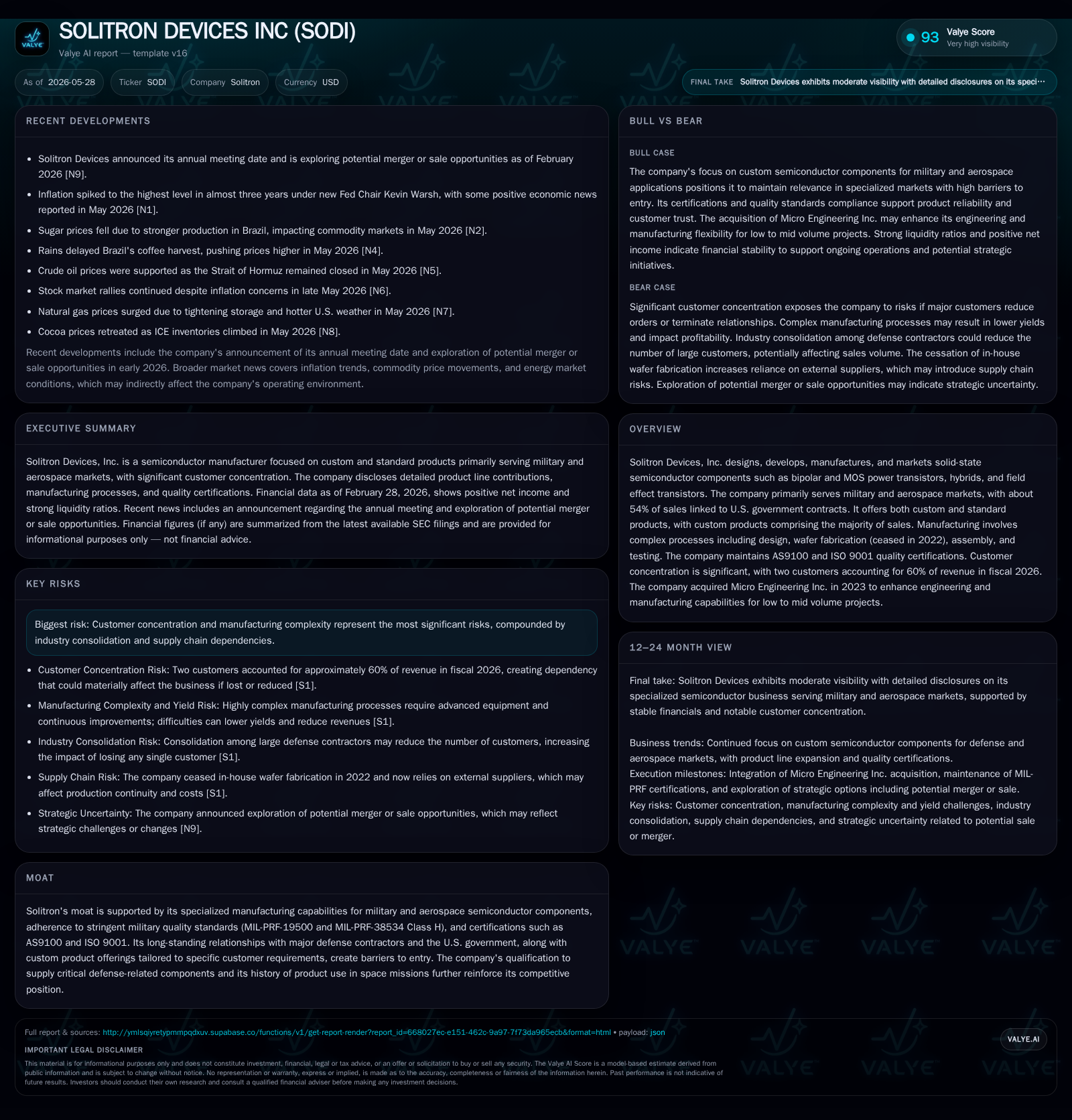
Solitron Devices' January 2026 quarterly update reveals steady operational momentum anchored by strong military and aerospace semiconductor orders. The firm’s strategic acquisition of Micro Engineering Inc. (MEI) in 2023 enhances their engineering and manufacturing agility, enabling better service of low- to mid-volume defense projects. Despite robust quality certifications and entrenched government contracts affirming their niche moat, customer concentration risks and complex manufacturing processes remain significant constraints. Near-term performance hinges on contract renewals and seamless MEI integration to capitalize on defense electronics demand.
Latest Quarterly Update Highlights Operational Trajectory
The company’s reported current ratio stands at a strong 4.56 at February end 2026 supported by $3.9 million in cash against $2.53 million in current liabilities, which suggests liquidity sufficiency to manage near-term obligations including working capital demands tied to custom production cycles [F1]. Total debt approximates $3.76 million with net debt nearly neutral at -$0.15 million given cash holdings [F1], framing a balanced financial profile supportive of operational flexibility.
Company Overview: Specialized Semiconductor Design and Manufacturing
Solitron Devices centers its business model on designing, manufacturing, assembling, and marketing solid-state semiconductor components primarily serving military and aerospace sectors where reliability under harsh conditions is paramount [S1]. Its product scope includes bipolar power transistors designed for high current/voltage applications (0.1A to 300A; up to ~1000V ratings), power MOSFETs (notably expanding), hybrids (analog circuitry mounted for integration), field-effect transistors (FETs), and other related devices.
A defining characteristic is that about 95% of sales derive from custom products manufactured under strict customer specifications, often linked to end products sold to the U.S. government or prime defense contractors; the remainder come from standard catalog items such as JAN-qualified transistors or voltage regulators [S28]. Approximately 54% of sales relate directly to government contracts governed by approved Source Control Drawings (SCDs), reflecting deep integration into military procurement processes [S28].
Strategically, the company ceased wafer fabrication operations in 2022 shifting fully into assembly and testing phases downstream of external wafer sourcing – a move possibly aimed at reducing capital intensity while focusing on specialization in assembly/testing expertise [S1]. Maintaining ISO 9001 and AS9100 certifications underpin quality assurance compliance essential for aerospace/military qualification mandates.
Product Portfolio and Quality Certifications Driving Competitive Advantage
The product mix reveals significant movement with power MOSFET sales increasing from representing 15% of total sales in FY2025 to 24% in FY2026, indicative of deliberate expansion into this segment responding to elevated demand for efficient power control components in defense electronics [S1]. Power bipolar transistors still represent the largest share but saw a proportional decline from 43% to 39%, potentially reflecting shifting application trends or competitive dynamics.
Hybrids—the assembly of discrete circuits into integrated modules—contributed a diminished share moving from 33% down to 27%, whereas field effect transistors increased slightly from 8% to 9%, suggesting fine-tuning of offerings within analog component niches where military systems require precision.
These products conform to rigorous military specs: MIL-PRF-19500 for bipolar devices emphasizing hermetic packaging and radiation resistance; MIL-PRF-38534 Class H for hybrid microcircuits ensuring high reliability; alongside broader AS9100 aerospace quality standards ensuring process consistency across design-manufacture-test stages. These certifications act as substantial barriers limiting new entrants given the extensive qualifications required for defense contract eligibility.
Industry Dynamics: Customer Concentration, Competition, and Supply Challenges
Customer concentration presents a prominent structural risk: two customers—ConMed Linvatec (33%) and RTX Corporation (27%)—comprise about 60% of total net sales as of FY2026 compared with previously higher concentration levels approaching nearly 70% in FY2025 [S4]. This concentration exposes Solitron both to order volatility should either client reduce commitments as well as pricing pressure stemming from their relative bargaining power.
Consolidation trends among large defense contractors may intensify this effect by reducing the supplier base but simultaneously concentrating purchasing decisions into fewer entities, potentially heightening negotiation leverage against smaller suppliers like Solitron [S23].
On the supply side, complex manufacturing processes coupled with aging equipment pose yield challenges that can reduce output efficiency or delay deliveries impacting revenue recognition cycles; such manufacturing complexities also raise fixed cost absorption thresholds that could erode margins if volumes fall short [S7]. The company explicitly acknowledges risks around sourcing qualified raw materials such as silicon wafers—whose price volatility has been notable globally—and other key inputs affecting production cost structures.
Compliance with conflict minerals regulations further restricts eligible suppliers potentially constraining raw material availability or elevating costs which may pressure margins if not passed through adequately to customers [S22].
Growth Drivers: Leveraging Acquisition and Product Line Expansion
The September 2023 acquisition of Micro Engineering Inc. (MEI) emerges as an important strategic initiative enhancing Solitron’s service capabilities for electronic component design layout challenges especially focused on low-to-mid volume projects requiring engineering dedication combined with flexible manufacturing throughput [S1]. MEI brings over four decades of experience optimizing design-to-manufacturing workflows tailored for cost efficiency and rapid delivery timelines—a critical capability when servicing highly customized defense orders where agility complements technical rigor.
This acquisition synergizes well with Solitron's core competencies by enabling better adaptation to smaller batch sizes without sacrificing quality or time-to-market—a notable differentiator amid industry peers who may concentrate on high volume standard parts production. Such nimbleness aligns directly with ongoing U.S. government defense procurement priorities that increasingly emphasize modularity, upgradeability and diversification away from large-volume sole-source contracts.
Additionally, expanded Power MOSFET offerings cater to growing market segments demanding efficient power management solutions in radar arrays, missile guidance electronics, satellites and other aerospace applications where miniature size combined with high-performance switching contributes directly to system effectiveness.
Risks and Constraints: Manufacturing Complexity and Client Dependency
Manufacturing represents a continuous constraint primarily through legacy equipment maintenance burdens that risk delivery interruption without timely replacement investments—a costly undertaking complicated by long lead times for specialized semiconductor tooling [S7]. Yield instability arising from highly complex processes introduces potential elevated scrap rates dampening margins unless process improvements mature steadily.
Client dependency remains acute: loss or significant reduction of one major customer order could materially impair revenues given over half the sales concentrated among two primary clients even as diversification efforts may be incremental at best [S23]. Limited negotiating leverage underpins vulnerability particularly if inflationary pressures trigger cost increases that the company cannot offset through price adjustments without risking order attrition
Other risks noted include regulatory compliance challenges spanning environmental laws relating to hazardous material handling during manufacturing operations as well as anti-corruption statutes applicable across international dealings which could impose unforeseen costs or business interruptions if violations arise inadvertently through third-party intermediaries or acquisitions like MEI [S25].
Monitoring Ahead: Key Milestones and Market Demand Indicators
Key near-term milestones spotlight renewal outcomes for core government contracts central to sustaining visibility into future revenues given their roughly half proportionate contribution. Management’s progress integrating MEI’s engineering teams into its manufacturing workflows will be a pivotal execution watchpoint influencing ability to target new low/mid volume custom orders efficiently while preserving customer satisfaction levels.
Congressional budget appropriations toward defense spending directly impact military electronic component demand; funding increases foster higher production volumes particularly for advanced power transistor families deployed across missile systems and satellite payloads [S3]. Conversely, any contraction could dampen order backlogs quickly due to relatively short contract terms or termination provisions common in government procurement agreements.
Corporate governance developments from April's stockholder meeting affirm board continuity while exploration of sale or merger opportunities suggests openness toward structural options that could redefine growth trajectories if pursued.[S3]
Financial Snapshot Anchoring Operational Analysis
This analysis synthesizes publicly filed SEC disclosures through early-mid calendar year 2026 alongside companyfacts financial data ensuring rigor through direct citations without speculative extrapolation. No investment advice is offered herein; readers should perform their own due diligence including assessment against evolving market conditions.
Disclaimer: This is research-only, informational analysis and not investment advice. It may include AI-generated interpretation and general industry context. Always verify important details using primary sources.

Comments