
Sonos Expands Installed Base Beyond 17 Million Homes with New Products and Software Gains
Sonos enhances customer retention and operational efficiency while managing supply chain constraints and global economic pressures.
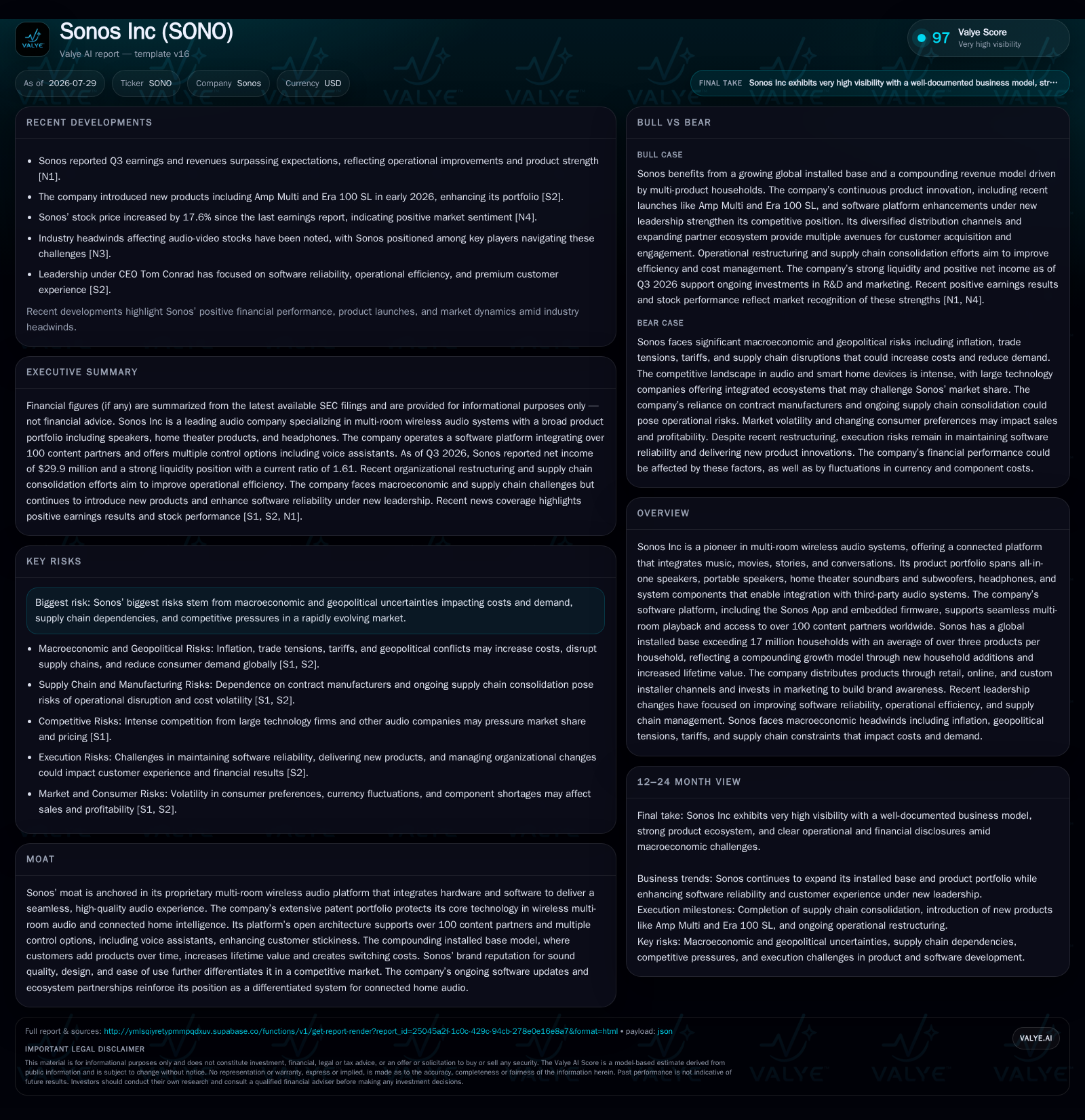
In its latest quarterly filing, Sonos continued to build on its multi-room wireless audio leadership through new product launches and software platform enhancements, reinforcing its compounding installed base growth strategy. The company has improved software reliability following past setbacks and streamlining operations under new CEO Tom Conrad. However, persistent macroeconomic headwinds, supply chain complexity, and component shortages present ongoing challenges. Sonos’ diversified contract manufacturing and brand positioning in premium connected audio remain key competitive advantages. Monitoring installed base expansion, product registrations, and supply chain execution will be critical in the near term.
Recent Operating Update
Sonos’ third fiscal quarter ended June 27, 2026 highlights continuity in its strategic execution amid external headwinds. Under CEO Tom Conrad's leadership—installed fully in July 2025 following an interim period—the company reports restored software reliability exceeding historical levels after prior disruptions related to its May 2024 Sonos app redesign [S2][S5]. This turnabout materially reversed customer dissatisfaction that had earlier impaired product sales. New product introductions early in fiscal 2026 such as the Amp Multi (January) and the Sonos Play™ alongside Era 100™ SL models (March) signal renewed innovation momentum reinforcing its market position for connected home audio [S2][S5].
Operationally, Sonos completed the exit of a contract manufacturing partner by the second quarter of fiscal 2026—a move begun in Q3 fiscal 2025—to consolidate production while maintaining diversified supplier relationships across Vietnam, China, and Malaysia [S1][S2]. Concurrent workforce restructurings totaling roughly an 18% reduction since August 2024 have flattened organizational layers aiming for improved efficiency and responsiveness [S1]. These changes occurred within a challenging global environment characterized by supply chain disruptions exacerbated by inflationary pressures, geopolitical conflicts, tariffs, fluctuating currency rates, and ongoing memory chip shortages due to AI/data center buildouts impacting semiconductor availability [S2][S5]. Sonos continues mitigation efforts through pricing strategies, expense management, supply chain flexibility, inventory optimization, and engineering improvements.
Business Model Analysis
Sonos operates at a premium tier in consumer audio electronics focusing on hardware combined tightly with proprietary software to deliver seamless multi-room wireless audio experiences. Its system architecture integrates various streaming formats (Bluetooth, AirPlay, Spotify Connect) with Dolby Atmos support enabling unified control across music, movies, stories, and conversation content within a household ecosystem [S1][S26]. This value proposition allows revenue primarily from direct hardware sales of speakers (portable and fixed), soundbars (home theater), subwoofers, and headphones sold mainly through retail (brick-and-mortar and online) plus custom installer channels. Monetization is straightforward—consumers pay upfront for devices—but lifetime value is amplified by the "compounding installed base" model where customers add multiple devices over time enhancing ecosystem stickiness [S1][S21].
The proprietary Sonos App serves as the control hub enabling firmware updates and access to over 100 content partners worldwide—another pillar of differentiation supporting customer loyalty through software platform enhancements. Product registrations serve as key operational KPIs reflecting active installed base engagement; by September 2025 about 53.4 million products were registered globally across 17.1 million households averaging approximately 3.13 devices per household with 61% owning more than one device [S1]. The ability to regularly release innovative products aligned with reliable software updates encourages repeat buying within its base rather than simple one-off purchases.
Manufacturing is outsourced exclusively to contract manufacturers selected for quality compliance in Asia. This arrangement reduces capital intensity but introduces supply risks requiring careful partner management—a risk compounded by recent sector-wide component shortages affecting lead times and cost inputs [S1][S27]. Marketing investments focus heavily on brand awareness through digital campaigns timed around holiday seasons or product launches given the discretionary nature of consumer spend on premium audio equipment [S24].
Industry Structure & Competitive Position
Sonos competes in an evolving consumer electronics niche centered on connected home audio systems. Major peer sets include premium audio hardware brands like Bose Corporation for sound quality standards; wireless multi-room specialists such as Denon, Yamaha, Bang & Olufsen; alongside tech giants like Apple or Amazon which influence audio ecosystems via integrated voice assistant platforms.
Sonos’ moat hinges on integration of hardware-software ecosystems delivering superior user experience differentiators such as seamless multi-room playback compatibility across multiple content sources. An extensive patent portfolio protecting wireless multi-room technologies bolsters barriers against direct replication [S19]. The open platform approach contrasts with closed ecosystems like Apple’s HomePod line enabling broader third-party content partner integrations which enhance user choice.
However, competition intensifies from technology incumbents incorporating audio into broader smart home platforms or pushing lower-cost alternatives targeting less premium segments potentially eroding demand elasticity among cost-sensitive consumers. Supply chain complexity imposes additional pressure on timing new product introductions relative to peer launches affecting market share capture opportunities.
Growth Drivers
Key growth drivers for Sonos are: expanding the global installed household base by enticing new customers with compelling gateway products; increasing average product count per household fueling lifetime value; continual innovation advancing product features that leverage proprietary design complemented with better integration into broader smart home ecosystems; tapping international markets alongside existing North American/European geographies; enhancing brand narrative around premium sound quality experience; growing ecosystem stickiness via software platform enhancements ensuring recurring engagement beyond initial hardware sale [S1][S26].
The recent series of product launches signaling recommitment to innovation paired with improved software stability are likely catalysts supporting unit growth through refreshed consumer interest [S2]. Moreover, strategic exits from less efficient contract manufacturing partnerships should yield better supply chain agility vital given ongoing industry-wide component constraints.
Risks & Watchpoints
Despite strategic strengths, several critical risks persist:
- Macroeconomic volatility includes inflationary cost pressures on components/logistics plus trade tensions raising tariffs creating margin compression risks [S2][S5].
- Component supply bottlenecks specifically memory chips drive uncertainty in manufacturing lead times potentially throttling timely order fulfillment constraining revenue growth potential [S1][S27].
- Competitive threats from large tech firms bundling smart speakers into broader ecosystems may limit Sonos’ addressable market or compress pricing power.
- Software platform risk remains since past app rollout glitches caused reputational damage; while reliability is restored now sustained QA vigilance is needed.
- Dependency on third-party content partnerships requires ongoing collaboration to avoid service disruptions or user experience degradation that could hurt customer retention.
- Inventory management challenges due to forecasting mismatches can create excess working capital tied up or stockouts harming sales cadence.
- Currency fluctuations pose earnings volatility given global sales footprint.
Monitoring these factors closely will be essential for near-term operational stability.
What To Watch Next
Important upcoming markers include:
- Progression of new product adoption measured via registered products growth post-launchs such as Amp Multi or Era series.
- Software update cadence maintaining high uptime/reliability statistics avoiding feature rollbacks.
- Channel sales mix evolution indicating enhanced online or custom installer penetration improving margin profile.
- Supply chain lead time trends especially for constrained components like memory chips signaling normalization or worsening delays.
- Pricing strategy adjustments reflecting cost pass-through versus margin preservation balance under inflationary conditions.
- Execution on further operational transformation steps enhancing SG&A leverage without impeding innovation pipeline.
Earnings releases following each quarter will offer empirical confirmation of these metrics.
Financial Profile Discussion
As of June 27, 2026, Sonos held cash & equivalents totaling approximately $207 million juxtaposed with current liabilities around $367 million yielding a current ratio near 1.61—indicating reasonable short-term liquidity coverage though working capital management warrants attention given supplier payment cycles [F1]
R&D expense ratios remain significant aligning with continuous product development initiatives crucial to maintain technological leadership within a rapidly evolving consumer electronics landscape [S24]. This balanced investment approach between top-line expansion efforts plus efficiency-led operating expense controls characterizes current management priorities.
This analysis reflects publicly available information through July 29, 2026 filings combined with industry knowledge contextualizing Sonos’ positioning within the connected home audio sub-sector. No investment research views are expressed or implied herein.
Disclaimer: This is research-only, informational analysis and not investment advice. It may include AI-generated interpretation and general industry context. Always verify important details using primary sources.

Comments