
Shorepower Technologies Expands Heavy-Duty EV Infrastructure with Strategic Upgrades
Shorepower’s Q1 2026 update reveals progress on electrified parking infrastructure amid tight liquidity and ongoing grant reliance.
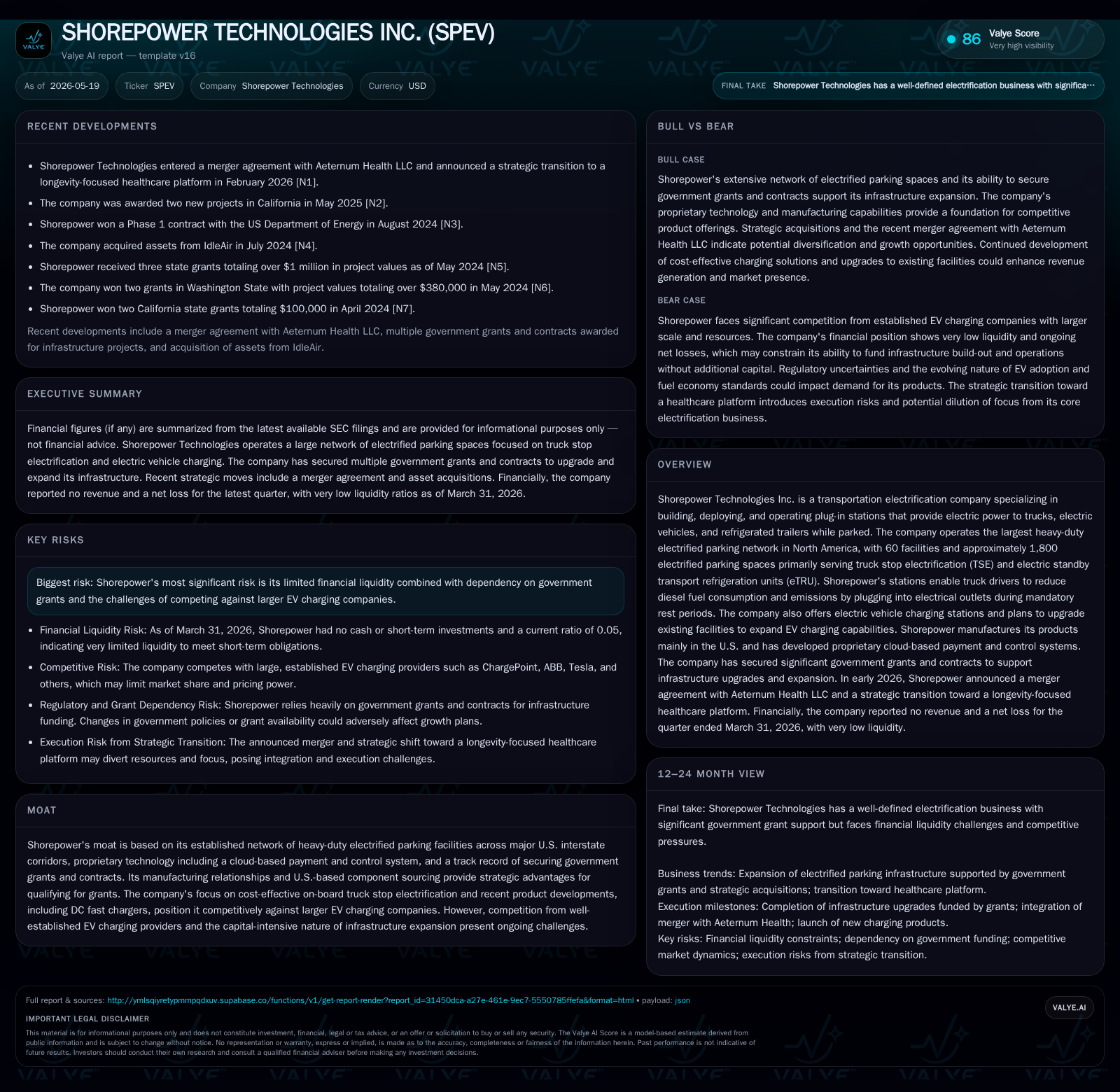
Shorepower Technologies continues to advance its electrified parking network for heavy-duty trucks and EVs, focusing on strategic upgrades to increase charging capacity across its facilities. The company’s latest quarterly report underlines existing financial constraints, with very limited cash reserves and substantial current liabilities threatening near-term operational flexibility. Shorepower’s moat lies in its proprietary cloud-based control systems and a widely distributed network of approximately 1,800 electrified spaces, mainly concentrated in truck stop electrification and refrigerated trailer charging. Growth prospects hinge on securing government grants to fund infrastructure upgrades and expanding EV charging offerings, but persistent liquidity challenges and competition from larger market players remain critical risks.
Latest Quarterly Update: Operational Progress and Funding Realities
Shorepower Technologies’ latest quarterly report filed May 19, 2026 ([S2]) reveals a company managing forward momentum under tight financial constraints. At quarter-end March 31, cash and equivalents stood at zero with current assets totaling only $59,000 against current liabilities exceeding $1.21 million ([F1]). The filing notes reliance on consulting contractors for bookkeeping, engineering, and installation services as a cost containment strategy but anticipates adding full-time personnel contingent upon securing sufficient funding ([S1]).
Operationally, Shorepower continues to focus on upgrading its heavy-duty electrified parking stations with planned installations of Level 2 chargers alongside multiple DC fast charging ports at select facilities. The company has secured approximately $1 million in various state grants to fund these upgrades with more than $1 million in pending applications ([S1]). These grants represent vital lifelines sustaining expansion amidst constrained cash flows.
Business Model: Plug-in Stations Serving Heavy-Duty Fleets and EVs
Shorepower’s fundamental value proposition is anchored in its deployment of plug-in stations enabling trucks, refrigerated trailers (eTRUs), and electric vehicles to access electrical power while parked or resting ([S1]). The company targets a niche within transportation electrification focused on heavy-duty fleet operators who benefit economically by drastically reducing diesel engine idling during mandatory driver rest periods.
Traditional operation requires truck drivers to run their diesel engines for heating or cooling accessories during rest breaks—costing upwards of $10,000 annually per driver in wasted fuel. Shorepower’s truck stop electrification (TSE) stations provide reliable electric power outlets allowing drivers to shut off engines and plug into grid power instead. This switch can save fleets approximately $7,000 per vehicle annually while also curbing greenhouse gas emissions.
In addition to TSE for trucks and eTRU refrigeration units reliant on electricity when parked, Shorepower is scaling out electric vehicle (EV) charging stations at some locations. Presently controlling or having sold rights to over 300 EV charging connection points primed for upgrade via the company's cellular-based control modules promises future revenue generation enhancements ([S1]). Upgrading TSE sites alongside EV connectors aims to expand total electrified connection points beyond 2,000.
Product Quality and Proprietary Technology Offering Competitive Advantage
A key differentiator for Shorepower lies in its proprietary technology stack including a cloud-based payment and station-control system integrated with cellular connectivity modules (,[S1]). This platform enables remote monitoring, usage-based billing, real-time diagnostics, and flexible tariff management—features attractive to fleet operators seeking simplified management of their electrical resource consumption.
Moreover, Shorepower’s manufacturing approach emphasizes U.S.-based component sourcing which strategically positions the company favorably when applying for government grants that often require domestic production criteria ([S1]). This vertical integration contributes not only to compliance credentials but potentially shortens supply chains relative to some competitors reliant on imported parts.
Overall product quality focuses on ruggedness suitable for heavy-duty vehicle environments combined with technological sophistication necessary for scalable revenue models through cellular-enabled upgrades.
Industry Structure: Positioning Within Truck Stop Electrification and EV Charge Networks
Shorepower operates within the specialized segment of heavy-duty truck stop electrification (TSE) distinct from mainstream light-duty passenger EV charging markets dominated by larger incumbents like ChargePoint or Blink Charging. Its footprint includes approximately 60 facilities with roughly 1,800 electrified parking spaces focused heavily on truck stops serving interstate trucking routes ([S1],).
The industry is shaped strongly by public policy signals—especially through bipartisan infrastructure law initiatives channeling billions towards EV infrastructure development throughout North America. However, federal funding volatility remains a strategic uncertainty due to shifting political priorities highlighted since the Bipartisan Infrastructure Law passed in late 2021 ([S1]). State-level grants continue playing a pivotal role in supplementing Shorepower's capital requirements.
Capacity constraints are less pronounced than in congested light-duty public charging hubs but site utility upgrades require capital-intensive investments typical of physical infrastructure rollouts. Pricing power is moderate given alternative fueling options still available; however, switching costs create some stickiness as fleets elect consistent service providers across travel corridors.
Growth Drivers: Network Expansion, Infrastructure Upgrades, and Government Support
The primary growth levers align around expanding the existing heavy-duty EPS network both horizontally by increasing electrified parking spaces and vertically by enhancing station capabilities through advanced charger integrations ([S1]). Planned rollouts include converting up to six stations per facility to Level 2 charging with additional DC fast chargers at key locations.
Secured grant funds nearing $1 million support these projects along with over $1 million pending applications comprising state-specific awards targeting Washington State ($100K), Tennessee ($495K), North Carolina ($44K), Oregon ($171K), and California ($265K preliminary) among others ([S1]). These measurable KPIs—grant size combined with planned new charger counts—anchor tangible expansion benchmarks.
Further growth opportunities arise from upgrading the over 300 EV connection points eligible for cellular control retrofits that turn previously static stations into revenue-generating assets via subscription or pay-per-use models enabled by Shorepower's technology suite.
Risks and Constraints: Liquidity Challenges and Competitive Pressures
Financially the company operates under significant strain as evidenced by its minimal cash position (zero cash as of March quarter-end) offset by over $1.2 million in near-term liabilities ([F1],[S2]). Such conditions raise concerns about Shorepower's ability to sustain operational activities without further funding infusions.
Dependency on government grants injects vulnerability given shifts in federal policy agendas (notably the uncertain future of the Bipartisan Infrastructure Law allocation) coupled with intense competition from well-capitalized EV charging companies competing for similar contracts or pursuing organic network growth (,[S2],[F1]).
Competitive pressures challenge market share gains especially considering scale advantages of larger firms able to leverage broader networks to negotiate better terms with utilities or site hosts.
Additionally, technology obsolescence risk exists if innovation pace among peers accelerates beyond Shorepower's upgrade cycles given its constrained resource base.
Outlook: Key Milestones and Capital Needs to Watch
Near-term investor attention should focus closely on quarterly updates reporting tangible progress on grant-funded infrastructure enhancements—particularly the pace of Level 2 converter installations plus added DC fast chargers—as indicators of execution capability under resource limits ([S2],[S1]).
Monitoring changes in Shorepower’s liquidity profile such as any capital raises or refinancing efforts will provide insights into sustainability beyond government funding cycles [S2]. Staffing expansions signaled post-funding success would reflect confidence in scaling operations from primarily contractor-dependent models.
Other potential catalysts include new grant awards or contract wins that would expand project backlog visibility; conversely delays or cancellations could imperil planned growth trajectories.
Given industry trends pushing toward decarbonization mandates among fleets coupled with increasing regulatory mandates restricting diesel idling; Shorepower occupies a strategically relevant node though execution depends heavily on financial health improvements.
Disclaimer: This analysis is based solely on information available as of May 19, 2026, including SEC filings S2 (10-Q) dated May 19, 2026; S1 (10-K) dated March 31, 2026; Valye report excerpts; and Companyfacts metrics dated March 31, 2026. It does not constitute investment advice or research views.
Disclaimer: This is research-only, informational analysis and not investment advice. It may include AI-generated interpretation and general industry context. Always verify important details using primary sources.

Comments