
SiriusPoint’s Strategy Tradeoff Between Portfolio Simplification and Growth Through MGA Partnerships
SiriusPoint maintains growth with disciplined underwriting and strategic MGA expansion amid inflation and capital constraints.
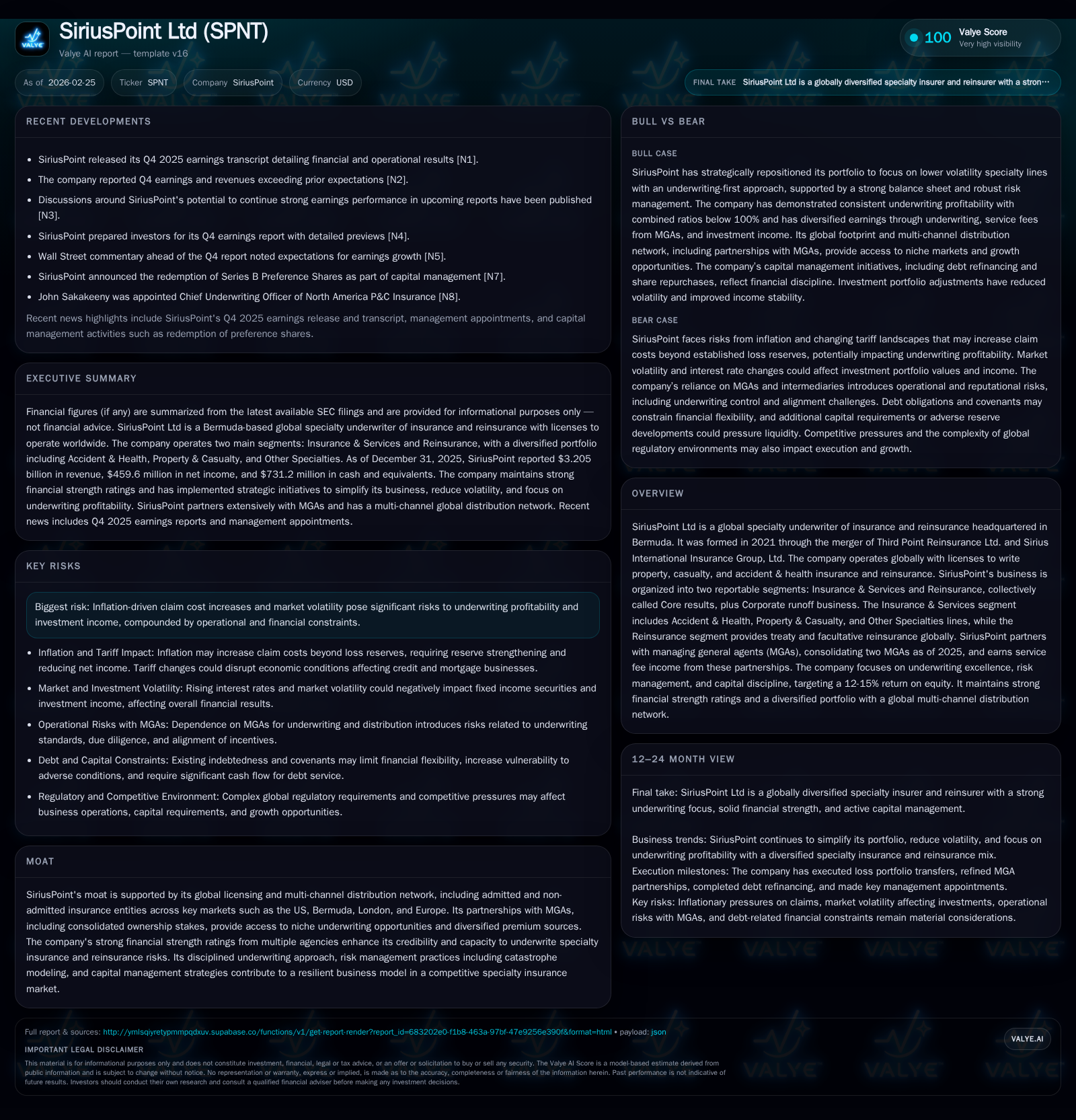
SiriusPoint Ltd, formed in 2021 through a merger of specialty insurers, has pursued a deliberate portfolio simplification and risk reduction strategy from 2022 to 2025. This reshaping involved exiting volatile lines and reducing volatility via loss portfolio transfers while deepening partnerships with managing general agents (MGAs) to access niche specialty markets. The company delivered strong earnings growth in 2025 driven by underwriting improvements, service fees from MGAs, and investment income despite inflation and market volatility pressures. However, SiriusPoint faces capital allocation challenges due to regulatory constraints on dividend payments amid ongoing debt obligations. Going forward, growth depends on expanding profitable MGA relationships and maintaining underwriting discipline in a competitive and inflationary environment.
Company Background and History
SiriusPoint Ltd was formed in early 2021 via the combination of Third Point Reinsurance Ltd., a Bermuda-based specialty reinsurer founded in 2011, and Sirius International Insurance Group Ltd., with roots extending back to 1945 from Sweden. The merger aimed to create a diversified global specialty underwriter with licenses spanning property, casualty (P&C), and accident & health (A&H) insurance and reinsurance across major markets including the U.S., Bermuda, London, Europe, and Sweden [S1][S23].
Post-merger, SiriusPoint has developed a multi-channel distribution platform comprised of admitted and non-admitted insurance entities complemented by consolidated interests in managing general agents (MGAs). These partnerships provide access to tailored specialty lines often addressed under delegated underwriting authorities that feed both insurance primary paper capacity and reinsurance treaty structures [S23][S9].
Historical Performance Drivers (2019-2025)
From the data provided for recent years—note earlier data pre-merger is not detailed—the company has navigated a volatile specialty insurance landscape marked by inflationary pressures and competitive headwinds. Business simplification since inception focused on exiting higher-volatility programs such as Cyber liability and Workers' Compensation along with closing five offices contributed materially to cost savings upwards of $50 million annualized by year-end 2025 [S20].
Moreover, SiriusPoint executed multiple loss portfolio transfers (LPTs) worth approximately $2.1 billion in reserves which effectively removed legacy runoff risks inflating volatility within reported results [S20]. This operational cleanup helped reposition SiriusPoint towards a lower volatility profile consistent with its target underwriting return on equity of approximately 12–15% [S1].
Key financials reveal:
Historical performance (annual)
| FY | Rev ($bn) | Net ($mm) | CFO ($mm) | Rev YoY | Net YoY |
|---|---|---|---|---|---|
| 2025 | 3.2 | 460 | 102 | +23.1% | +129.9% |
| 2024 | 2.6 | 200 | 75 | -4.9% | -43.7% |
| 2023 | 2.7 | 355 | 581 | +30.0% | +191.7% |
| 2022 | 2.1 | -387 | 293 |
Note: Omitted columns lack sufficient annual XBRL coverage in the provided tags (need ≥2 annual points): OpInc, Capex, FCF. Source: SEC companyfacts cache [F1].
Capital returns and efficiency (annual)
| FY | Div | Buybacks ($mm) | ROE% |
|---|---|---|---|
| 2025 | 0 | 491 | 18.6 |
| 2024 | 0 | 300 | 10.3 |
| 2023 | 0 | 0 | 14.1 |
| 2022 | 0 | 5 | -18.6 |
Source: SEC companyfacts cache [F1].
Note: Capex data not available from tags.
The table shows revenue volatility affected partly by portfolio reshaping but overall a recovery with +23% revenue growth in FY25 over FY24 driven by robust underwriting performance across core segments plus enhanced service fee income from MGAs consolidated under the company's umbrella [N1][S9]. Net income returned strongly positive post large losses in FY22 consistent with restructuring results flowing through.
Operating cash flow also varies reflecting timing differences in claims settlements but remains positive with a solid increase in FY25 versus prior year [F1]. Despite operating profitability improvements, equity fluctuated due mainly to share repurchases—the company resumed aggressive stock buybacks totaling nearly half a billion USD in FY25 after scaling up repurchases starting FY24—to optimize capital structure while suspending dividends given regulatory constraints [F1][S20][S9].
Business Segments and Products
SiriusPoint organizes its business into two main reportable segments: Insurance & Services and Reinsurance.
- Insurance & Services: includes Accident & Health (A&H), Property & Casualty (P&C), and Other Specialties lines such as Marine/Energy and Aviation exposures typically written on an admitted or surplus lines basis under MGA delegated authorities.
- Reinsurance: focuses predominantly on treaty and facultative reinsurance globally including catastrophe excess-of-loss covers targeting natural hazard mitigation risk pools.
In recent years, SiriusPoint strategically increased exposure to "Other Specialties," Accident & Health programs leveraging MGAs while scaling down traditional Property cat-excess exposures for reduced result variability [S20][S25]. The company deploys catastrophe modeling extensively to calibrate risk appetite particularly within Property catastrophe excess lines where multiple layers of proportional and excess loss reinsurance are purchased as retrocession protections for accumulation management [S14].
Distribution is anchored heavily on partnerships with MGAs and program administrators who act as intermediaries authorized to underwrite business under SiriusPoint’s carrier licenses offering product breadth beyond narrow reinsurance treaties alone [S23]. As of December 31, 2025, SiriusPoint held equity positions in eighteen MGAs compared to thirty-six at end-2022 after rationalization—this streamlining sharpened capital focus while maintaining diversification into niche areas such as Casualty, Property A&H and specialized sectors like Credit or Space/Marine [S20].
Future Growth Prospects
Growth levers hinge primarily on extending profitable capacities within MGAs—with newly launched partnerships totaling sixteen during calendar year 2025—focused on niche specialty classes underserved by larger commercial insurers [S9]. SiriusPoint’s disciplined underwriting culture aims to preserve margin amid inflation-driven cost pressures that risk underpricing losses if not offset properly by premium adjustments [S2][S7]. The company’s strong financial strength ratings (AM Best A-, Fitch A-, S&P A-, Moody’s A3) provide distribution leverage allowing access to both insured clients requiring admitted coverage as well as global brokers seeking specialized excess risk solutions [S6][S23].
Yet concerns persist around macroeconomic factors such as inflation that may inflate claim severity quicker than premiums adjust causing reserve strengthening charges adversely impacting near-term earnings [S7]. Additionally, the evolving tariff landscape potentially depresses economic activity affecting creditworthiness of insured portfolios especially within credit-related specialties handled partially through reinsurance channels [S2]. Successfully expanding MGA partnerships requires careful monitoring of their business models given many are early stage entities imbued with technology risks and higher operating costs that could translate into elevated expense ratios or underwriting losses if unmanaged [S22]. Thus operational execution remains paramount.
Capital Structure, Returns & Allocation Strategy
At the end of FY25 SiriusPoint reported total shareholders’ equity of approximately $2.47 billion against revenues of $3.21 billion yielding an estimated return on equity near an impressive ~18.6%, outperforming the targeted cyclically normalized range of 12-15% driven by strong underwriting discipline augmented by service fees from MGAs plus steady investment yields from high-quality fixed income securities averaging AA- ratings with no defaults recorded during the fiscal year [F1][S17][S20].
Liquidity is managed conservatively although the holding company structure limits dividend distributions due to Bermuda Class 4 regulatory solvency margins restricting payout unless minimum thresholds are met—thus no dividends have been paid historically through FY25 while substantial capital has been returned via share repurchases scaling from $5 million in FY22 up to nearly $491 million in FY25 indicating management preference for buybacks as primary shareholder returns mechanism pending relaxations in regulatory environments or further earnings stability gains [F1][S9][S19].
Debt refinancing activities included a $400 million transaction easing interest coverage pressures while preserving financial flexibility though covenant limitations remain relevant considering the cyclical nature of insurance liabilities requiring conservative liquidity buffers against catastrophe event shocks [S4][S5]. Ongoing maturities include subordinated notes where refinancing options may be exercised depending on market conditions.
Competitive Advantages & Risks
The moat derives from global licensing enabling participation across major insurance hubs combined with multi-channel distribution through direct relationships with MGAs operating in focused niches allowing access unavailable via pure-reinsurance providers or standard carriers . Risk management employs rigorous catastrophe modeling backed by enterprise risk frameworks overseen by experienced actuarial teams ensuring prudent portfolio construction targeting stable combined ratios amidst cat events.
Significant risks include inflationary claims cost pressures challenging reserve adequacy assumptions; competitive pricing squeeze intensified also due to alternative capital sources like Insurance Linked Securities (ILS); technology disruptions within partner MGAs raising cyber risks; legal/regulatory uncertainties particularly given evolving U.S.-EU reinsurance collateral arrangements; potential rating agency downgrades diminishing market access; plus concentration risks around key shareholders exerting influence over governance matters [S7][S21]. Litigation exposure is typical but currently not individually material per disclosures.
What To Watch Next (Analysis)
Absent explicit guidance beyond FY25 results release, monitoring priorities include:
- Further evolution of core underwriting margins through combined ratio trends reported quarterly,
- Pace of new MGA partnership formations against loss patterns,
- Changes or shifts in contingent capital instruments or debt financing,
- Issuance or changes to share repurchase authorizations,
- Reserve development updates signaling claim inflation impacts,
- Market conditions affecting reinvestment yields influencing investment income stability,
- Regulatory developments especially impacting Bermuda solvency rules or U.S./EU collateral regimes,
- The impact of macroeconomic tariffs or trade policies affecting global specialty risk exposure,
- Any disclosed changes to ratings outlooks or capital adequacy metrics.
These elements collectively will inform how SiriusPoint balances its twin mandates: preserving underwriting discipline while fueling measured growth via innovative channels such as expanded MGA collaborations within shifting specialty markets.
This analysis is based on information sourced from publicly available SEC filings including the latest Form 10-K as filed February 24, 2026 ([S1]-[S29]), recent Nasdaq transcripts ([N1]-[N8]) as well as XBRL data points ([F1]). All forward-looking statements are subject to risks detailed in official disclosures; this report does not constitute investment advice but aims for informative insight into SiriusPoint Ltd's corporate strategies and operating context.
Disclaimer: This is research-only, informational analysis and not investment advice. It may include AI-generated interpretation and general industry context. Always verify important details using primary sources.

Comments