
Sportsman's Warehouse Battles Profit Pressure While Leveraging Niche Outdoor Retail Footprint
Q1 2026 results reveal persistent losses and tight liquidity, spotlighting the company’s focused retail niche and risk governance amid ongoing legal challenges.
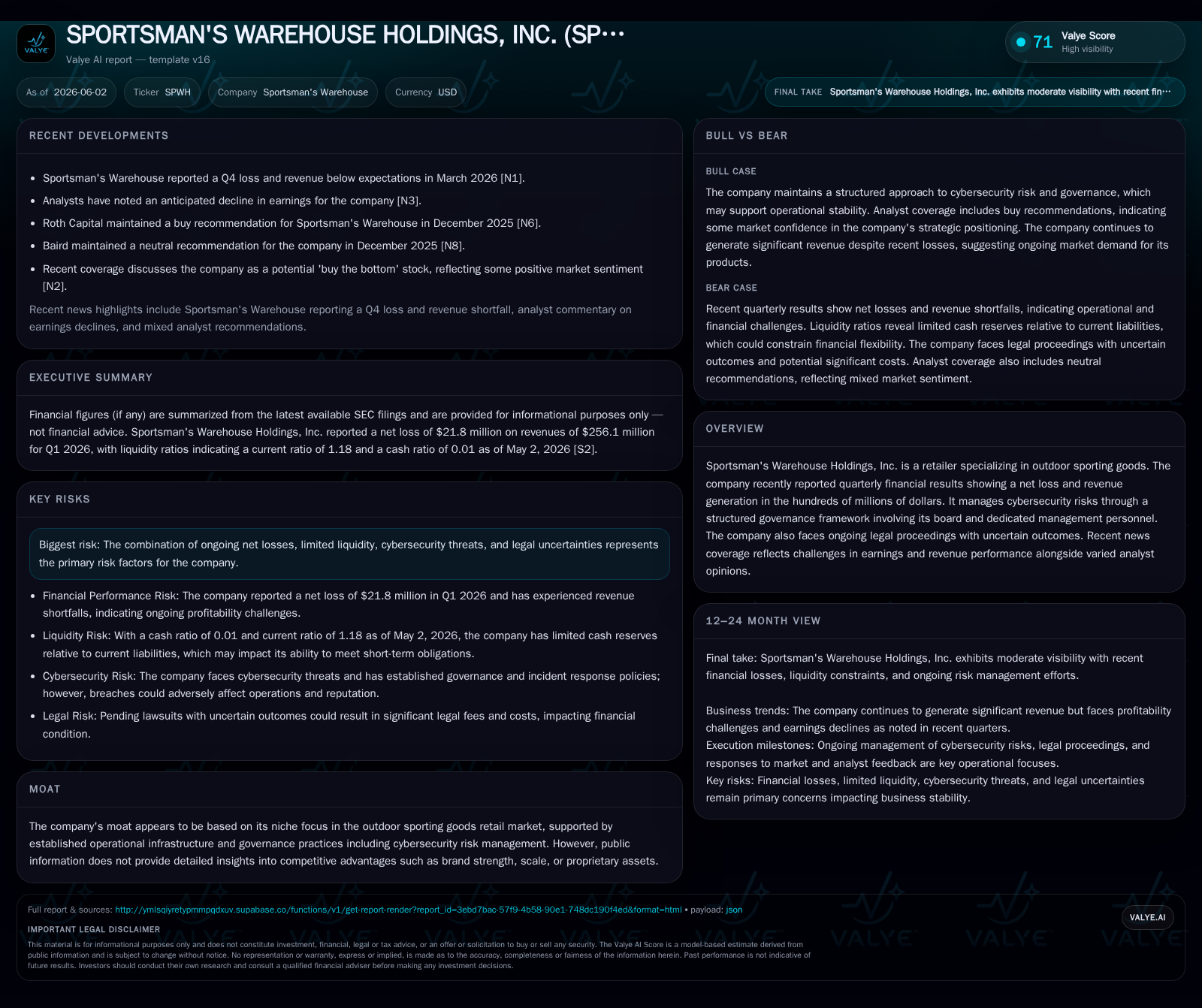
Sportsman’s Warehouse reported a net loss of $50 million in Q1 2026 despite revenue exceeding expectations at approximately $1.2 billion, highlighting continuing margin pressures. The company’s liquidity remains constrained with only about $2 million cash against $45 million total debt, reflected in a modest current ratio of 1.18. Its business model centers on a niche outdoor sporting goods market supported by specialized product offerings and operational infrastructure but faces profit challenges amid legal uncertainties and cybersecurity threats managed through structured governance. Growth potential hinges on margin improvement, seasonal demand recovery, and channel expansion balanced against risks from sustained losses, liquidity pressure, and ongoing litigation.
Latest Quarter Operating Update Highlights Stress
Sportsman’s Warehouse Holdings’ Q1 2026 financial performance reported on June 2 shows continuing operational challenges despite maintaining sizable revenue throughput. The company recorded approximately $1.21 billion in sales revenue for the quarter ended May 2, surpassing analyst expectations slightly but still absorbing an operating loss of $37.4 million and a net loss standing at $50.06 million [S2][F1]. These figures underline persistent margin pressure where top-line growth is insufficiently translating into profitability.
Current assets stood at approximately $410.7 million against current liabilities of around $348.8 million, resulting in a current ratio of 1.18 — signaling only moderate cushion against short-term obligations and underscoring tight working capital conditions [F1]. This pressure complicates the company's ability to absorb unexpected expenses or invest aggressively without additional financing.
Furthermore, the filings reaffirm ongoing involvement in material legal proceedings characterized by intrinsic uncertainties regarding defense costs and final outcomes that could strain financial resources further [S1][S2]. Simultaneously, Sportsman’s Warehouse maintains a robust cybersecurity governance framework despite such external risks adding operational layers to management’s oversight responsibilities.
Business Model: Niche Outdoor Sporting Goods Retail Dynamics
Sportsman’s Warehouse operates as a specialized retailer catering primarily to outdoor sporting enthusiasts. Its revenue generation model hinges on sales of hunting gear, fishing equipment, camping supplies, and related apparel — typically marketed toward consumers seeking tailored product assortments rather than mass-market general merchandise [S1]. This specialized product mix grants some pricing latitude above commoditized goods; however, margins remain pressured by inventory turnover demands and seasonally concentrated sales patterns characteristic of leisure specialty retail.
Revenue mechanics here are driven by customer purchase behaviors linked tightly to product availability breadth and depth. Customers face moderate switching costs anchored in assortment variety—loyalty can be fostered with comprehensive selections appealing to hobbyists who value expertise alongside price considerations. On the cost side, inventory carrying costs weigh heavily given the need to stock seasonal items timely while avoiding obsolescence.
The company’s physical store footprint acts as both a revenue-generating channel and an operational capacity element requiring effective utilization to contain fixed overheads—capacity constraints or underperformance can magnify profitability drag in fixed-cost-heavy retail environments.
Industry Context and Competitive Positioning
Within the outdoor sporting goods retail sector, Sportsman’s Warehouse competes alongside larger players benefiting from economies of scale such as Bass Pro Shops or Cabela's (owned by Vista Outdoor). Compared with these entrenched peers boasting broader geographic penetration and scale advantages, Sportsman’s Warehouse occupies a more narrowly focused market position targeting regional customers with specific merchandise needs [N2][S1].
This relative scale disadvantage likely constrains pricing power versus bigger competitors able to negotiate more favorable supplier terms or cross-subsidize promotional activities across extensive channels. Nonetheless, differentiation efforts through curated product selection and localized customer service can provide resilience within its niche.
Industry-wide headwinds influencing SPWH include supply chain disruption risks that impact merchandise availability and costs; shifts towards e-commerce channels affecting brick-and-mortar capacity utilization; plus cost inflation pressures that erode retail margins broadly—factors requiring strategic adjustments to inventory planning and online-offline balance.
Structured Cybersecurity and Legal Risk Management
Acknowledging cyber threats as salient operational risks—especially given sensitive customer data handled—the board's audit committee allocates explicit oversight responsibility for cybersecurity risk management [S1]. Day-to-day implementation resides with seasoned personnel including the Vice President of Information Technology supported by Governance, Risk & Compliance managers plus external consultants certified in security protocols.
Incident response policies are clearly defined with escalation frameworks reaching executive leadership depending on severity. Regular status updates flow upwards to the audit committee as part of ongoing threat mitigation and vulnerability assessments aimed at minimizing breach exposures or service disruptions.
Alongside cybersecurity vigilance lies exposure from ongoing legal proceedings that present indeterminate financial demands. These suits contribute notable uncertainty around future operating costs related to defense expenses or settlement liabilities—a factor that complicates forward planning within an already strained profitability context [S1]
Growth Catalysts and Potential Demand Drivers
Looking ahead, Sportsman's Warehouse may unlock margin expansion through refined product pricing aligned more tightly with consumer willingness-to-pay within its specialty segments. Product mix optimization emphasizing higher-margin proprietary or exclusive lines could alleviate some cost pressures exacerbated by commodity-price competition.
Seasonal surges tied to hunting seasons or camping cycles remain critical demand accelerators capable of generating disproportionate revenue within limited periods—strengthening inventory responsiveness during these windows can help drive top-line acceleration.
Digitally enabled channel enhancements also represent growth avenues; deploying improved omni-channel integration may boost customer reach beyond traditional store catchments while reinforcing loyalty programs tailored for repeat buyers.
Exploration into adjacent geographic markets or deeper penetration within existing territories offers incremental volume gains though may require upfront capital investment balanced against liquidity constraints currently evident.
Risks and Constraints: Liquidity, Earnings Pressure, Legal Exposure
Despite top-line robustness close to $1.2 billion per quarter, sustained net losses expose critical vulnerabilities regarding profitability sustainability absent structural improvements [F1][S2]. Such losses erode retained earnings reserves often necessary to support working capital cycles especially relevant given narrow cash buffers around two million dollars juxtaposed against multimillion-dollar debt obligations.
The visible gap between current assets and liabilities further reinforces working capital tightness which heightens dependency on efficient inventory turnover—a common challenge in seasonal retail that if mishandled results in markdowns or stockouts impacting margins [F1]
Legal exposures add an unpredictable cost overlay potentially draining financial resources intermittently depending on litigation outcomes or settlements required [S1]. Moreover, macroeconomic headwinds including inflationary input costs for raw materials plus discretionary consumer spending weakness amid economic uncertainty potentially suppress demand for outdoor leisure products.
Outlook: Metrics and Milestones to Monitor in Coming Quarters
Investors should keep close watch on subsequent quarterly revenue trajectory post-Q1 volatility as initial recovery signs may indicate whether recent margin pressures ease or deepen [S3]. Margins merit scrutiny especially any progress tied to cost reduction programs or improved selling price realization initiatives notably within higher-value categories.
The evolution of pending lawsuits—including any settlements or dismissals—will materially influence contingency funding needs impacting near-term earnings forecasting.[N1]
Cybersecurity incident frequency or severity developments will also serve as key indicators reflecting efficacy of governance frameworks in containing operational disruption risks.[S3]
Lastly, observable shifts toward enhanced digital engagement metrics or same-store sales trends will shed light on customer retention strength amidst competitive retail environment transitions.
Supporting Financial Overview from Latest Quarter
The quarter-ending balance sheet snapshots reaffirm operational stresses underlying Sportsman’s Warehouse's business dynamics. Revenue clocked just over $1.2 billion with an operating loss exceeding $37 million resulting in a net loss outage surpassing $50 million—the disconnect between substantial sales volume and bottom-line erosion remains pressing [F1][S2]
Current assets and liabilities reflect a current ratio of 1.18, confirming tight short-term asset liability matching requiring vigilant working capital discipline moving forward [F1]
These financial metrics provide tangible context supporting analysis that despite niche strength within outdoor specialty retail markets Sportsman’s Warehouse confronts persistent profit headwinds coupled with balance-sheet limitations necessitating cautious execution strategies over ensuing quarters.
This analysis is intended solely for informational purposes based on publicly available regulatory filings and news reports as of June 2026 detailing Sportsman's Warehouse Holdings' operating environment without any research view regarding investment decisions.
Disclaimer: This is research-only, informational analysis and not investment advice. It may include AI-generated interpretation and general industry context. Always verify important details using primary sources.

Comments