
1st Source Corp Strengthens Regional Banking with Diversified Specialty Finance and Community Focus
Robust Q2 2026 results reflect steady loan growth and resilient credit quality amid evolving regulatory landscape.
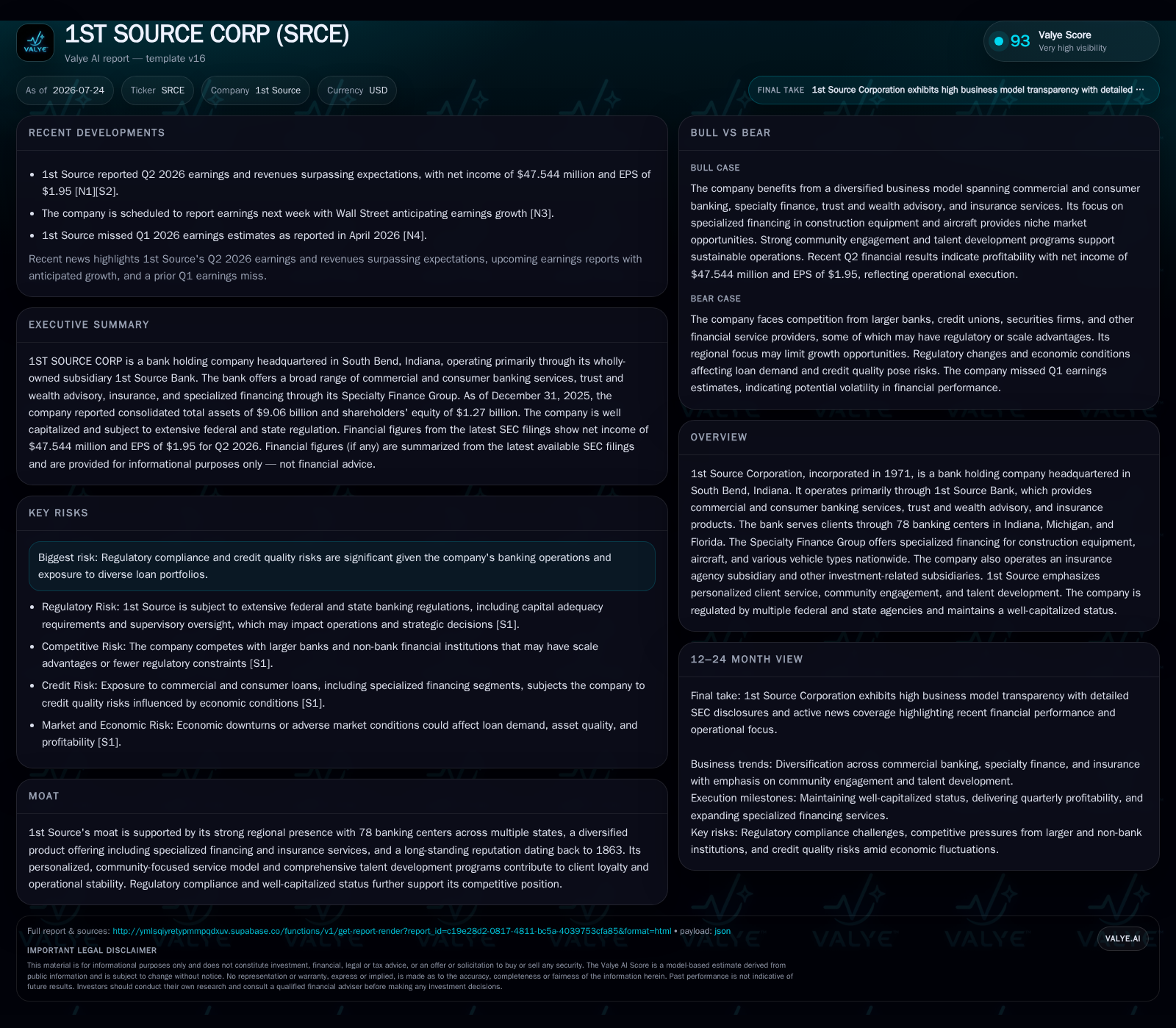
1st Source Corporation delivered stronger-than-expected earnings in Q2 2026, supported by growth in its commercial banking and specialty finance portfolios. The company's business model leverages a regional branch network complemented by specialized lending and wealth services, creating a diversified revenue base resilient to interest rate pressures and economic cycles. Regulatory reforms in 2025 have tempered supervisory focus toward material financial risk, presenting both compliance challenges and operational clarity. Key risks remain around credit quality in niche specialty finance segments and evolving regulatory requirements. Monitoring loan-to-deposit trends, net interest margin, and allowance for credit losses will be critical near-term indicators of execution.
Recent Operating Update
1st Source Corporation reported second-quarter earnings for 2026 on July 23 that exceeded consensus expectations, driven by solid net interest income growth and broad-based loan portfolio expansion [S2][N1]. The company’s commercial banking segment saw sustained demand for business loans supporting industrial and commercial property financing, equipment acquisition, and working capital needs. Simultaneously, the Specialty Finance Group contributed steady revenue through its niche lending in construction equipment, aircraft, and fleet vehicle financing across 15 U.S. locations [S2][S3]. Despite an operating backdrop characterized by moderate economic uncertainty and interest rate volatility, 1st Source maintained stable asset quality metrics with consistent provisions for credit losses, reflecting prudent risk management.
This quarter’s performance reflects management’s effective balance sheet positioning amid evolving regulatory conditions. The 2025 regulatory reforms, initiated under the new federal administration, shifted supervisory focus from broad governance and reputational risk toward a more targeted assessment of material financial risks [S1]. This recalibration reduced some compliance complexities but heightened the importance of dynamic credit risk modeling and allowance for credit losses estimation, particularly for diversified loan portfolios like 1st Source’s.
Business Model Overview
1st Source operates as a regional bank holding company through its wholly owned subsidiary, 1st Source Bank, which delivers a comprehensive suite of financial services. The commercial banking division provides loans primarily to privately owned businesses for industrial and commercial real estate, equipment financing, inventory, acquisitions, and general corporate purposes. Consumer banking products include checking and savings accounts, certificates of deposit, and health savings accounts, offered through 78 banking centers located mainly in Indiana, Michigan, and Florida [S1][S4].
The Specialty Finance Group complements this footprint by offering specialized asset-backed lending products, focusing on construction equipment, new and pre-owned private and cargo aircraft, and automotive fleets including trucks, vans, motor coaches, and vocational vehicles. This segment serves a diverse national client base, targeting industries underserved by traditional lenders and thereby diversifying revenue streams beyond conventional commercial loans [S1]
Revenue generation primarily stems from net interest income derived from lending activities, supported by a stable core deposit base cultivated through the branch network and digital channels [S1]. Fee income from trust and wealth advisory services and commissions from insurance products further diversify earnings, leveraging cross-selling opportunities within the existing client base
Key operating metrics demonstrate disciplined balance sheet management, with the loan-to-deposit ratio maintained below 100%, underscoring conservative liquidity positioning that supports resilience amid economic fluctuations [S6][S8]. Deposit growth benefits from the physical branch network complemented by increasing digital adoption, enabling cost-effective client acquisition and retention.
Industry Structure and Competitive Position
1st Source operates within the regional banking and specialty finance industry, a sector characterized by intense regulatory oversight and competitive pressures from larger national banks and fintech entrants. Regional banks like 1st Source differentiate themselves through personalized client relationships and specialized lending niches. Peers such as Regions Financial Corporation and Wintrust Financial Corporation illustrate the benefits of scale and product breadth, whereas 1st Source leverages its specialty finance expertise and community banking focus to maintain competitive positioning.
The Specialty Finance segment is a strategic differentiator, providing tailored financing solutions for capital-intensive sectors such as construction and transportation. While this specialization supports revenue diversification, it also introduces cyclicality linked to the capital expenditure cycles of these industries, which can impact asset quality and credit risk profiles [S1]
Profitability in the sector hinges on maintaining net interest margin (NIM) amid fluctuating interest rates and effectively managing allowance for credit losses in response to evolving macroeconomic conditions [S12][S22]. Regulatory capital requirements impose discipline on leverage and risk-taking; 1st Source’s well-capitalized status provides flexibility to pursue growth while maintaining compliance.
Growth Drivers
Growth initiatives focus on expanding the commercial loan portfolio aligned with regional economic development and scaling Specialty Finance offerings nationally to meet demand for asset-backed lending solutions [S1]. The bank’s engagement in renewable energy financing, particularly commercial solar projects across the Northeast and Midwest, represents an opportunistic pivot toward emerging sectors with sustainable growth potential.
Augmenting the deposit base remains critical, as stable core deposits provide low-cost funding essential for net interest margin optimization [S6][S8]. Growth is supported by the extensive branch network and enhanced digital banking capabilities, facilitating acquisition of younger demographics alongside traditional customers
Fee income growth from trust and wealth advisory services and insurance products contributes to revenue diversification and strengthens client relationships, supporting retention in a competitive market. Cross-selling integrated financial products enhances customer lifetime value.
The geographic footprint across Indiana, Michigan, Florida, and select national markets accessed via Specialty Finance mitigates concentration risk while capitalizing on regional economic tailwinds [S4].
Risks and Watchpoints
Credit risk remains a focal point, particularly in Specialty Finance segments exposed to cyclical industries such as construction equipment and fleet vehicles. The allowance for credit losses incorporates sophisticated cohort and PD/LGD models with macroeconomic overlays, but the inherent uncertainty in forecasting economic conditions—including inflation persistence, geopolitical tensions, and labor market softness—necessitates vigilant monitoring [S1].
Interest rate risk poses ongoing challenges to net interest margin stability [S6][S8]. Despite active asset-liability committee (ALCO) management and use of interest rate swaps, repricing mismatches between assets and liabilities, especially sticky deposit costs, could compress margins in volatile rate environments
Regulatory developments, while recently easing supervisory intensity toward governance and reputational risks, remain a variable. Changes in capital adequacy standards, reporting requirements, or enforcement focus could materially affect operational flexibility and compliance costs.
Competitive pressures from larger banks with scale advantages and fintech firms leveraging digital innovation may increase customer acquisition costs and necessitate ongoing investment in product and technology enhancements.
What to Watch Next
Key near-term indicators include quarterly loan portfolio growth segmented by commercial and Specialty Finance categories, providing insight into demand dynamics and risk concentration.
Deposit base trends, including core versus brokered deposits and retention rates, will signal funding stability and liquidity health.
Adjustments to allowance for credit losses and provisioning levels, reflecting updated economic outlooks and portfolio performance, will reveal management’s risk assessment and credit quality trajectory.
Net interest margin trends amid interest rate fluctuations and the contribution of non-interest income from fee-based services will indicate the effectiveness of revenue diversification strategies.
Operational efficiency metrics, such as the cost-to-income ratio, will shed light on scalability and cost management amid multi-product delivery through physical and digital channels.
Renewable energy financing volumes will be a barometer of the bank’s positioning in this emerging growth sector.
Financial Profile Discussion
1st Source maintains a robust capital position, with common equity Tier 1 capital ratios near 14%, comfortably exceeding Basel III regulatory minimums and qualifying the bank as well-capitalized under federal standards [S12][S22]. This capital adequacy supports growth initiatives and provides a buffer against unexpected credit or market shocks.
The allowance for credit losses reflects a conservative approach, incorporating forward-looking qualitative overlays responsive to macroeconomic uncertainties, thereby ensuring sufficient loan loss reserves without current material impairments [S1]
Liquidity remains a strength, supported by over $1.28 billion in unencumbered securities and access to approximately $480 million in Federal Home Loan Bank advances, underpinning contingency funding plans [S7]. The funding mix balances a core deposit base exceeding 70% of total assets with controlled use of purchased funds, maintaining flexibility and cost efficiency [S6][S15].
Disclaimer: This is research-only, informational analysis and not investment advice. It may include AI-generated interpretation and general industry context. Always verify important details using primary sources.

Comments