
Sempra Expands LNG Infrastructure Amid Volatile Earnings and Regulatory Complexities
The energy infrastructure leader balances massive LNG projects and regulated utilities with rising capital demands and regulatory hurdles.
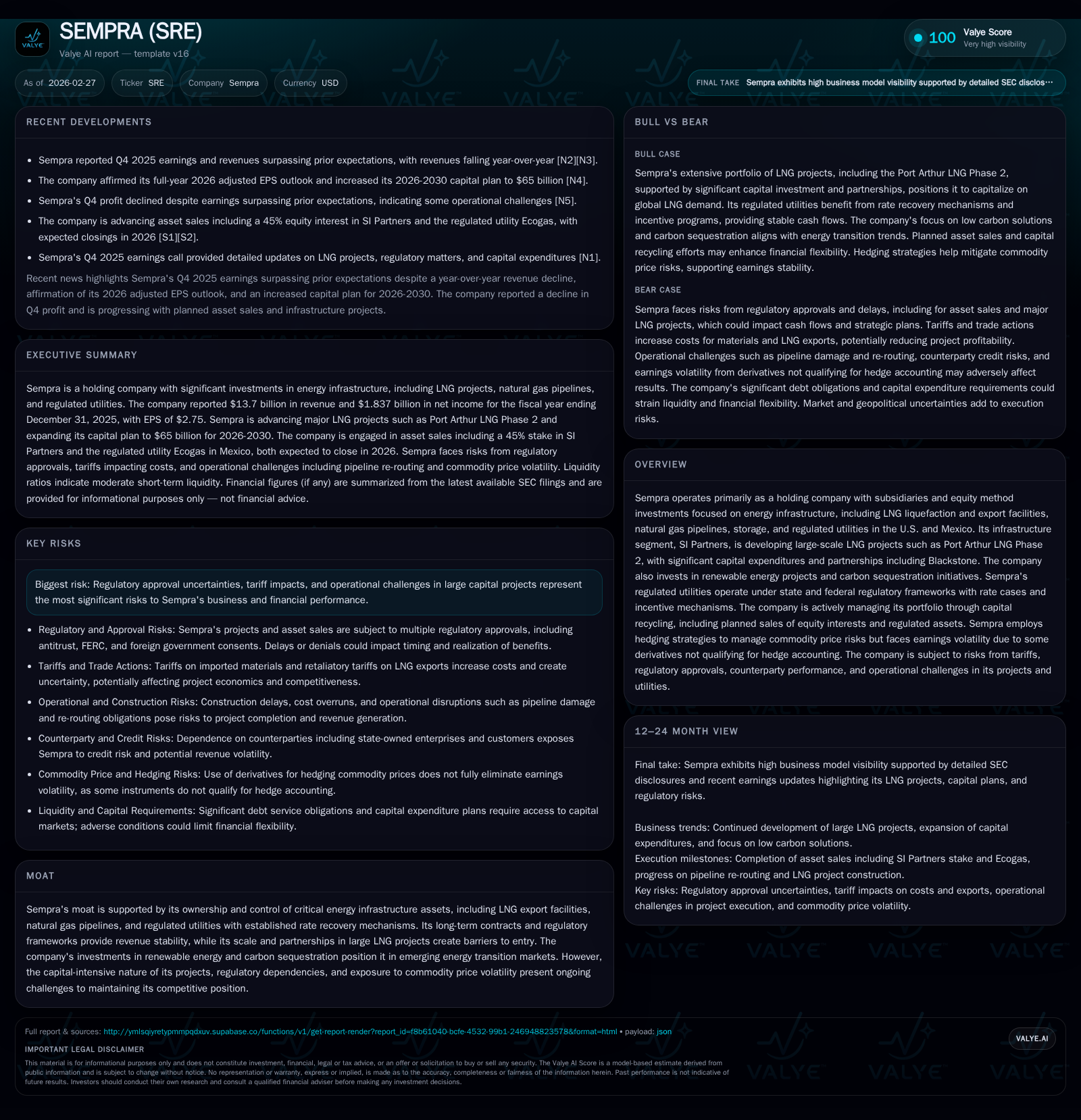
Sempra’s 2025 financials reflect modest revenue growth but markedly lower net income, driven in part by amplified operational costs and project investments. The company’s strategic focus remains on scaling its LNG liquefaction capacity through the Port Arthur LNG Phase 2 project, leveraging partnerships with Blackstone and KKR amid a $65 billion capital plan through 2030. Regulatory environments across California, Texas, and Mexico impose uncertainties, especially in rate approvals and wildfire-related liabilities. Despite solid operating cash flows, heavy capex results in negative free cash flow, pressuring liquidity and underscoring growing debt service needs.
Historical Financial Performance
Over the past four years, Sempra has witnessed generally steady but uneven financial outcomes shaped by its dual focus on regulated utilities and large-scale LNG infrastructure development. Revenue peaked at $16.7 billion in 2023 before retreating to $13.7 billion in 2025. Notably, net income demonstrated volatility with a sharp decline from $3.08 billion in 2023 to $1.84 billion in 2025—a near 36% drop year-over-year mainly attributable to elevated operating costs and project-related expenses.
Operating cash flows have remained positive albeit downward trending from $6.22 billion (2023) to $4.57 billion (2025), reflecting higher working capital demands partially offset by increased revenues.
Capital expenditures spiked dramatically by over 70% compared to the prior year due largely to aggressive investments in LNG capacity expansions such as Port Arthur Phase 2 ($14 billion total capex expected), requiring substantial upfront outlays during construction phases [F1][S1]. The combination of soaring capex and declining CFO generated approximately negative $1.51 billion free cash flow last fiscal year.
Historical performance (annual)
| FY | Rev ($bn) | Net ($bn) | CFO ($bn) | Capex ($bn) | Rev YoY | Net YoY |
|---|---|---|---|---|---|---|
| 2025 | 13.7 | 1.8 | 4.6 | +3.9% | -35.8% | |
| 2024 | 13.2 | 2.9 | 4.9 | -21.1% | -6.9% | |
| 2023 | 16.7 | 3.1 | 6.2 | 6.1 | +15.8% | |
| 2022 | 14.4 | 1.1 | 3.5 |
Source: SEC companyfacts cache [F1].
Capital returns and efficiency (annual)
| FY | Div ($mm) | Buybacks ($mm) | FCF ($bn) |
|---|---|---|---|
| 2025 | 1603 | 58 | |
| 2024 | 1499 | 43 | |
| 2023 | 1483 | 32 | 0.1 |
| 2022 | 1430 | 478 | -2.4 |
Source: SEC companyfacts cache [F1].
Note: Capex shown for latest full year data available is for Q3 periods where relevant.
Business Overview and Moat
Sempra operates as an energy infrastructure holding company with significant assets spanning California, Texas, and Mexico—including regulated utilities such as San Diego Gas & Electric (SDG&E), Southern California Gas Company (SoCalGas), Sempra Texas Utilities (Oncor & Sharyland)—and nonregulated businesses primarily through Sempra Infrastructure focused on LNG export facilities, pipelines, storage, renewables, and carbon sequestration.
The company's competitive advantage is supported by regulatory frameworks that provide revenue stability via rate cases granting authorized returns on equity typically near high single digits (~9.6%-9.7%) approved by agencies such as the CPUC for California entities and PUCT for Texas utilities [S13][S14]. Long-term contracts underpinning LNG operations further de-risk cash flows while scale advantages enable large-capital LNG developments alongside institutional partners like Blackstone and KKR.
Renewable energy investments paired with emerging carbon capture initiatives position Sempra within evolving low-carbon markets supported by regulatory incentives though still nascent.
Growth Drivers
Port Arthur LNG Phase Two Expansion
A key growth driver is the Port Arthur LNG Phase Two development comprising four additional liquefaction trains expected to commence commercial operations around 2030-31 [S1]. The project carries an estimated total capex exceeding $14 billion including a major EPC contract awarded primarily to Bechtel valued near $9 billion plus contingencies.
SI Partners retains majority equity ownership alongside Blackstone's nearly half stake following a recent $3.4B equity injection plus future commitments of ~$3.6B; Sempra’s remaining commitment is up to ~$7.8B [S1][S2]. Pending completion of a transaction selling approximately a 45% minority stake in SI Partners to KKR ($10B valuation) expected mid-2026 would provide capital recycling benefits though reduce future profit share from this segment [S2].
Regulated Utility Rate Cases & Environmental Compliance Programs
On the regulated utility side, ongoing rate cases permit recovery of prudent costs related to safety programs—including wildfire mitigation critical given California's fire risk—and environmental mandates such as renewable portfolio standards targeting zero-carbon electricity procurement by mid-century under SB100 legislation [S16][S17]. These mechanisms bolster predictable revenues but carry execution risk due to regulator scrutiny around cost prudence amid affordability concerns.
Renewable Gas Procurement & Carbon Sequestration Initiatives
California’s biomethane procurement program requires utilities like SDG&E and SoCalGas progressively increase renewable gas volumes delivered through distribution networks; coupled with initial carbon capture investments, these efforts could create new revenue streams or offset emissions liabilities though remain small relative to core fossil fuel infrastructure presently [S16].
Constraints & Risks
- Capital Intensity: Massive capex requirements for Port Arthur LNG Phase Two ($14B+) plus ongoing utility investments strain liquidity and leverage metrics, heightening refinancing risks amid volatile credit markets or rating agency downgrades observed since early/mid-2025 [S5][S6][S8][S12].
- Regulatory Uncertainties: Delays or modifications in rate approvals by CPUC/PUCT/FERC—especially concerning capitalization methods or wildfire-related cost recoveries—could affect revenue adequacy; evolving environmental compliance costs add unpredictability [S10][S17][S20].
- Commodity Price Volatility: Despite hedging strategies using derivatives designed to mitigate earnings swings from natural gas/LNG/electricity price fluctuations, imperfect hedge accounting treatment causes earnings volatility due to mark-to-market effects without matching economic offsets reflected simultaneously [S19].
- Transaction Execution Risks: Planned sales of significant SI Partners stake (~45%) and Ecogas utility involve complex multi-jurisdictional regulatory approvals prone to delays or conditions potentially impairing anticipated capital recycling benefits or altering cash flow profiles post-sale [S2].
- Operational & Litigation Exposure: Ongoing litigation linked to California wildfires presents contingent liabilities with uncertain timing or magnitude; upcoming labor contract renewals mid-2026 could affect workforce stability given certain union agreements expiring soon [S11][S24].
Capital Allocation & Returns
Dividend payments rose moderately with approximately $1.6 billion distributed during fiscal year ending December 2025 reflecting management’s commitment to returning capital despite significant reinvestment needs for growth projects [F1]. Conversely, share repurchases declined sharply representing only about $58 million versus previous hundreds of millions annually likely constrained by negative free cash flow after heavy capital spending years.
Approximate return on equity based on net income relative to shareholder equity is near a modest ~5.8%, influenced by elevated equity balances tied up in infrastructure development alongside profitability headwinds such as commodity price impacts and ramp-up phase operating costs [F1].
Liquidity metrics indicate reasonable short-term coverage with a current ratio around 1.59 reflecting sufficient current assets relative to liabilities; however, significant debt maturities loom necessitating timely refinancing or fresh capital raises given multi-billion-dollar projected capital requirements per updated five-year plan raising total forecasted spend toward $65 billion through decade-end [N12][S21].
Outlook & Milestones To Watch
Investors should monitor:
- Progress against critical construction milestones at Port Arthur LNG Phase Two where cost overruns or delays would materially affect cash flow timing and profitability.
- Receipt of final regulatory approvals enabling closing of KKR’s SI Partners stake acquisition alongside Ecogas sale—delays may constrain funding flexibility.
- Outcomes of key utility rate cases managed by California CPUC or Texas PUCT reviewing authorized ROEs or recovery mechanisms tied to wildfire mitigation/environmental compliance expenditures.
- Market dynamics influencing commodity prices which impact derivative fair value adjustments causing earnings volatility.
- Labor contract negotiations due mid-to-late-2026 that could affect operational continuity.
These elements will collectively shape Sempra’s medium-term financial trajectory balancing expansion of fossil fuel infrastructure alongside gradual decarbonization initiatives integral within its regulated utility franchises.
This report synthesizes publicly available SEC filings and recent news disclosures regarding Sempra Energy as of February 2026 without providing investment advice or recommendations.
Disclaimer: This is research-only, informational analysis and not investment advice. It may include AI-generated interpretation and general industry context. Always verify important details using primary sources.

Comments