
Capital Allocation and Market Focus Drive Sterling Infrastructure’s 2025 Turnaround
Sterling Infrastructure has reshaped its portfolio since 2016 through strategic risk management, acquisitions, and focused capital deployment to realize marked margin improvements and market expansion by 2025.
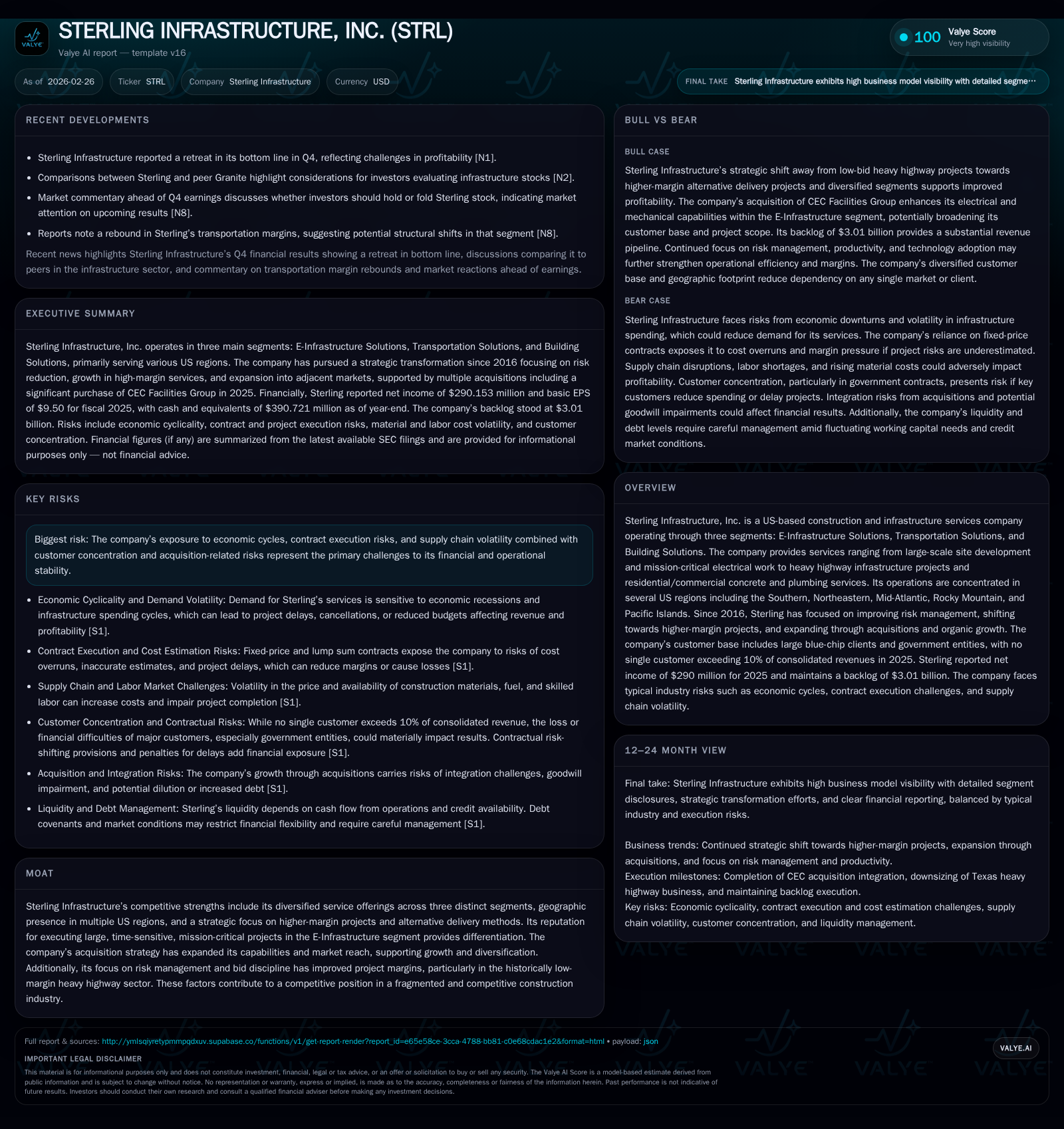
Sterling Infrastructure, Inc. evolved from a low-margin heavy highway contractor into a diversified infrastructure services provider with three distinct segments by emphasizing disciplined risk assessment and higher-margin projects since 2016. Strategic acquisitions, notably the 2025 purchase of CEC Facilities Group, expanded its technical capabilities and geographies, particularly in the high-growth E-Infrastructure space tied to mission-critical electrical and site development projects. Despite exposure to cyclical infrastructure spending and supply chain volatility challenges, Sterling’s robust backlog and healthy cash flow generation underpin an outlook supported by secular demand for data center-related infrastructure. The company has returned capital through share repurchases backed by strong free cash flow and achieved a return on equity exceeding 25% in 2025.
From Low-Margin Legacy to Risk-Managed Portfolio: Sterling’s Growth History
Since undertaking a transformative pivot in 2016, Sterling Infrastructure has transitioned away from its historic reliance on low-bid heavy highway projects — which once accounted for approximately 79% of total revenue — toward a diversified portfolio focused on higher-margin contract types across three segments: E-Infrastructure Solutions, Transportation Solutions, and Building Solutions [S1][S13]. This shift was underpinned by enhanced bid discipline and rigorous risk assessment protocols introduced starting in 2016 that successfully halved project risk exposure in heavy highway work and more than doubled gross margins therein.
Financially, this operational recalibration fueled a substantial escalation in profitability: operating income surged from $37.0 million in FY2022 to over $405.9 million by FY2025 [F1]. This extraordinary near-term improvement stems from both organic margin enhancement — particularly within Transportation Solutions as low-margin Texas heavy highway contracts phased out since early 2025 — and accretive effects of targeted acquisitions. Revenue similarly reflected this trajectory with compound annual growth propelling top-line figures beyond prior years’ levels [F1].
Historical performance (annual)
| FY | Net ($mm) | CFO ($mm) | OpInc ($mm) | Capex ($mm) | Net YoY |
|---|---|---|---|---|---|
| 2025 | 290 | 440 | 406 | 77 | +12.7% |
| 2024 | 257 | 497 | 265 | 81 | +85.7% |
| 2023 | 139 | 479 | 206 | 64 | +30.2% |
| 2022 | 106 | 219 | 37 | 61 |
Source: SEC companyfacts cache [F1].
Capital returns and efficiency (annual)
| FY | Buybacks ($mm) | FCF ($mm) | ROE% |
|---|---|---|---|
| 2025 | 74 | 363 | 26.2 |
| 2024 | 71 | 416 | 31.9 |
| 2023 | 414 | 22.4 | |
| 2022 | 158 | 22.4 |
Source: SEC companyfacts cache [F1].
Note: Revenue figures prior to FY2018 not continuously available; significant uplift aligns with operational improvements plus recent acquisitions [F1].
Breaking Down Segment Performance and Regional Footprint
Sterling operates via three specialized segments each addressing distinct markets:
E-Infrastructure Solutions targets sophisticated large-scale site development and mission-critical electrical/mechanical systems for data centers, semiconductor fabs, manufacturing hubs, warehousing, power generation facilities predominantly concentrated in Southeastern, Northeastern, Mid-Atlantic and Rocky Mountain US regions [S4][S5]. This segment serves blue-chip enterprise customers with repeat business vital for maintaining premium margin profiles.
Transportation Solutions encompasses heavy highway construction including highways, bridges, railways plus aviation infrastructure focusing heavily on state Departments of Transportation (DOTs) primarily across Utah, Arizona, Colorado, Nevada, Texas (with downsizing ongoing), and Pacific Islands [S4][S12]. DOT contracts form a significant but competitive revenue source subject to public sector budgeting cycles.
Building Solutions includes residential plumbing foundations (single-family/multi-family homes) plus commercial concrete structural work for multifamily dwellings and parking structures focused largely in Texas metro areas such as Dallas-Fort Worth and Houston; recent expansion into Phoenix follows selective acquisitions [S4][S11].
Geographically diversified operations limit undue dependence though top individual customers can represent substantial segment revenues while still falling beneath a consolidated threshold of approximately 10% [S4]. This reduces concentration risks slightly but loss of any major account or regional disruption could impact near-term revenue.
Strategic Acquisitions as Engines of Expansion and Diversification
Sterling's acquisition strategy since the transformational period centers less on scale alone than on augmenting service capabilities within adjacent high-growth markets tied to evolving industry needs [S5]. The headline transaction is the September 2025 acquisition of Irving-based CEC Facilities Group for $562 million ($443 million cash + $79 million stock + earn-out potential), expanding specialty electrical/mechanical contracting capacity within the E-Infrastructure segment crucially aligned with growing data center deployments [S7].
CEC broadened Sterling’s expertise toward mission-critical electrical services delivering premium gross margins through complex multi-trade integration acting as an accelerant for overall profitability improvement evident in the latest fiscal year operating results [S7][F1]. The decentralized business model supports nimble integration minimizing disruption while capturing complementary client relationships.
Periodic smaller tuck-ins complement organic growth initiatives enhancing geographic reach especially into Phoenix residential markets post-CCS acquisition and plumbing phases via PPG deal expanding Building Solutions breadth [S4].
Navigating Economic Cycles and Supply Chain Pressures: Key Constraints
Sterling remains exposed to typical cyclical fluctuations intrinsic to infrastructure sectors dependent on governmental capital spending patterns susceptible to macroeconomic variables including recessions or credit market contractions [S1][S14]. Risk factors include heightened competition compressing margins particularly within Transportation Solutions where low-bid legacy contracts have been curtailed but remain relevant.
Labor market tightness combined with volatility in construction materials pricing — influenced by global trade disruptions including tariffs — impose cost pressures which may be difficult to fully pass-through due to competitive bidding dynamics [S16][S14]. These headwinds complicate precise project risk estimations during bidding necessitating continually refined estimating processes.
The firm’s credit agreement imposes covenants limiting leeway to raise incremental debt curtailing financial flexibility amidst interest rate sensitivity posing refinancing risk considerations prior to maturity in mid-2028 if economic conditions deteriorate [S6][S8][S9]. Joint venture structures further expose Sterling to contingent liabilities amplifying execution risk should partners underperform [S2].
Bullish Outlook Underpinned by Robust Backlog and E-Infrastructure Demand
As of December 31, 2025 backlog stood at $3.01 billion excluding deconsolidated RHB results post-2024 contract restructuring reflecting stable future revenue visibility [S18]. The bulk comprises sizable contracts within E-Infrastructure solutions including multiple time-sensitive AI-oriented data center construction projects reinforcing structural demand drivers highlighted extensively across industry news outlets emphasizing secular tailwinds in mission-critical site development sectors ([N10],[N11]).
Management’s latest disclosures forecast continuity of this underlying momentum fostered by sustainable client demand patterns amid selective pipeline replenishment efforts coupled with geographic diversification minimizing region-specific downturn vulnerability [S3][N12]. Near-term earnings expectations anticipate continued margin resilience benefiting from previous bid discipline enhancements.
Capital Allocation Review: Cash Flows, Buybacks, and Return on Equity
Sterling Infrastructure generates ample operating cash flows supporting both operational reinvestment requirements alongside shareholder returns with CFO at approximately $440 million against capex steady at near $77 million during FY2025 yielding a robust free cash flow surplus around $363 million enabling liquidity preservation while funding discretionary buybacks totaling roughly $74 million last fiscal year [F1][S20][S26].
The company’s equity base ballooned from just under $475 million in FY2022 elevating past $1.1 billion entering FY2026 reflecting successful retention of earnings alongside capital injections linked primarily to stock consideration for acquisitions aligning returns with shareholders’ interests evidenced via an estimated return on equity above the notable threshold of approximately 26% last fiscal year calculated from reported net income over equity [F1].
This disciplined capital deployment exemplifies alignment between organic growth funding needs balanced against accretive financial engineering fostering shareholder value amid underlying operational strengthening.
What to Watch: Market Risks and Financial Milestones Ahead
Looking forward several critical indicators warrant close monitoring:
- Potential macroeconomic headwinds may dampen public infrastructure allocations impacting Transportation Solutions bidding opportunities; any severity could challenge backlog replenishment velocity placing pressure on margins.
- The success of integration efforts related to the CEC Facilities Group acquisition remains crucial for sustaining elevated segment-level profitability gains without dilution from execution missteps or cultural misalignment hazards frequently encountered post-acquisition [S22].
- Debt servicing flexibility governed by Credit Agreement covenants must be preserved amidst volatile interest rate environments requiring prudent liquidity management consistent with recent refinancing discussions highlighted in SEC filings [S9].
- Project delivery performance coupled with joint venture liability exposures poses continual operational risk necessitating stringent oversight ensuring contract completion timeliness avoiding penalties or liquidated damages detrimental to earnings quality [S14][N5][N6].
- Monitoring supply chain conditions especially materials availability/pricing trends will be important given persistent inflationary pressures outweighing past years' gradual stabilization attempts affecting margin sustainability across all segments.
Sterling Infrastructure's recent turnaround showcases a compelling case study of how targeted operational pivots combined with strategic acquisition-driven expansion can drive outsized profitability improvements even within cyclical sectors characterized historically by thin margins and competitive intensity.
Disclaimer: This analysis is provided for informational purposes only based on publicly available data as of February 26, 2026. It is not investment advice or a valuation recommendation.

Comments