
Sunoco LP’s Expansion and Capital Structure Shift Revenue Growth Amid Refinery Integration Risks
Sunoco LP’s recent international acquisitions and expanded operations drive top-line growth, while operational and regulatory challenges at the newly acquired refinery impose earnings pressure.
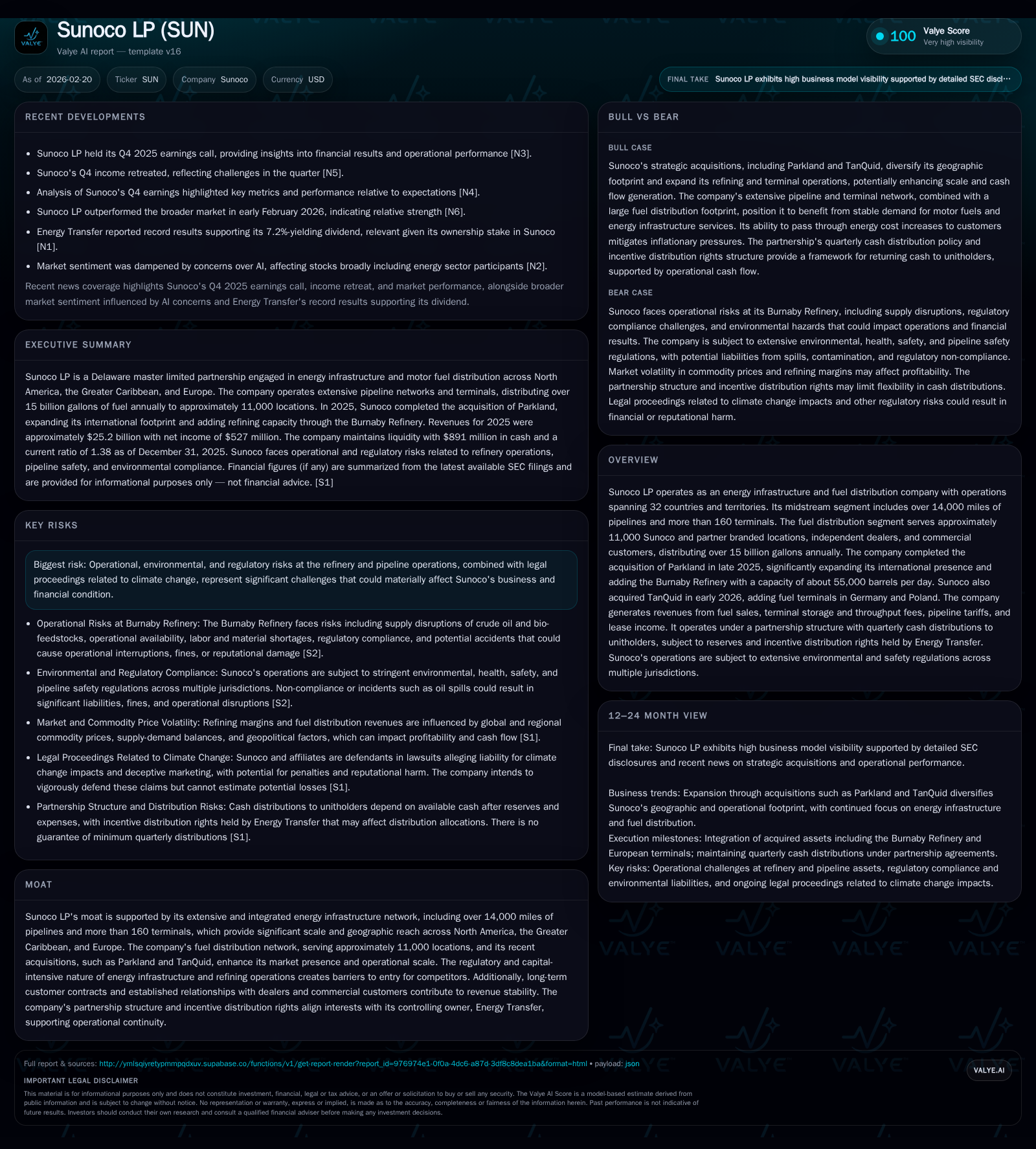
Sunoco LP posted an 11.1% revenue increase in FY2025, primarily fueled by its acquisitions of Parkland and TanQuid, which expanded its pipeline, terminal, and fuel distribution footprint across North America and Europe. Operating income rose by 18.2%, but net income declined 39.1%, impacted by integration costs and elevated environmental provisions linked to the Burnaby Refinery acquired with Parkland. The company maintains a solid operating cash flow growth (117%) and has significantly increased capital expenditures to support its network expansion. Going forward, balancing growth opportunities from its enhanced international presence against refinery operational risks and regulatory scrutiny will be critical.
Historical Performance Overview
Sunoco LP reported revenues of approximately $25.2 billion for FY2025, marking an 11.1% increase from $22.7 billion in FY2024 [F1]. This growth was predominantly driven by the acquisition of Parkland Corporation completed late in 2025 and the early-2026 acquisition of TanQuid — these deals expanded Sunoco’s operational footprint notably into Canada, Germany, Poland, and other European territories [N2][S1][S3]. Operating income improved sharply by 18.2% year-over-year to $935 million despite some headwinds due to refinery margin compression linked to the Burnaby Refinery now included within Sunoco’s portfolio [F1][S7]. Net income experienced a decline of about 39.1%, falling from $866 million in FY2024 to $527 million in FY2025 — this reflects elevated costs related to integration efforts, environmental provisions, and non-recurring expenses associated with these transformative acquisitions [F1][S11][S12].
Sunoco’s fuel distribution remains its core revenue engine — with about $23.9 billion attributed to this segment alone in FY2025 — distributing over 15 billion gallons annually across approximately 11,000 branded locations including independent dealers and commercial customers [S7][N2]. The addition of several hundred terminals through their latest deals extends their reach geographically and vertically integrates distribution channels.
Historical performance (annual)
| FY | Rev ($bn) | Net ($mm) | CFO ($mm) | OpInc ($mm) | Rev YoY | Net YoY |
|---|---|---|---|---|---|---|
| 2025 | 25.2 | 527 | 1192 | 935 | +11.1% | -39.1% |
| 2024 | 22.7 | 866 | 549 | 791 | -1.6% | +119.8% |
| 2023 | 23.1 | 394 | 600 | 635 | -10.3% | -17.1% |
| 2022 | 25.7 | 475 | 561 | 678 |
Note: Omitted columns lack sufficient annual XBRL coverage in the provided tags (need ≥2 annual points): Capex, Div, Buybacks, FCF, ROE%. Source: SEC companyfacts cache [F1].
*Capex data for FY2025 unavailable directly but was approximately $186 million for FY2022 pre-acquisition baseline [F1].
Expansion Through Acquisitions: Growth Drivers & Challenges
The Parkland acquisition brought into Sunoco a significant refining asset — the Burnaby Refinery with a capacity around 55,000 barrels per day — along with expanded storage terminals and pipelines mainly serving western Canada markets [S1][S2]. The TanQuid deal added strategic fuel terminals in Germany and Poland enhancing European market access [N3][S7]. These moves diversified Sunoco’s revenue base beyond North America into Europe and the Greater Caribbean.
However, the Burnaby Refinery presents distinct operational risks: it is highly dependent on crude feedstock delivered via the Trans Mountain Pipeline (TMPL); any apportionment or disruption can hamper throughput causing variability in refinery utilization and margins [S2]. Scheduled maintenance or unplanned outages also create earnings volatility given large power, natural gas, water inputs required for refining processes [S2]. Additionally, regulatory compliance regarding emissions limits and community opposition may lead to increased operating costs or potential license restrictions [S11][S12]. Moreover, refining margins are inherently volatile due to global commodity price dynamics beyond Sunoco’s control.
On balance, these acquisitions position Sunoco as a more integrated midstream-to-distribution player with stronger international presence but place operational discipline demands on managing refinery complexity alongside pipeline & terminal assets.
Financial Position & Capital Allocation
Post-acquisition balance sheets reflect substantial increases in long-term debt: total consolidated debt rose markedly from approximately $7.5 billion at end-2024 to $13.4 billion by end-2025 reflecting issuance for acquisition financing [F1][S4][S13][S23]. The company’s revolving credit facility ($2.5 billion maturing in mid-2030) was amended multiple times during this period evidencing proactive liquidity management amidst M&A activity [S4][S8]. The net leverage ratio stood at about 4.03x at year-end indicating elevated but manageable leverage given enhanced scale.
Operating cash flow showed robust expansion — more than doubling YoY from $549 million in FY2024 to roughly $1.19 billion climbing by 117%, supporting funding for capex (18% increase historically before acquisitions) as well as sustaining distributions [F1]. Though direct dividend or buyback data is unavailable in disclosures for recent years ([F1]), Sunoco maintains quarterly cash distributions consistent with its partnership structure aligned with Energy Transfer interests [S26]. Free cash flow appears comfortably positive after capital expenditures necessary for integration.
Sunoco leverages related party agreements extensively with Energy Transfer affiliates for pipeline services, storage, fuel purchases etc., intensifying operational synergies but necessitating transparency around transfer pricing and governance [S13][S21].
Industry Context & Regulatory Risks
Energy infrastructure operators face significant hurdles related to safety regulation compliance (pipeline safety rules under DOT), environmental liabilities under CERCLA-type statutes for contamination remediation liabilities, plus increasingly litigious climate change accountability claims as seen with ongoing cases involving Sunoco entities across US states [S11][S12][S17]. These risks could lead to meaningful financial reserves or penalties impacting reported profits.
Additionally, integration of foreign subsidiaries introduces cross-jurisdictional regulatory complexities especially around environmental norms affecting terminal operations in Europe [N3][S7]. Managing these factors while capturing growth via organic expansions or further tuck-ins will require disciplined risk mitigation.
Future Growth & Monitoring Points
While explicit financial guidance is sparse beyond milestone completion announcements regarding acquisitions [N3], key growth catalysts stem from:
- Synergies realized from Parkland refinery integration boosting refining throughput profitability if pipeline supply stabilizes;
- Enhanced terminal network utilization gains across Europe-Caribbean fueling volume growth;
- Commercial expansion leveraging newly added supply agreements.
Constraints include potential volatility in refining margins driven by commodity swings plus heightened regulatory costs particularly linked to carbon emissions laws.
Investors should monitor:
- Refining margin performance at Burnaby refinery relative to crude supply reliability on TMPL;
- Pipeline tariffs realization amid capacity utilization trends;
- Debt ratios as further acquisition or capex activity unfolds;
- Litigation or regulatory developments on climate-related environmental claims;
- Cash distribution stability given competitive pressures on margin extraction.
Concluding Perspective
Sunoco LP has strategically transformed itself through large-scale acquisitions expanding midstream energy infrastructure plus downstream distribution reach internationally by integrating Parkland and TanQuid assets recently. Top-line growth reflects these moves effectively alongside a rising operating income trajectory albeit tempered on net earnings by integration costs and environmental provisions tied mainly to its new refinery segment.
The company now balances new operational complexities coupled with higher leverage levels against attractive free cash flow generation capacity grounded in stable fuel distribution volume demand supported by broad multi-national infrastructure networks spanning over 14,000 miles of pipeline and more than 160 terminals.
Given inherent execution risks accompanied by an evolving energy regulatory landscape focusing increasingly on climate accountability measures — navigating these tradeoffs will define Sunoco's near- to medium-term financial trajectory.
This analysis is strictly informational based on available public documents without any explicit investment recommendation or guidance regarding security transactions.
Disclaimer: This is research-only, informational analysis and not investment advice. It may include AI-generated interpretation and general industry context. Always verify important details using primary sources.

Comments