
SunocoCorp’s Capital-Intensive Integration and Pipeline Network Expansion Shape 2025 Financial Performance
SunocoCorp LLC’s extensive pipeline and fuel distribution infrastructure, combined with key acquisitions, underpin a complex growth environment balanced by leverage and environmental risk considerations.
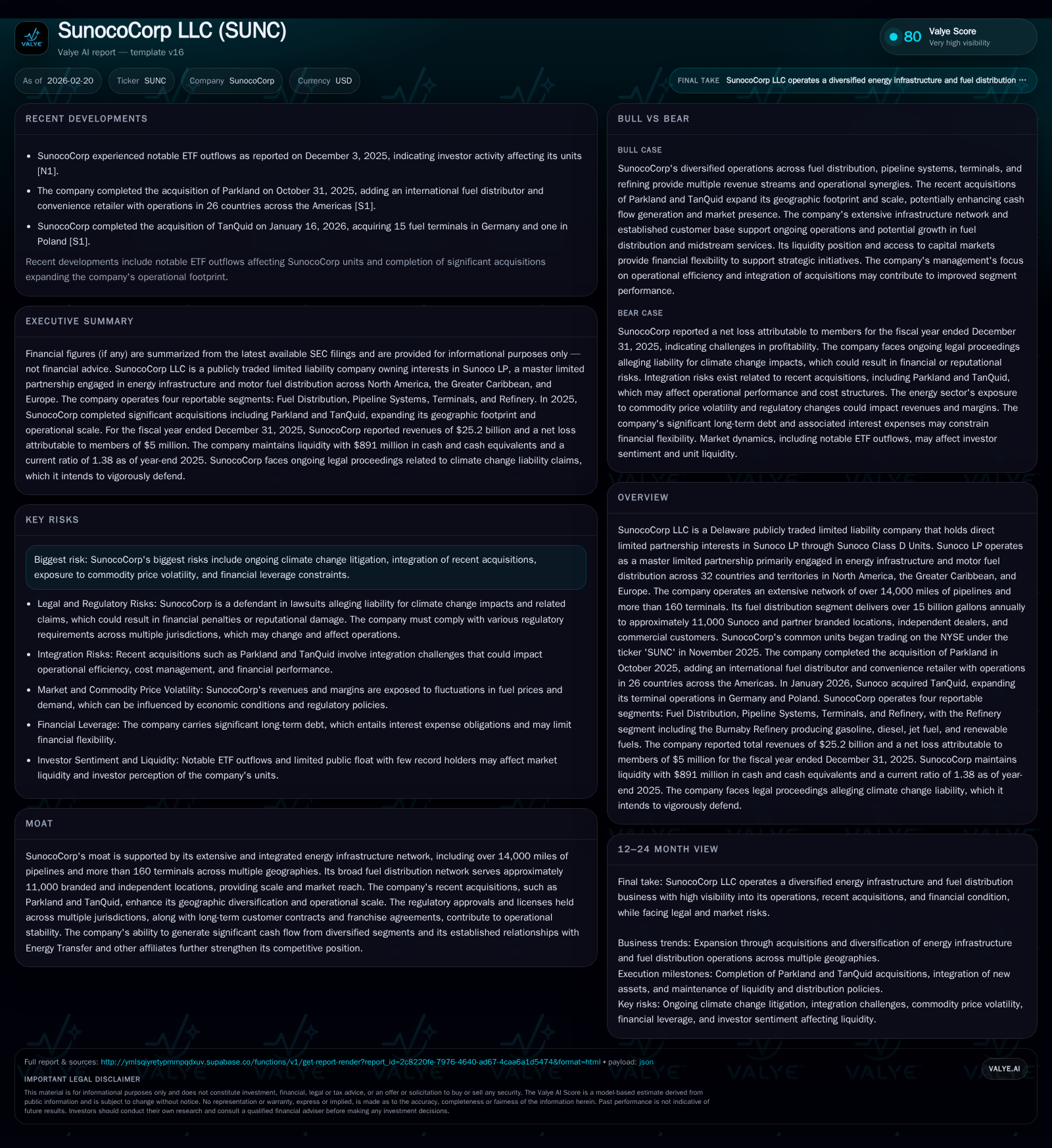
SunocoCorp LLC reported $25.2 billion in revenue for fiscal year 2025 following transformative acquisitions of Parkland and NuStar, marking significant growth driven largely by expanded fuel distribution and infrastructure segments. Despite strong operating income of $935 million, the company recorded a slight net loss primarily due to increased interest expenses and integration-related costs. The company’s diverse asset base spans over 14,000 miles of pipelines and more than 160 terminals across multiple geographies, supporting distribution to over 11,000 locations annually. SunocoCorp’s future growth hinges on successful integration of recent acquisitions, operational efficiency gains across its segments, and managing regulatory as well as climate litigation risks amid high leverage constraints.
Historical Growth and Financial Performance
SunocoCorp LLC's fiscal year 2025 marked a pivotal period with reported revenues of approximately $25.2 billion, evidencing significant expansion facilitated by the October 2025 acquisition of Parkland Corporation and the previously closed NuStar acquisition [F1][S18]. This revenue figure represents an increase over prior years where comparable revenues hovered around $22.7 billion (2024) and $23 billion (2023), indicating that inorganic growth through acquisitions has been central.
Operating income reached $935 million in 2025 — a rise relative to historical figures — driven primarily by improved segment adjusted EBITDA totaling around $2.05 billion. This was largely attributable to the Fuel Distribution segment ($990 million Adjusted EBITDA) which remains the core volume driver delivering over 15 billion gallons annually across roughly 11,000 branded and partner sites encompassing North America, the Caribbean, and Europe [F1][S15]. Pipeline Systems also showed impressive gains with Adjusted EBITDA doubling to approximately $718 million supported by an integrated network of about 14,000 pipeline miles including refined product, crude oil, and ammonia routes alongside terminals [S4][S15].
Despite this robust operational performance, SunocoCorp reported a marginal net loss of $5 million in 2025 compared to profitable outcomes in prior years. The drag on bottom-line profitability is mainly linked to elevated net interest expense—$541 million versus $391 million in the previous year—and one-time acquisition-related charges including transaction costs for Parkland acquisition accounting consolidation [F1][S15]. Depreciation and amortization also increased significantly reflecting larger asset bases including goodwill and intangible assets related to customer contracts acquired [S17].
The company's capital expenditures increased to approximately $577 million in 2025 compared with prior years’ investments ($344 million in 2024), emphasizing ongoing investment in expanding fuel distribution channels, terminals' modernization, and infrastructure enhancement across all segments except Refinery where recent acquisition supplied new capacity [F1][S15].
Historical performance (annual)
| FY |
|---|
| 2025 |
Note: Omitted columns lack sufficient annual XBRL coverage in the provided tags (need ≥2 annual points): Rev, Net, CFO, OpInc, Capex, Div, Buybacks, FCF, ROE%. Source: SEC companyfacts cache [F1].
Note: Operating income for prior years not available from provided tags; Net income data only for FY2025; Capex detailed only for FY2025; CFO is Cash Flow from Operations.
Future Growth Prospects
SunocoCorp’s future prospects are largely intertwined with the successful assimilation of recently acquired entities—Parkland and NuStar—which collectively expand its geographic reach into Canada, parts of Europe, and the Greater Caribbean. The Parkland acquisition notably introduced refinery operations (Burnaby Refinery at ~55k bpd capacity), which adds diversification into refining alongside traditional midstream logistics and fuel distribution activities [N#][S4]. This refinery integrates renewable business activities such as co-processing bio-feedstocks enhancing compliance with low-carbon fuel standards.
Growth catalysts include further pipeline expansions especially crude oil lines in resource-rich basins such as Permian via ET-S Permian JV pipelines acquired through NuStar, which complement Sunoco’s strategic focus on hydrocarbons transportation efficiency . Additionally, expanding convenience retail outlets under various brands leveraging supply chain synergies could boost downstream earnings.
However, growth may be capped or restrained by several factors:
- Regulatory pressures including ongoing climate change litigation targeting greenhouse gas emissions disclosures potentially increasing legal expenses or settlements [S14][S22].
- High financial leverage limits flexibility for new large-scale capital projects without jeopardizing covenant compliance; management targets maintaining leverage below certain thresholds but significant refinancing required ahead given debt maturities clustered through early-to-mid next decade [S5][S21].
- Commodity price volatility impacting inventory valuations temporarily depresses gross margins despite hedging strategies.
Forecasts & Key Expectations
While explicit forward guidance was not detailed in filings reviewed herein, relevant indicators for performance will include quarterly trends in segment adjusted EBITDA growth especially from refining operations ramp-up post-Parkland integration; reduction of debt leverage via free cash flow deployment; mitigation of environmental liabilities including accelerated clean-up or reclamation expenses; and achievement of synergies.
Capital allocation decisions should prioritize deleveraging given current net leverage around 4.0x with total consolidated debt estimated near $13.4 billion at year-end along with close monitoring of liquidity metrics supported by ~$891 million cash reserves plus a broadly undrawn credit facility approximating $2.47 billion availability as of December 31, 2025 [F1][S10].
Additional key milestones involve successful transition from bridge financing used for acquisitions to stable long-term funding structures alongside maintaining investment-grade credit rating aspirations.
Returns & Capital Allocation Considerations
Return on equity (ROE) data is not disclosed in available filings possibly due to the holding company structure wherein SunocoCorp holds partnership units from Sunoco LP generating cash distributions rather than direct operating returns reported at parent level.
Cash flows from operations improved materially reaching over $1.19 billion supported by higher revenues but net earnings were offset by sizable interest payments ($541 million) coupled with depreciation related to expanded asset bases [F1][S19]. Dividend or unit distribution details are less transparent though company agreement indicates regular quarterly cash distributions policy subject to available cash after operational needs (see narrative excerpt).
No publicly available data on share buybacks or preferred dividend payouts was found in provided tags requiring further disclosure review if investment return analysis is pursued.
Operational & Regulatory Risks
SunocoCorp faces notable challenges:
- Climate-related lawsuits filed in states such as Hawaii, Maine, Vermont alleging liability tied to fossil fuel emissions exposures which could yield material damages or reputational impact if unresolved favorably [S14].
- Environmental remediation liabilities have risen substantially—accruals for underground storage tank system cleanups increased from ~$28 million to ~$168 million year-over-year—highlighting regulatory compliance cost escalation risks inherent in downstream fuel operations [S22][S26].
- Integration complexity from large-scale acquisitions poses operational execution risk regarding system harmonization across multinational footprint including IT platforms, culture melding, and regulatory compliance adherence.
- Financial risk from sizeable debt load concentrated in senior notes maturing between 2026–2034 requiring prioritized maturity management strategies.
Strategic Moat & Competitive Advantages
SunocoCorp’s competitive moat builds upon extensive energy infrastructure assets comprising an integrated pipeline system exceeding 14,000 miles combining refined products pipelines (6k miles), crude oil pipelines (6k miles), ammonia pipelines (~2k miles), complemented by over 160 strategically located terminals across multiple jurisdictions offering critical regional access points for storage and transshipment activities [S4].
Additionally, its vast fuel distribution network services approximately eleven thousand retail outlets under a mix of proprietary Sunoco branding plus partner franchises enabling scale advantages particularly when sourcing negotiated contracts with wholesalers or manufacturers.
Synergies realized through vertical integration from supply chain control spanning refining outputs through logistics down to retail transactions underpin potential margin optimization absent in less integrated competitors.
The company benefits further through long-term customer contracts together with regulatory licenses necessary for continuous operations across jurisdictions adding barriers to entry.
Conclusion & Monitoring Points
In summary, SunocoCorp LLC sits at a transformational juncture post its aggressive acquisition spree which reshapes its scale dramatically while amplifying complexities spanning capital structure management, environmental regulatory compliance, and operational integration risks.
Investors analyzing this enterprise should closely monitor quarterly segment adjusted EBITDA trends particularly refining contribution growth rates, deleveraging progress against covenants reflected via leverage ratios and interest coverage consistency alongside legal developments tied to climate litigation cases.
Capital expenditure pacing relative to cash flow generation will reveal management discipline amid evolving energy transition dynamics impacting fuel demand profiles.
This report is prepared solely for informational purposes based on available public financial disclosures as of February 20, 2026. It does not constitute investment advice or recommendations regarding securities of SunocoCorp LLC or any related entities.
Disclaimer: This is research-only, informational analysis and not investment advice. It may include AI-generated interpretation and general industry context. Always verify important details using primary sources.

Comments