
Growth and Consolidation Drive SUNation Energy Amid Operational Challenges
SUNation Energy initiates a strategic alternatives review while leveraging its integrated solar offerings to pursue growth amid capital constraints.
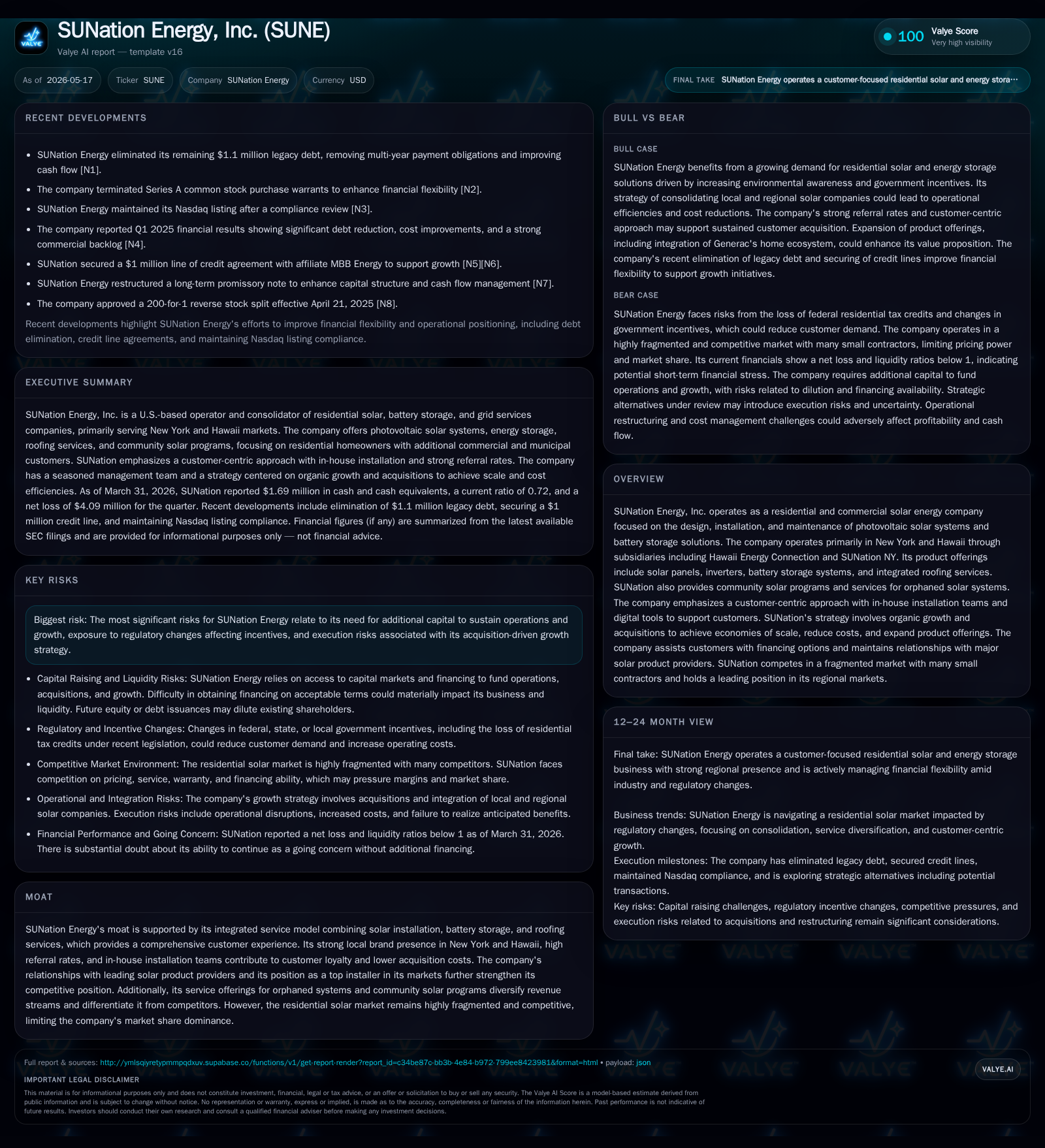
SUNation Energy's latest 10-Q reveals a board-approved strategic alternatives process, including potential sales or mergers, indicating a critical juncture in managing capital and growth. The company’s integrated model combining solar installation, battery storage, roofing services, and community solar programs remains a core competitive advantage amid a fragmented regional market. Growth is driven by consolidation efforts, referral-based customer acquisition, and expanding service lines, yet significant capital access challenges and execution risks persist. Monitoring strategic transaction developments and liquidity improvements will be crucial for assessing the company’s path forward.
Recent Quarterly Operating Highlights and Strategic Initiatives
SUNation Energy announced on April 9, 2026, that its Board of Directors authorized a comprehensive review of strategic alternatives aimed at increasing shareholder value [S2]. This initiative represents a pivotal development reflecting management's acknowledgment of capital constraints and operational challenges faced by the company. The engagement of Maxim Group as M&A and financial advisor underlines a formalized exploration of possibilities including but not limited to asset sales, mergers, acquisitions, divestitures, or corporate restructuring [S2]. Such a process inherently implies heightened scrutiny on optimizing capital deployment while balancing organic growth prospects.
This strategic alternatives review emerges during lingering market pressures such as regulatory shifts impacting solar incentives and operational stresses related to labor availability. The company acknowledges the substantial resources—both human and financial—that will be allocated toward this effort with no assurance of consummated transactions or guaranteed value enhancement for shareholders [S2]. This development underscores the board’s shift towards proactively addressing balance sheet challenges while seeking long-term positioning advantages.
SUNation Energy’s Business Model and Product Ecosystem
SUNation's core business centers on designing, installing, and maintaining photovoltaic solar systems coupled with battery storage solutions across residential, commercial, and municipal customers primarily in New York (especially Long Island) and Hawaii markets [S1][S10]. The company differentiates itself with an integrated service approach that includes roofing solutions—a natural extension supporting solar installations—and community solar programs enabling shared benefits from larger arrays [S10][S16].
Revenue generation follows project milestones: for residential customers who typically finance through loans sourced via SUNation's relationships with various funding entities, cash inflows are linked to completion percentages during installation phases [S16]. This model features no upfront cost for many homeowners but depends significantly on capital liquidity to finance system components until customer payments are realized. A notable element is SUNation’s emphasis on in-house installation teams rather than subcontracting; this strategy purportedly ensures superior quality control and customer service consistency which supports high referral rates (~35% of installed jobs cited as referrals or repeat customers) driving down CAC (customer acquisition cost) [S5][S10].
Strong vendor relationships with leading suppliers—including Enphase, Tesla, FranklinWH, and planned expansion into Generac ecosystems—enable SUNation to offer cutting-edge hardware while aiming to benefit from supply chain economies at scale through both organic growth and acquisitions [S19]. Additionally, maintaining service contracts for orphaned systems left by former installers offers a diversified revenue stream rarely leveraged by competitors [S21].
Competitive Environment and Industry Positioning
The U.S. residential solar market remains highly fragmented with over 4,000 contractors nationwide; regional players dominate more than 75% of the market per Wood Mackenzie data referenced by SUNation [S10]. SUNation occupies a leading regional position within New York and Hawaii but contends with sizeable local competition that limits market share domination.
Its moat derives mainly from an integrated service offering uniting solar panel installation with battery storage and complementary roofing services. High referral rates stem from intensive community engagement by field crews enhancing brand loyalty. By maintaining direct installation teams rather than outsourcing work, SUNation controls customer experience end-to-end allowing competitive CAC metrics relative to peers dependent on subcontractors [S5]. However, pricing pressure from entrenched local competitors and ongoing cost inflation stemming from supply shortages constrain margin expansion potential. Regulatory complexity across key geographies further adds to operational hurdles requiring specialized oversight teams.
Despite pursuing acquisitive growth for economies of scale advantage (lower input costs for modules/inverters/BOS components), achieving national scale akin to industry leaders has remained elusive given capital limits and regional focus thus far [S10]. Nevertheless, continued consolidation offers scope for incremental footprint optimization.
Growth Catalysts: Consolidation and Service Expansion
SUNation aims to capitalize on industry fragmentation through an accelerated M&A rollup strategy targeting leading local installers. This growth lever banks on synergies such as scaled common overhead functions (HR/legal/accounting/marketing) reducing fixed cost ratios presumably improving future operating margins once integration hurdles are overcome [S5].
Organic growth is supported by its robust referral network which lowers CAC—a critical driver in residential solar where finding new customers can be costly. By cross-selling energy storage products including lithium-ion batteries alongside its solar systems—and integrating roofing services particularly in New York—the company can extract higher unit economics per customer relationship while broadening the revenue base beyond initial installations [S10][S21].
Additionally, servicing orphaned systems abandoned by other contractors solidifies recurring revenue performance beyond initial sales cycles while addressing an unmet service niche. Community solar programs further diversify offerings enabling shared renewable access for participants unable or unwilling to install individual systems directly.
Risks and Constraints: Capital Access and Execution Challenges
A central constraint hampering SUNation's progression is its constrained capital position. As of March 31, 2026 data indicate total debt approximating $6.64 million against cash reserves near $1.69 million yielding net debt around $4.96 million; the current ratio stood at a suboptimal 0.72 highlighting short-term liquidity tightness potentially constraining working capital flexibility [F1].
The reliance on external financing is underscored repeatedly in filings emphasizing difficulties accessing timely credit given sector volatility amplified by recent federal tax credit phase-outs embodied in the One Big Beautiful Bill Act effective July 2025 [S4][S8][S9].
Execution risks compound these issues: acquiring multiple local operators demands complex integration expertise with failure risking goodwill impairment or disrupted customer service adversely impacting referral momentum. Moreover, labor shortages among skilled electricians/installers remain industry-wide challenges inflating project timelines/costs while component supply intermittency (e.g., batteries/inverters) could hamper system deployment velocity affecting revenue recognition pacing [S8][S12]. Regulatory uncertainties around permitting processes or incentive regimes pose additional operational variability.
Despite current compliance with Nasdaq listing rules following prior minimum bid price concerns resolved mid-2025 ([S1],[S17]), proposed tighter Nasdaq listing standards pose ongoing delisting risk potentially eroding investor confidence further if share price weakness persists.
Key Milestones and What To Watch Next
Market participants should monitor updates from SUNation regarding outcomes from the ongoing strategic alternatives process led by Maxim Group including any transactional announcements encompassing asset sales or mergers impacting corporate structure/diversification scope [S2][S3].
Quarterly updates providing insight into installation volumes or revenues serve as vital demand indicators reflecting effectiveness of expansion tactics alongside referral program efficacy under shifting incentive environments.
Closely observed will be commentary relating to liquidity enhancements such as successful capital raises or refinancings alleviating pressing funding bottlenecks enabling continued growth investments.
Regulatory developments affecting solar tax credits or permitting frameworks remain critical given their direct influence on project economics thus future customer adoption rates.
Latest Financial Profile and Liquidity Assessment
Latest financial snapshot
| Metric | Value | Period |
|---|---|---|
| Cash & equivalents | $1,686,605 | |
| 2026-03-31 | ||
| Total debt | $6,643,856 | |
| 2025-12-31 | ||
| Net debt | $4,957,251 | |
| 2025-12-31 | ||
| Current assets | $9,049,534 | |
| 2026-03-31 | ||
| Current liabilities | $12,559,290 | |
| 2026-03-31 | ||
| Current ratio | 0.72x | |
| 2026-03-31 |
Source: SEC companyfacts cache [F1].
| Metric | Value (USD) |
|---|---|
| Cash & Equivalents | 1,686,605 |
| Total Debt | 6,643,856 |
| Approximate Net Debt | 4,957,251 |
| Current Assets | 9,049,534 |
| Current Liabilities | 12,559,290 |
| Current Ratio | 0.72 |
These figures frame SUNation's immediate financial condition as challenged yet managing operating continuity with material liquidity risk present given liabilities exceeding current assets demonstrably pointing to near-term dependence on new financing arrangements [F1]. It does not constitute investment advice or endorsement but serves informational purposes consistent with an industry analyst perspective._
Disclaimer: This is research-only, informational analysis and not investment advice. It may include AI-generated interpretation and general industry context. Always verify important details using primary sources.

Comments