
SurgePays Advances Integrated Wireless and Point-of-Sale Platform Amid Liquidity Pressures
SurgePays leverages a unique retail distribution network to serve underserved prepaid wireless customers while confronting significant financial constraints.
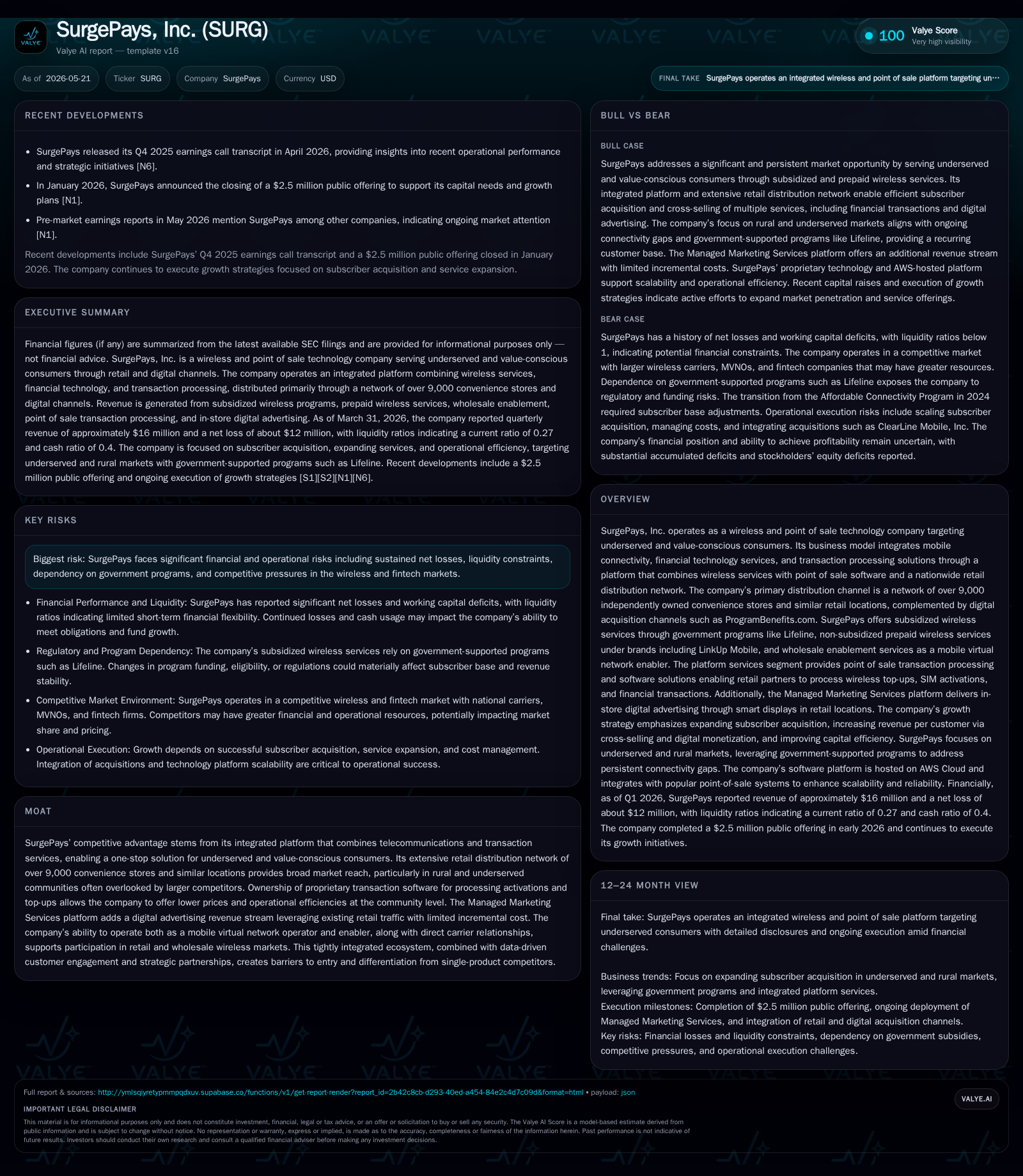
In its latest quarter, SurgePays maintained a focus on subscriber retention through Lifeline program expansions and digital acquisition despite ongoing financial losses and liquidity challenges. The company operates an integrated wireless MVNO and point-of-sale platform targeting value-conscious, underbanked consumers via a sprawling convenience store network. Growth hinges on expanding subsidized wireless subscribers and enhancing cross-selling within its fintech transaction ecosystem, while risks stem from dependency on government subsidies, substantial debt, and competitive pressures in prepaid wireless markets.
Recent Operating Update
SurgePays reported quarterly results for the period ending March 31, 2026 [S2][S3], reinforcing its strategic commitment to subsidized wireless services during industry subsidy program shifts. Following cessation of the federal Affordable Connectivity Program (ACP) discounts in mid-2024, SurgePays continued transitioning affected subscribers into the Lifeline program and expanded the Lifeline subscriber base during 2025 and into early 2026. Despite losing ACP funding — which previously supported substantial revenue — SurgePays chose to retain existing customers by absorbing wholesale network costs internally rather than undertaking drastic subscriber cuts.
While Q1 2026 detailed operating metrics are not exhaustively disclosed, this ongoing strategy to maintain broad subscriber coverage evidences the company's focus on long-term engagement even under short-term financial pressure. The company also continues to develop its transaction-based business segments centered on point-of-sale processing at retail partners.
Business Model
SurgePays operates at the nexus of wireless telecommunications as a Mobile Virtual Network Operator (MVNO) and financial technology-enabled point-of-sale (POS) convenience store services. The company’s revenue streams are integrated across three segments:
Wireless Services (MVNO Telecommunications): SurgePays offers both subsidized service under government programs such as Lifeline (targeting eligible low-income consumers) and non-subsidized prepaid wireless plans branded under LinkUp Mobile. These contract-free plans provide flexible monthly pricing without long-term commitments.
Platform Services (MVNE Enablement): Through its HERO platform, SurgePays enables third-party providers with backend infrastructure for wireless activation and customer management.
Comprehensive Platform Services: This segment encompasses point-of-sale transaction processing including prepaid top-ups, SIM activations, bill payments, gift cards, reloadable debit cards, and digital advertising through Managed Marketing Services embedded in retail hardware.
Customers pay primarily at retail points—convenience stores forming an extensive distribution network exceeding 9,000 independently owned outlets nationwide—enabling access for underserved demographics that rely heavily on cash transactions. Digital channels including ProgramBenefits.com complement physical locations for direct consumer engagement.
Revenue mechanics include recurring wireless service fees influenced by volume of subscribers sustained or acquired; transactional fees generated per convenience store activation or top-up process; digital advertising income earned from promotions delivered via POS devices; and wholesale enablement fees charged to third-party clients using Surges’ infrastructure. The company strategically focuses on cross-selling opportunities within this ecosystem to enhance customer lifetime value.
Industry Structure and Competitive Position
The prepaid wireless market targeted by SurgePays is characterized by intense competition from national carriers with direct-to-consumer brands as well as other MVNOs catering to subprime or value-conscious segments. Larger carriers benefit from economies of scale but often have limited reach into rural or underserved markets that remain underserved due to lower margins or regulatory complexity.
SurgePays’ moat stems from its tightly integrated telecommunications-fintech platform coupled with a vast retail distribution footprint penetrating rural areas often ignored by big players. Proprietary transaction software embedded in POS devices allows operational efficiencies that enable more competitive pricing at the point of sale compared to fragmented or outsourced counterparts.
The combination of subsidized Lifeline offerings alongside non-subsidized prepaid plans enables diversified exposure across federal subsidy cycles. Moreover, the Managed Marketing Services platform positions SurgePays uniquely with incremental digital advertising revenue harnessing captive retail traffic.
Its wholesale enablement MVNE operations provide another layer of differentiation by supplying platform services to third parties, expanding SurgePays’ addressable market beyond direct-to-consumer sales.
Growth Drivers
Expanding Subsidized Wireless Programs
The core growth lever remains scaling Lifeline program participation following ACP discontinuation. By integrating enrollment directly at checkout points within its retail network, SurgePays reduces friction for eligible customers to join or switch programs [S14][S23]. Geographic expansion into additional states like California aims to capture more low-income consumers needing cost-effective broadband access
Increasing Digital Acquisition Channels
Beyond physical retail activation, efforts to grow online customer acquisition via ProgramBenefits.com facilitate broader national reach without corresponding increases in fixed retail costs. This channel supports customer monetization post-enrollment through plan renewals and add-on services.
Enhancing Platform Transaction Revenue
Growth in prepaid top-up volumes provides steady fee income correlated with foot traffic at convenience stores. SurgePays leverages data analytics from transaction activity to launch targeted promotional campaigns via its Managed Marketing Services platform—driving customer retention and stimulating higher wallet share per user.
Wholesale MVNE Enablement Expansion
Scaling HERO's MVNE capabilities broadens SurgePays’ business model beyond acting solely as a end-provider towards becoming a critical infrastructure partner for smaller MVNOs lacking advanced backend systems.
Leveraging Proprietary Software Technology
Ownership of activation and transaction processing software grants pricing agility & cost control advantages facilitating tailored offers responsive to local market conditions—especially crucial where price sensitivity is pronounced.
Risks / Watchpoints / Growth Constraints
Dependency on Government Subsidy Programs
The expiration of ACP funding significantly impacted revenues historically; future reliance on Lifeline subsidies subjects SurgePays to regulatory risk including eligibility changes or funding cuts that could reduce recurring revenue stability [S1]
Liquidity Constraints & Balance Sheet Leverage
As of Q1 2026 end, cash & equivalents stood near $2 million against total debt approximating $12.3 million [F1][S2]. Sustained operating losses necessitate continued capital raises or refinancing efforts to fund ongoing operations without impairing growth initiatives.
Competitive Pressure & Market Fragmentation
Larger national carriers have greater capital resources for marketing subsidies or network investments potentially eroding SurgePays’ price competitiveness or subscriber acquisitions especially outside rural strongholds.
Operational Challenges Amid Transition Phases
Maintaining subscriber retention while transitioning away from defunct subsidy programs involves absorbing costly wholesale network expenses impacting margins adversely until scale efficiencies are restored.
What to Watch Next
- Subscriber Metrics: Tracking quarterly net adds/losses within Lifeline versus non-subsidized segments will clarify if current strategies stabilize or grow customer base amid evolving subsidy environments.
- Financing Execution: Implementation progress on the $20 million convertible secured note financing authorized in January 2026 will be critical for liquidity support [S22].
- State-Level Expansion: Advancement into additional state markets for Lifeline enrollment should be monitored as an indicator of accessible growth pipelines [S14].
- Platform Monetization: Developments in Managed Marketing Services revenue growth through increased digital ad placements leveraging POS traffic.
- Cost Management: Evidence of reducing wholesale cost burdens per subscriber through contract negotiations or technology enhancements would signal improving margin potential.
Financial Profile Summary
As per the latest available SEC filings ([F1],[S2]), SurgePays ended Q1 2026 with approximately $2 million cash versus $12.3 million total debt resulting in net debt near $10.3 million. The current ratio was below 0.3, reflecting current liabilities exceeding current assets, indicating tight short-term liquidity [F1].
Operating losses persist as the company invests heavily in retaining subsidized subscribers after ACP termination while scaling new platforms. Revenue for the full year ending December 31, 2025 was about $57 million with operating loss exceeding $34 million associated primarily with subsidy revenue decline offset partially by growth in transaction fees [F1][S1]
Management plans ongoing capital raises supplemented by operational improvements focused on growth areas described above but must navigate challenging macroeconomic headwinds impacting discretionary spending among target customers.
-- This analysis is based solely on public information provided through SEC filings dated up to May 20, 2026 and relevant news reports without any forward-looking investment research views intended.
Disclaimer: This is research-only, informational analysis and not investment advice. It may include AI-generated interpretation and general industry context. Always verify important details using primary sources.

Comments