
Sypris Solutions’ Multi-Year Contracts Underpin Stability Amid Industrial Cyclicality and Supply Challenges
Sypris leverages sole-source agreements in forged components and aerospace electronics to manage cyclical demand and competitive pressures in critical infrastructure sectors.
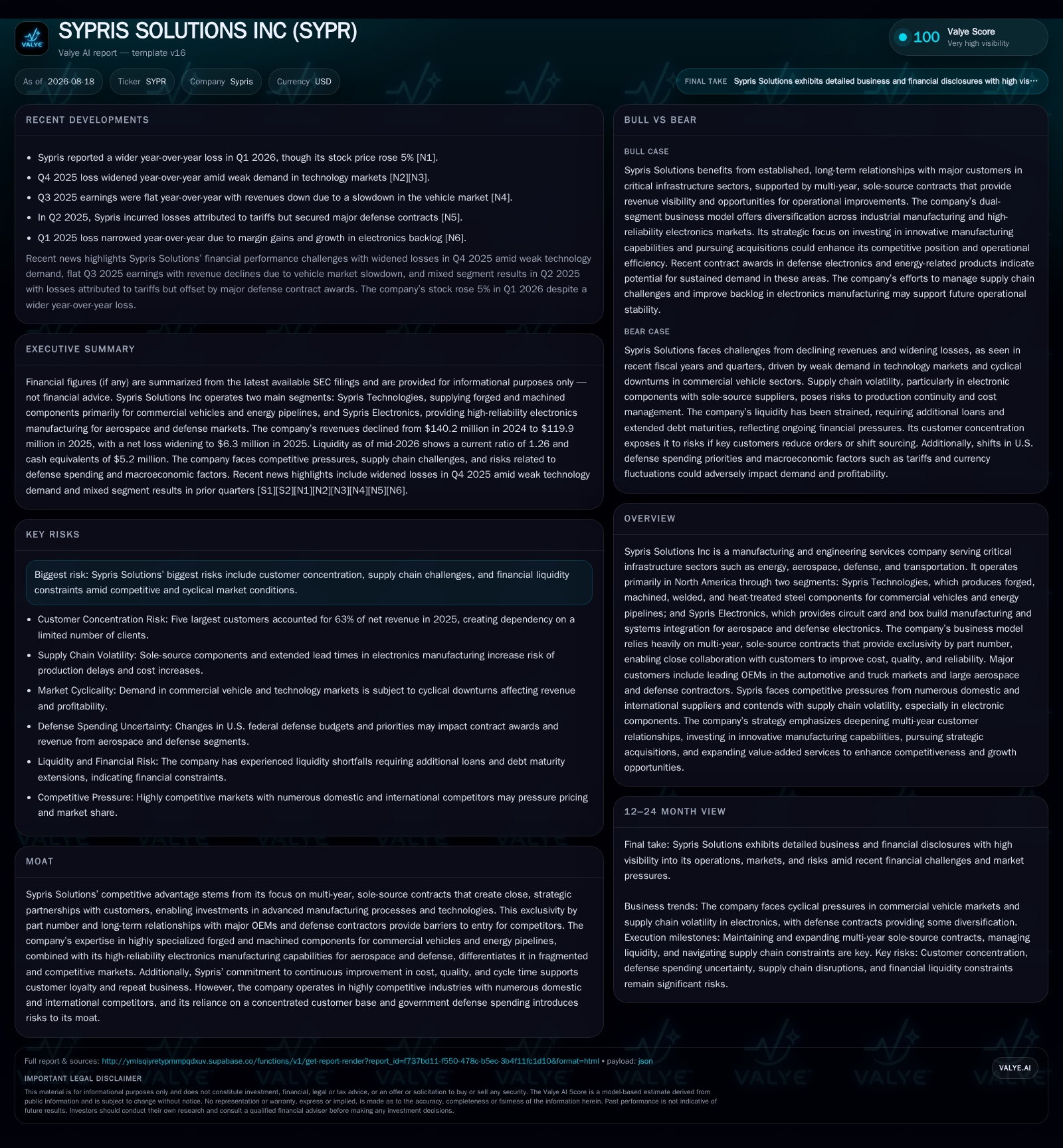
Sypris Solutions operates two complementary segments focusing on forged steel components for commercial vehicles and high-reliability electronics for aerospace and defense, relying heavily on multi-year, sole-source contracts that enhance customer collaboration and revenue visibility. The latest quarter reflects ongoing supply chain pressures, cyclical softness in heavy truck markets, and investment in operational improvements, consistent with industry-wide challenges. The company’s business model emphasizes technological agility and cost management through lean manufacturing and long-term customer relationships, while exposure to concentrated customers and macroeconomic factors remain key risks. Financially, Sypris faces liquidity considerations but benefits from related-party financing with maturities extended to 2027 and beyond, underpinning near-term stability.
Recent Operating Update
Conversely, Sypris Electronics showed growth driven by circuit card assembly and box build manufacturing for aerospace and defense customers amidst a strengthened defense budget environment. This segment benefits from multi-year sole-source contracts granting exclusivity per part number, enabling deep collaboration on design-for-manufacturability enhancements to reduce cost while meeting strict reliability standards required by national security programs [S1][S28]. Nevertheless, operating income contraction was evident due to engineering scope changes, excess inventory provisions aligned with demand fluctuations, and higher costs associated with program ramp-ups [S26].
Management has underscored no material changes in risk factors this quarter but reiterated supply chain disruptions internally inflating costs alongside external geopolitical volatility impacting energy-related products [S2]. Recent public disclosures also highlight incremental investment in manufacturing capabilities supported by lean manufacturing principles and cycle time reduction efforts as levers for mid-term competitiveness [S1].
Business Model Analysis
Sypris Solutions operates through two complementary segments: Sypris Technologies focusing on forged, machined, welded, heat-treated steel components primarily serving heavy commercial vehicles along with automotive diversification; Sypris Electronics delivers integrated aerospace-grade circuit card assemblies and box builds under stringent quality regimes.
Revenue is predominantly derived via long-term multi-year contracts that are often sole-source per part number. This contractual structure provides stable order backlogs while encouraging co-development initiatives where Sypris can invest in process improvements such as six sigma quality control methods or total quality management systems aimed at reducing defect rates and cycle times [S1]. Customers are principally large OEMs or Tier 1 suppliers who value reliability given the mission-critical nature of the products—whether drivetrain components on trucks or radar systems used in defense applications.
The company monetizes its offerings by selling engineered components priced based on volume forecasts embedded in contracts that adjust for raw material cost fluctuations through periodic price renegotiations. Margins fluctuate with mix (higher-margin engineering services or prototype work vs. production runs), throughput efficiency influenced by capacity utilization rates, yield improvement initiatives, and supply chain logistics effectiveness. Production capacity in both metals fabrication/manufacturing facilities and electronics clean rooms is capital intensive but benefits from economies of scale when multi-year programs scale successfully.
Strategically Sypris seeks to sustain competitive advantages via technical expertise enabling design-for-manufacturability improvements reducing downstream costs for customers as well as leveraging exclusive contract positions that erect barriers against commoditization. It supplements these advantages with continuous equipment modernization funded primarily through moderate capital expenditures targeting flexible manufacturing cells adaptable to evolving product requirements.
Industry Structure & Competitive Landscape
Operating within the industrial manufacturing ecosystem serving commercial vehicles, energy infrastructure pipelines, aerospace, and defense sectors places Sypris among specialized component manufacturers akin to TimkenSteel or Alcoa for forged products on the metals side, while its electronics business aligns more closely with firms like Plexus Corp or Celestica specializing in high-reliability electronic assemblies.
Competition is intense given overlapping competences with domestic suppliers offering lower labor cost structures in Mexico (where Sypris maintains operations) plus international players potentially entering via mergers/acquisitions or bidding efforts.
The reliance on long-term sole-source contracts held by prime contractors balances some pricing pressure but requires ongoing performance excellence reflected through KPIs such as order backlog consistency (high renewal rates indicative of customer satisfaction), defect rate minimization ensuring adherence to aerospace/defense quality standards, cycle time reductions maintaining just-in-time availability without excess inventory buildup.
The industry’s cyclicality—especially visible in heavy-duty truck production linked to broader economic freight movement—and sensitivity to geopolitical shifts influencing energy exploration/construction spending or federal defense budgets amplify operational complexity while presenting growth windows when market conditions improve.
Growth Drivers
Several vectors support growth potential for Sypris Solutions:
- Strengthened defense spending amid geopolitical tensions increases demand for advanced electronic assemblies within sensitive military applications where reliability drives outsized supplier selection metrics.
- Infrastructure investment trends fueling pipeline expansions sustain volumetric demand for high-pressure forged components under the Tube Turns® brand.
- Expansion into adjacent automotive markets with light vehicle driveline parts offers exposure outside traditional Class 8 truck cycles.
- Adoption of lean manufacturing techniques combined with Six Sigma methodologies aims at driving operational efficiencies that can translate into cost leadership attracting incremental business.
- Multi-year contract wins provide revenue visibility encouraging calibrated capital expenditure aligned with anticipated volumes ensuring capacity remains well matched.
- Customer outsourcing trends favor specialized suppliers like Sypris capable of offering integrated design-for-manufacturability services alongside precision manufacturing abilities.
Risks & Constraints
The core risks include:
- High customer concentration: The top five customers comprised approximately 63% of revenue in 2025; loss or downsizing at any major account could materially disrupt revenues [S5].
- Cyclical exposure: Commercial vehicle market downturns create pressure on volumes; despite diversification efforts this remains a sizable vulnerability affecting fixed cost leverage.
- Supply chain constraints: Raw material inflation combined with logistics delays elevate costs; failure of pricing mechanisms or transformation initiatives to fully offset could compress margins further [S1][S2].
- Contract renewals: Sole-source agreements offer protection but also concentrate dependency; increased competitive bidding or budget cuts could imperil renewal probabilities.
- Liquidity pressure: The company has access to related-party promissory notes totaling $12 million with maturities extended through April 2029, providing structural financing flexibility [S4][F1]. Ongoing negative cash flows necessitate prudent capital management.
- Environmental liabilities tied to historic site contamination pose contingent risk without definitive indemnification assurances [S25].
- Macroeconomic uncertainties including inflationary cost escalations above current expectations may force difficult tradeoffs between margin preservation and volume retention.
What To Watch Next
Monitoring order backlog evolution will reveal if recent contract awards translate into tangible near-term revenues. Renewal activity on existing sole-source agreements alongside any evidence of new market penetration beyond traditional end markets will signal strategic success. Margins will remain sensitive indicators of supply chain management effectiveness against inflationary pressures. Capital expenditure pacing against volume ramps will reflect confidence levels regarding demand forecasts. Additionally, any updates on related-party loan arrangements including refinancing terms will clarify liquidity runway assumptions. Finally, geopolitical developments impacting federal spending priorities may set the tone for growth trajectories in aerospace/defense-related product lines.
Financial Profile Discussion
As of July 5, 2026, Sypris Solutions reported current assets of approximately $77.99 million and current liabilities of about $61.92 million, resulting in a current ratio of roughly 1.26, indicating a modest liquidity cushion supporting near-term obligations [F1]. The company maintains access to related-party promissory notes totaling $12 million with maturities extended through April 2029, providing structural financing flexibility [S4][F1]. Operating activities have generated negative cash flow in recent years primarily due to working capital challenges and cyclical volume declines impacting profitability [S13][S8]. Capital expenditures remain controlled, emphasizing maintenance over expansion to conserve cash flow amidst ongoing margin pressures. Interest expense remains manageable due to favorable note terms, but elevated leverage requires cautious balance sheet stewardship going forward.
This analysis synthesizes publicly available SEC filings up to mid-2026 without speculative market assessments or unverified claims regarding forward-looking guidance not explicitly stated by management. Insight reflects contextualization within industrial manufacturing sector dynamics where long contract durations mitigate volatility yet cyclical demand patterns paired with supply chain turbulence require continual operational focus. The company's strategic emphasis on multi-year sole-source relationships integrates well-established industry practices fostering durability albeit not immune from macroeconomic or customer-specific risks typical within aerospace/defense/energy-linked components markets.
Disclaimer: This is research-only, informational analysis and not investment advice. It may include AI-generated interpretation and general industry context. Always verify important details using primary sources.

Comments