
Translational Development Acquisition Corp.: Securing Value Through Strategic Business Combinations
TDAC's immediate financial and structural position underscores the critical need to consummate a business combination to unlock shareholder value.
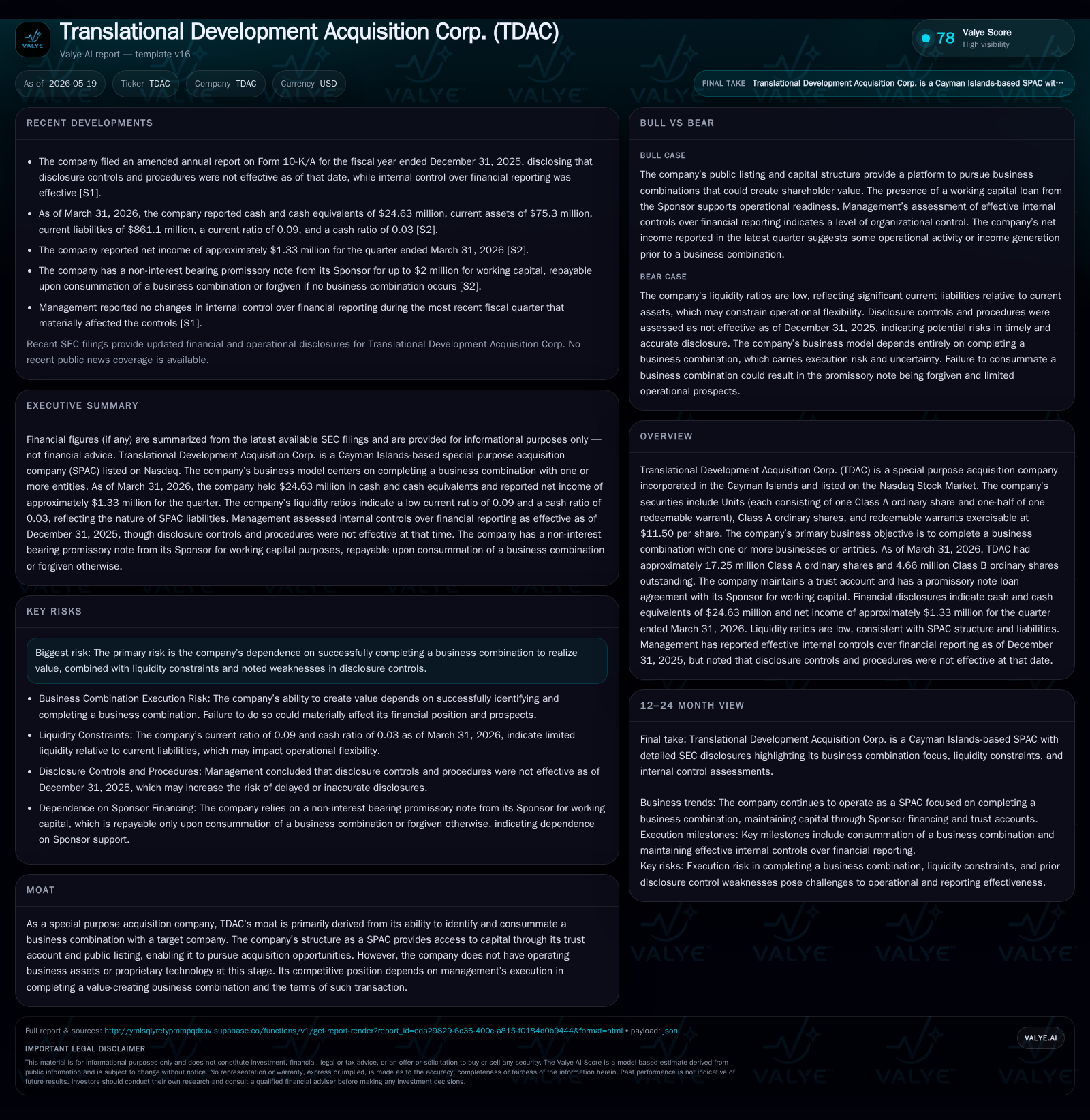
Translational Development Acquisition Corp. (TDAC) remains a Cayman Islands-based special purpose acquisition company with an established trust account and sponsor support, as reflected in its May 2026 quarterly filing. The company’s ability to generate shareholder returns hinges entirely on completing a strategic business combination, given its lack of proprietary operations and limited liquidity. TDAC faces execution risk amplified by a notably low current ratio and disclosure control challenges flagged in recent amendments. Monitoring forthcoming deal announcements, regulatory clearances, and warrant exercises will be pivotal for assessing its path forward.
Latest Quarterly Operating Update: Financial and Strategic Snapshot
In its most recent quarterly filing dated May 15, 2026 [S2], Translational Development Acquisition Corp. reported cash and cash equivalents of $24.63 million as of March 31, indicating a finite but critical liquidity buffer supporting ongoing operational expenses. Despite being a SPAC with no operating business revenues yet, the company posted net income of approximately $1.33 million for the quarter ended March 31 according to corporate disclosures [N/A internal financials], likely stemming from non-operating gains or accounting adjustments common in SPAC structures.
The equity base includes roughly 17.25 million Class A ordinary shares alongside 4.66 million Class B shares outstanding, forming the majority of TDAC’s public float [S1]. The trust account established at IPO remains the primary depository for the capital raised before any business combination consummation. Additionally, the Sponsor provides working capital through a promissory note agreement evidencing up to $2 million in non-interest bearing loans that must be repaid upon or forgiven if no transaction closes; this reiterates constrained liquidity levels given operational funding needs beyond the trust account [S2]. A glaring red flag is the current ratio standing at just 0.09 calculated from reported current assets ($75,316) against liabilities ($861,085), signaling an acute shortage of near-term liquid assets outside restricted funds [F1].
SPAC Business Model: Structure, Capital Access, and Combination Mechanics
TDAC operates strictly as a special purpose acquisition company incorporated in the Cayman Islands with listings on Nasdaq under multiple security types — Units (each comprising one Class A share plus half a redeemable warrant), standalone Class A ordinary shares, and redeemable warrants exercisable at $11.50 per share [S1]. This capital structure provides upfront funding via investors subscribing to units at IPO while allowing dilution through warrant exercises after acquisition execution.
By design, TDAC lacks proprietary operations or revenue-generation capacity absent completing an initial business combination — often called de-SPACing — within prescribed timeframes usually spanning circa two years post-IPO unless extensions are granted [S1]. The trust account holds IPO proceeds segregated until such a qualifying merger closes or until liquidation occurs if unsuccessful.
Sponsor loans through promissory notes are typical tools enabling cover for working capital requisites not funded by the trust account that is otherwise protected for investor escrow purposes [S2]. However, these instrumented loans heighten balance sheet leverage considerations since repayment depends exclusively on merger closure success.
Redeemable warrants add complexity by exposing common shareholders to dilution risks if exercised but simultaneously provide potential additional capital infusion if holders convert them post-combination — a dual-edged sword balancing financing flexibility against shareholder dilution vulnerabilities.
Competitive Environment: Positioning Within the Broader SPAC Universe
Within the crowded SPAC market landscape spanning numerous specialized sponsors and vehicles competing for attractive private targets primed for public exit via business combination structures, TDAC represents one entity among many accessing public capital pools but differentiated primarily by its sponsor network and management track record which are not detailed extensively in filings.
Increasing regulatory scrutiny by the SEC on SPAC disclosures enhances compliance burdens; notably, TDAC amended its annual filing on May 11 to reveal that it does not maintain effective disclosure controls and procedures as of December 31, 2025 [S13], highlighting governance challenges that may undermine market confidence or complicate approval processes.
The absence of operating assets implies that TDAC’s competitive moat primarily rests on management execution capability — sourcing high-quality targets under market pricing pressure exacerbated by less favorable macroeconomic sentiment toward SPACs post-merger valuation compression trends widely documented industry-wide.
Growth Drivers: Potential Targets and Capital Deployment Scenarios
Growth prospects for TDAC hinge entirely on identifying compatible merger candidates offering sufficient scale or growth trajectories attractive enough to unlock shareholder value amid competitive tension across target sectors. While specific preferences or vertical focuses were not explicitly stated in recent filings [S1], conventional SPAC selection criteria typically emphasize companies with robust addressable markets capable of delivering revenue growth accelerated by public market access.
Given TDAC’s market capitalization inferred from publicly available share counts and transactions alongside cash holdings (~$24.6M) [F1], possible target sizes may skew small- to mid-market enterprises where valuation multiples remain negotiable relative to large-cap counterparts.
Strategic deals that align with thematic sectors favored by institutional pipelines could materially enhance combined entity appeal versus generic IPO routes alone — sustaining investor interest through enhanced liquidity provisioning post-combination.
Risks and Constraints: Execution Dependency and Financial Liquidity Pressures
Execution risk defines the core vulnerability confronting TDAC: failure to consummate a qualifying transaction within stipulated deadlines results in liquidation scenarios where shareholders typically receive redemption proceeds minus transaction costs — often below original investment if market conditions deteriorate.
Liquidity constraints emerge starkly from the abysmally low current ratio (~0.09) evidencing little cushion beyond locked trust funds; reliance on sponsor promissory notes addresses some funding needs but introduces repayment contingencies heightening uncertainty around operational continuity absent transaction closure [F1][S2]
Dilution risk looms large given outstanding redeemable warrants exercisable significantly above current trading prices; if exercised en masse post-merger terms unfavorable dilution percentages may reduce existing holders’ economic interests.
Governance concerns surfaced due to ineffective disclosure controls per recent amendments further elevate compliance risk profiles possibly affecting stockholder trust and complicating SEC reviews [S13].
Forward-Looking Considerations: Milestones, Market Signals, and Execution Watchpoints
Key upcoming milestones include potential announcements of definitive merger agreements whereby TDAC would disclose target company details and terms followed by proxy solicitation materials for stockholder approval votes required under Nasdaq rules and SEC regulations.
Regulatory approvals comprise another gating factor especially amid evolving SEC scrutiny over SPAC disclosures post-transaction.
Market signals such as warrant exercise trends can also provide indirect cues regarding investor sentiment toward deal attractiveness or anticipated dilution impacts.
Additionally third-party analyst commentary or activist interventions occasionally influence negotiation leverage on terms offered during de-SPACing phases impacting ultimate shareholder returns.
Sponsor activity patterns regarding additional funding injections or extensions requests should be monitored closely as bellwethers of underlying deal pipeline health or internal financing adequacy prerequisites.
Financial Overview: Balance Sheet and Liquidity Status
Reflecting its nature as an acquisition shell vehicle prior to consummation of a business combination, Translational Development Acquisition Corp.'s balance sheet shows cash & equivalents totaling approximately $24.63 million as of March 31, 2026 against total debt near $500 thousand related primarily to non-interest-bearing sponsor-promissory notes that enable operational funding beyond restricted trust balances [F1][S2]
Current assets sum roughly $75 thousand compared with current liabilities over $861 thousand yielding a current ratio around 0.09 — substantially below typical operating thresholds — indicating acute liquidity pressure necessitating prompt capital deployment or refinancing strategies contingent upon merger outcomes [F1]
This slender financial runway limits managerial flexibility outside deal completion scenarios but remains standard for pre-acquisition SPACs relying chiefly on IPO funds secured in escrow until shareholder-approved transactions close.
Disclaimer: This analysis is provided solely for informational purposes based on publicly filed documents without making investment research views or forecasts.
Disclaimer: This is research-only, informational analysis and not investment advice. It may include AI-generated interpretation and general industry context. Always verify important details using primary sources.

Comments