
Teva Pharmaceutical’s Q2 2026 Reflects Strategic Recovery Amid Generic Market Pressures
Teva’s latest filing highlights pipeline advancement and licensing gains offset by generic pricing pressures and regulatory compliance costs.
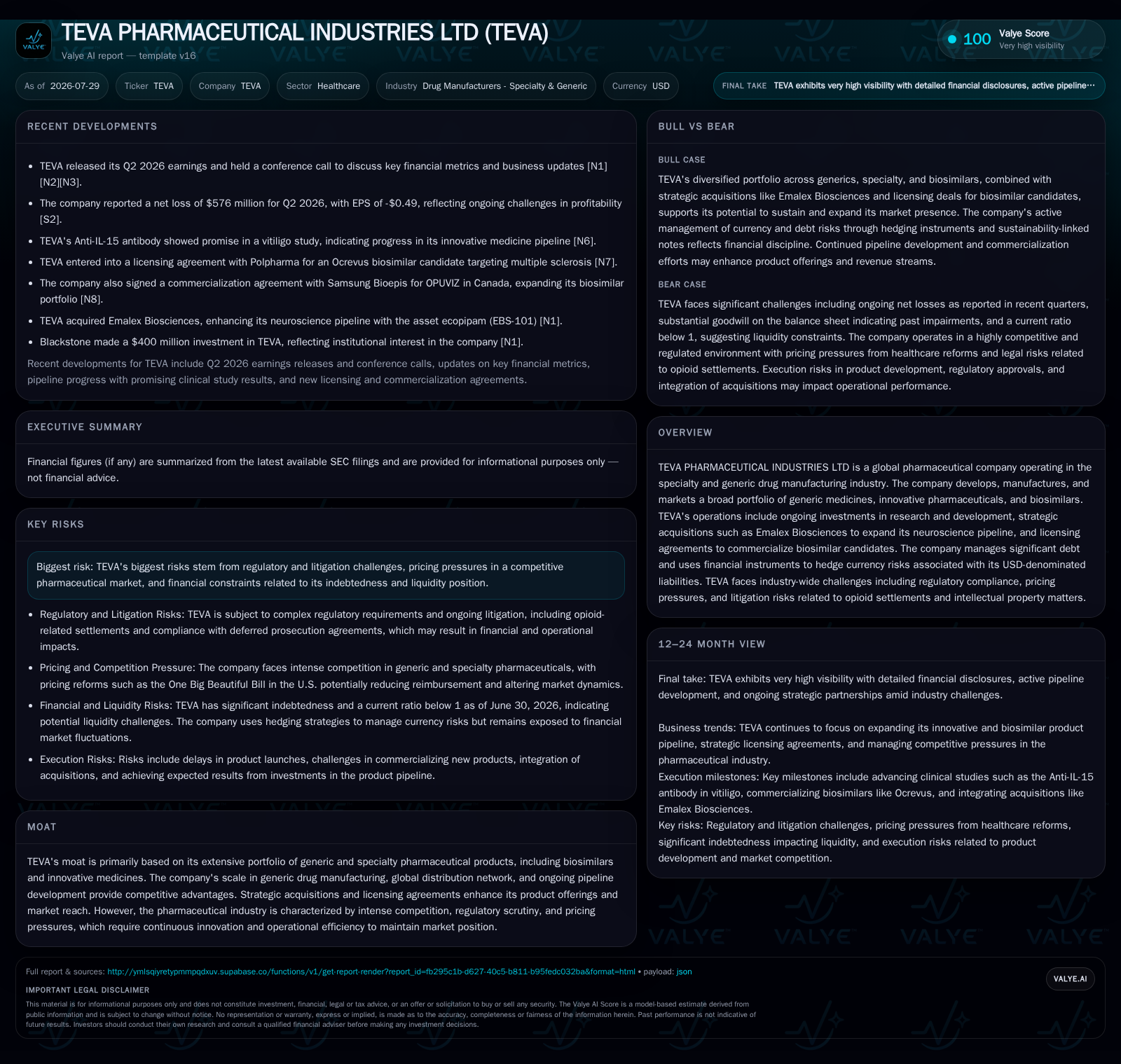
In Q2 2026, Teva Pharmaceutical Industries showed cautious progress in its turnaround strategy marked by growth in specialty pharmaceuticals and biosimilars, notably through acquisitions like Emalex Biosciences and key licensing deals. Challenges persisted in the highly competitive generics segment, where pricing pressure and delayed product launches impacted revenues. The company continues to manage regulatory scrutiny and patent litigation risks while maintaining financial discipline via currency hedging and sustainability-linked debt arrangements. Execution on pipeline milestones and regulatory approvals remain critical for sustaining momentum.
Q2 2026 Operating Update: Specialty Growth Counters Generics Market Pressures
Teva Pharmaceutical Industries Ltd.'s Q2 2026 results reflect a complex operating environment where gains in specialty pharmaceuticals and biosimilars partially offset ongoing challenges in the generics segment [S2][S3]. The company’s strategic acquisition of Emalex Biosciences, which added the neuroscience asset ecopipam (EBS-101) to its pipeline, exemplifies its 'Pivot to Growth' strategy aimed at expanding higher-margin specialty offerings alongside its large-scale generic drug portfolio [S1][S2].
Despite this progress, the generics business continues to face intense pricing pressure driven by a concentrated customer base and aggressive competition, which, combined with regulatory delays in product launches, constrained volume growth and revenue generation in the quarter [S2]. Regulatory compliance costs have increased amid heightened oversight, with quality control challenges occasionally resulting in product recalls and manufacturing facility shutdowns, underscoring operational risks that can affect both margins and market access [S2].
Dual Business Model: Balancing Scale in Generics with Specialty Innovation
Teva’s business model operates on two distinct but complementary axes. The generics segment leverages manufacturing scale and capacity utilization to maintain cost competitiveness in a commoditized market characterized by significant pricing erosion and reimbursement pressures [S1]. The number of approved generic product launches and time to regulatory approval remain critical KPIs influencing volume and revenue trends in this segment [S2]. However, pricing power is limited, and customer concentration adds to market risk.
Conversely, specialty pharmaceuticals, including biosimilars and novel neuroscience assets acquired through Emalex, target niche therapeutic areas with less direct competition and higher gross margins supported by sustained R&D investment [S1][S2]. Pipeline development progress, measured by clinical stage advancement and regulatory submission milestones, is a key driver of future revenue streams. This segment’s innovation intensity positions Teva to compete with specialty pharma peers, albeit with a legacy rooted in generics.
Quality control and manufacturing reliability are pivotal across both segments. Manufacturing disruptions due to regulatory non-compliance or quality issues can lead to costly recalls or supply interruptions, directly impacting market share and profitability [S1][S2]. Maintaining high standards across global manufacturing sites is essential to safeguard operational continuity and competitive positioning.
Biosimilars Strategy: Licensing Agreements and Market Expansion
Biosimilars represent a strategic growth vector for Teva as patents on biologic drugs expire globally. The company’s licensing agreements, such as the global deal with Polpharma Biologics for an Ocrevus biosimilar targeting multiple sclerosis, generate milestone payments that diversify revenue beyond direct product sales and support geographic expansion through commercialization partnerships [N6][N12][N14]
These collaborations enable Teva to access markets that may be challenging to enter independently, leveraging partners’ distribution networks. However, biosimilar commercialization requires navigating complex regulatory pathways involving rigorous comparative clinical data submissions, with approval delays posing risks to revenue timing and recognition.
Regulatory and Litigation Risks: Operational and Financial Implications
Teva operates under stringent regulatory scrutiny worldwide, with increased expenditures to ensure compliance with evolving research, production, and quality control standards [S2]. Non-compliance risks include delayed product launches, forced recalls, and facility shutdowns, all of which can disrupt supply chains and erode revenue.
Patent litigation remains a significant risk factor, influencing the timing of generic and biosimilar product entries. Ongoing and potential intellectual property disputes can affect market exclusivity periods, impacting Teva’s ability to defend its products or challenge competitors [S2]. These legal uncertainties necessitate vigilant risk management and adequate legal provisions.
Manufacturing Scale and Quality Control: Critical to Competitiveness
In the face of severe pricing pressures in the generic drugs market, Teva’s manufacturing scale is a critical competitive advantage, enabling cost efficiencies through high capacity utilization [S1][S2]. However, this scale must be balanced with rigorous quality control to prevent operational disruptions. Manufacturing setbacks can lead to product withdrawals or supply constraints, damaging customer trust and market share.
Operational excellence initiatives focusing on continuous process improvement and compliance adherence are essential to maintain cost leadership and meet regulatory expectations. This focus is vital to compete effectively against peers such as Mylan (Viatris) and Sandoz (Novartis), who face similar market dynamics.
Growth Drivers: Strategic Acquisitions and Licensing Milestones
Teva’s acquisition of Emalex Biosciences strengthens its specialty pharmaceuticals pipeline, particularly in neuroscience, supporting a shift toward innovation-led growth [S1][S2]. This acquisition complements organic R&D efforts and enhances the company’s ability to develop differentiated therapies with higher pricing flexibility.
Licensing agreements, including those for biosimilars like Ocrevus, contribute upfront and milestone payments that provide non-product revenue streams, helping to smooth income volatility inherent in the generics business [N6]. These partnerships also facilitate expansion into new geographic markets where direct commercial presence may be limited.
Together, these initiatives underpin Teva’s balanced growth model, aiming to improve margins and diversify revenue sources.
Key Performance Indicators and Watchpoints for Upcoming Quarters
Monitoring the progression of pipeline candidates through clinical development and regulatory approval processes, especially neuroscience assets from Emalex, will be critical to validating Teva’s specialty growth strategy [S2][N10]
The volume and timing of new generic product approvals remain important indicators of near-term revenue potential amid ongoing pricing pressures. Additionally, adherence to cost savings and operational efficiency targets will reflect the effectiveness of restructuring and productivity initiatives.
Developments in patent litigation and regulatory compliance will continue to influence product exclusivity and market access, warranting close observation.
Financial Position and Risk Management
As of June 30, 2026, Teva held approximately $3.65 billion in cash and equivalents, with current assets of $13.76 billion against current liabilities of $15.65 billion, resulting in a current ratio of about 0.88, indicative of working capital constraints but supported by ongoing operating cash flows [F1]
Reported total debt appears low relative to historical levels, reflecting prior repayments and extinguishments of senior notes [S1]. Currency risk management remains a priority given the USD-denominated debt exposure; cross-currency interest rate swaps initiated in May 2025 synthetically convert part of the USD debt into Swiss francs, aligning debt servicing costs with operational cash inflows and reducing earnings volatility from foreign exchange fluctuations [S2]. These swaps are designated as cash flow hedges, enhancing financial stability.
Moreover, Teva achieved all sustainability performance targets tied to its sustainability-linked bonds, avoiding premium interest payments that would have increased financing costs [S2]. This outcome reflects disciplined financial stewardship balancing deleveraging with strategic investment flexibility amid sector headwinds.
This analysis is based on Teva Pharmaceutical Industries Ltd.'s latest SEC filings and publicly available information, incorporating industry context without providing investment advice.
Financial snapshot as of 2026-06-30
- Cash and equivalents: $3.65 billion [F1]
- Current assets: $13.76 billion [F1]
- Current liabilities: $15.65 billion [F1]
- Current ratio: 0.88x [F1]
Disclaimer: This content is for informational purposes only and does not constitute investment advice. Verify all details with primary sources before making decisions.
Disclaimer: This is research-only, informational analysis and not investment advice. It may include AI-generated interpretation and general industry context. Always verify important details using primary sources.

Comments