
Treasure Global Accelerates Fintech Shift with Southeast Asia Growth Focus
Treasure Global's latest quarterly update reflects strategic divestitures, leadership realignment, and concentrated efforts on AI-driven fintech growth in Southeast Asia.
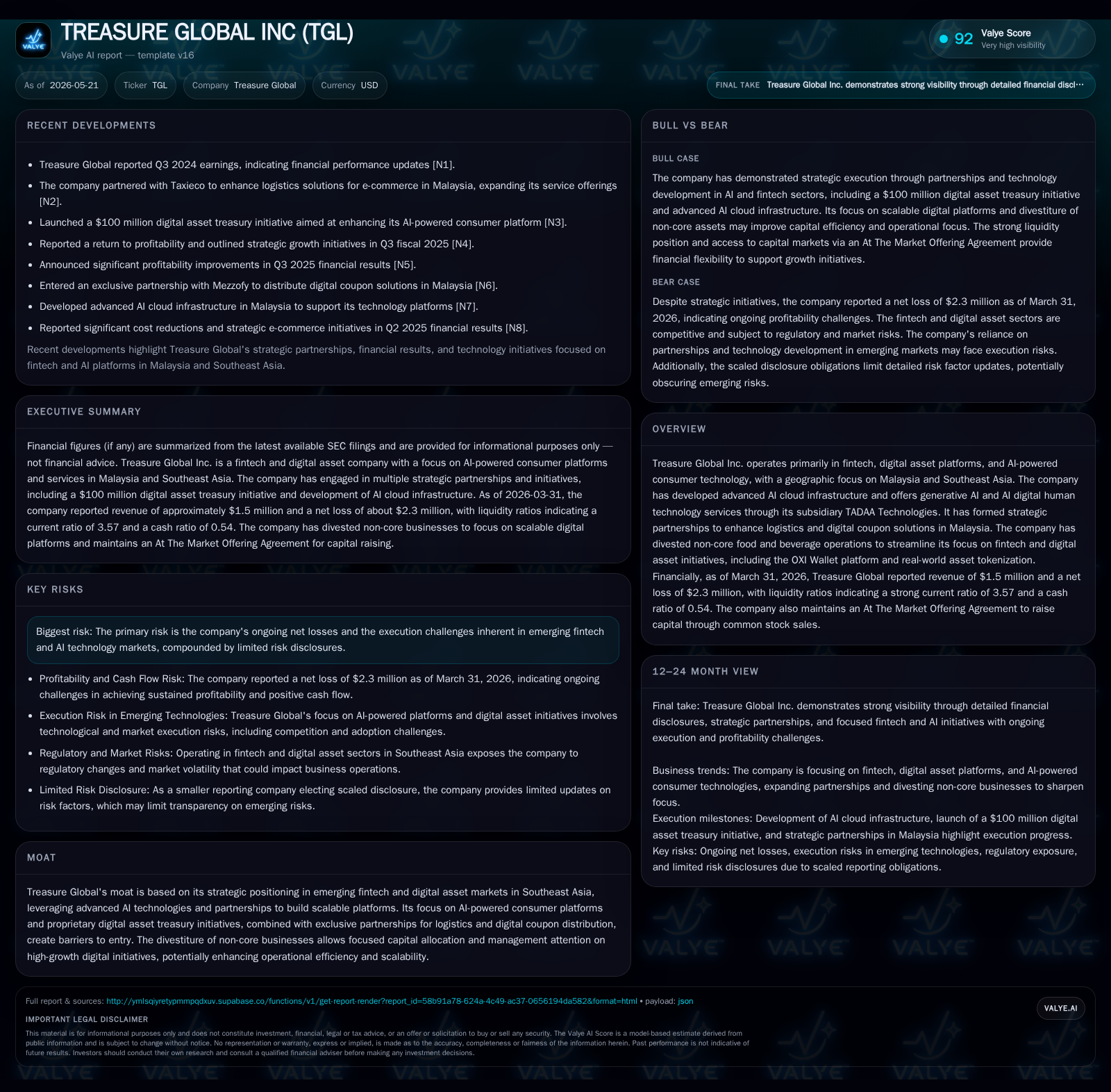
In its 2026 Q1 filing, Treasure Global Inc. signaled a sharpening of its strategic focus by divesting non-core food and beverage operations and appointing leadership with strong government-sector experience to bolster regional initiatives. The company's core fintech and digital asset platforms, powered by proprietary AI technology and enhanced through key partnerships in Malaysia, form the foundation for scalable growth. While ongoing net losses highlight execution challenges typical in emerging tech markets, robust liquidity metrics provide a buffer as TGL pursues expansion within Southeast Asia’s evolving digital economy.
Latest Quarterly Operating Update Highlights
Treasure Global's Q1 2026 filing (10-Q dated May 20) confirms its ongoing transformation into a fintech-centric enterprise sharply focused on Southeast Asia markets [S2]. The company reports revenues around $1.5 million with a net loss nearing $2.3 million, indicative of early-stage commercialization costs in relatively nascent product categories.
A pivotal operational pivot involved the divestiture of non-core food and beverage businesses finalized late 2025 [S4][S11], allowing the firm to streamline its asset base and managerial attention toward scalable digital platforms. This move aligns with its strategy to emphasize higher-margin fintech initiatives such as the OXI Wallet platform and complementary real-world asset tokenization efforts.
The recent appointment of Tengku Dato’ Musahiddin Shah to the board [S3] represents a significant governance shift intended to leverage his extensive experience navigating government frameworks in Malaysia. This is expected to accelerate Treasure Global's participation in public sector projects that could increase adoption and provide regulatory navigation advantages.
Together these developments underscore Treasure Global’s deliberate capital allocation towards proprietary AI cloud infrastructure and generative AI services delivered via subsidiary TADAA Technologies, crystallizing the company’s repositioning as an AI-powered fintech growth vehicle serving Southeast Asia.
Business Model and Product Portfolio Overview
Treasure Global generates revenue primarily through B2B fintech platform licensing fees coupled with consumer-facing digital service revenues anchored by its proprietary AI technologies. Its business architecture leverages advanced AI cloud infrastructure that supports generative AI applications and digital human technology through TADAA Technologies—an offering with distinct competitive differentiation given its regional focus.
The OXI Wallet platform exemplifies Treasure Global’s fintech core—a digital asset management tool facilitating user transactions underpinned by blockchain-enabled real-world asset tokenization. This approach targets increasing digitization trends across Malaysia and neighboring countries where financial inclusion remains an emerging priority.
Supplementary to core fintech offerings are strategic partnership ecosystems enhancing distribution reach; these include logistics providers for streamlined coupon delivery solutions targeting retail customers. The divestiture of legacy food & beverage units reduces capital strain from operating assets misaligned with this growth path, shifting Treasure Global towards an asset-light model conducive to margin improvement.
On the customer side, Treasure Global primarily serves institutional fintech clients alongside consumer users engaging with its digital wallet and coupon services. Pricing dynamics appear dependent on volume-driven platform usage fees plus potential transaction-based margins associated with real-world asset token sales—common revenue mechanics within digital asset ecosystems.
Competitive Positioning within Fintech and AI-Enabled Platforms
Within Southeast Asia's emerging fintech landscape, Treasure Global benefits from differentiated proprietary AI middleware layers that enable generative AI functionalities rarely replicated by regional peers. Its focused geographic footprint allows tailored solutions adapting to local consumer behavior and regulatory nuances—critical advantages over broader global competitors less embedded locally.
Partnerships with logistics vendors and coupon distributors create operational network effects boosting platform stickiness while raising switching costs artificially. Moreover, exclusive engagements for digital asset treasury management underpin barriers against new entrants who lack access to similar ecosystem collaborators.
Nonetheless, burgeoning fintech landscapes are characterized by regulatory flux which can induce market entry delays or compliance cost inflation. Capital intensity remains notable due to ongoing R&D expenses required for maintaining state-of-the-art AI capabilities and scaling blockchain-based applications effectively. Regulated payment ecosystems also limit room for pricing power until critical mass adoption is reached.
Strategic Growth Drivers in Emerging Southeast Asian Markets
Key growth vectors include:
- User Adoption Expansion: Accelerated onboarding of users onto the OXI Wallet platform powered by enhanced generative AI features which improve customer experience and service personalization.
- Public-Sector Collaboration: Leveraging the newly appointed director's governmental ties to realize participation in larger-scale digitization programs underway in Malaysia’s public initiatives.
- Ecosystem Partnerships: Amplifying alliance networks—particularly with logistics firms—support distribution scalability for digital coupons linked to consumer spending behavior shifts.
- Tokenization Solutions Penetration: Expanding usage of real-world asset token sales offering distinct value propositions tied to transparency and fractional ownership models unique to blockchain technology.
These drivers correspond directly with front-end KPIs such as platform active user counts, transaction volumes processed on OXI Wallet, number of public contracts secured or pipeline visibility for upcoming deals — though explicit quantitative disclosures remain limited at this stage [S3].
Risks and Execution Challenges Ahead
Treasure Global faces several risk factors warranting close monitoring:
- Sustained Net Losses: Continuing operating deficits necessitate additional financing or accelerated monetization efforts; current losses reflect commercialization phase yet constrain runway.
- Regulatory Ambiguity: Regulatory environments across Southeast Asian nations remain unsettled regarding digital assets; this may impede go-to-market momentum or require costly compliance adaptations.
- Execution Complexity: Integrating multifaceted technologies (AI platforms + blockchain-based tokenization) concurrently elevates project risk exposure compared to single-focus fintech startups.
- Limited Risk Transparency: Scaled disclosure exemptions imply potentially underinformative filings hindering comprehensive external assessment of emerging contingencies [S28].
- Dependence on At-The-Market Offerings: Reliance on incremental capital raises under variable market conditions can dilute shares or pressure cash flow flexibility if issuance volumes fluctuate unpredictably [S27].
These constraints emphasize the importance of disciplined capital allocation along with operational rigor in scaling niche technology platforms tailored for regional priorities.
Key Milestones and What to Watch Next
Several markers will offer insight into Treasure Global’s execution trajectory:
- Quarterly updates on user growth metrics post-divestiture will evidence traction gains attributable to strategic refocus.
- Announcements detailing expanded partnerships or contract wins—particularly involving government-linked projects—could validate new leadership impact.
- Regulatory disclosures clarifying tokenization scope nationwide will signal environmental stability or emerging headwinds.
- Management commentary in subsequent investor communications providing explicit guidance revisions or roadmap refinements reflecting scaled commercial progress.
Such developments constitute leading indicators measuring if Treasure Global can translate its AI-enabled fintech innovations into sustainable revenue streams amidst challenging market contexts.
Concise Financial Context
As of March 31, 2026, Treasure Global reported current assets totaling approximately $17.16 million against current liabilities near $4.81 million — resulting in a robust current ratio of roughly 3.57 [F1], underscoring ample short-term liquidity buffers supporting working capital needs. Cash & equivalents stood around $2.62 million as per latest available data [F1].
Total debt is estimated at approximately $5.5 million offset by cash holdings yielding a moderate net debt position near $2.88 million indicative of manageable leverage [F1]. Revenue remains modest at approximately $1.5 million reflecting early commercial stages whereas net losses around $2.3 million highlight ongoing investment cycles focused on product development and market expansion [S2].
This financial profile supports continued operational runway but flags profitability challenges typical within innovation-driven fintech ventures transitioning from nascent footholds toward meaningful scale.
Disclaimer: This analysis is based solely on publicly filed SEC documents as well as validated internal research excerpts available as of May 2026. It does not constitute investment advice or research views.
Disclaimer: This is research-only, informational analysis and not investment advice. It may include AI-generated interpretation and general industry context. Always verify important details using primary sources.

Comments