
Target Corporation (TGT) Equity Analysis: Accelerating Digital Fulfillment Amid Competitive Retail Dynamics
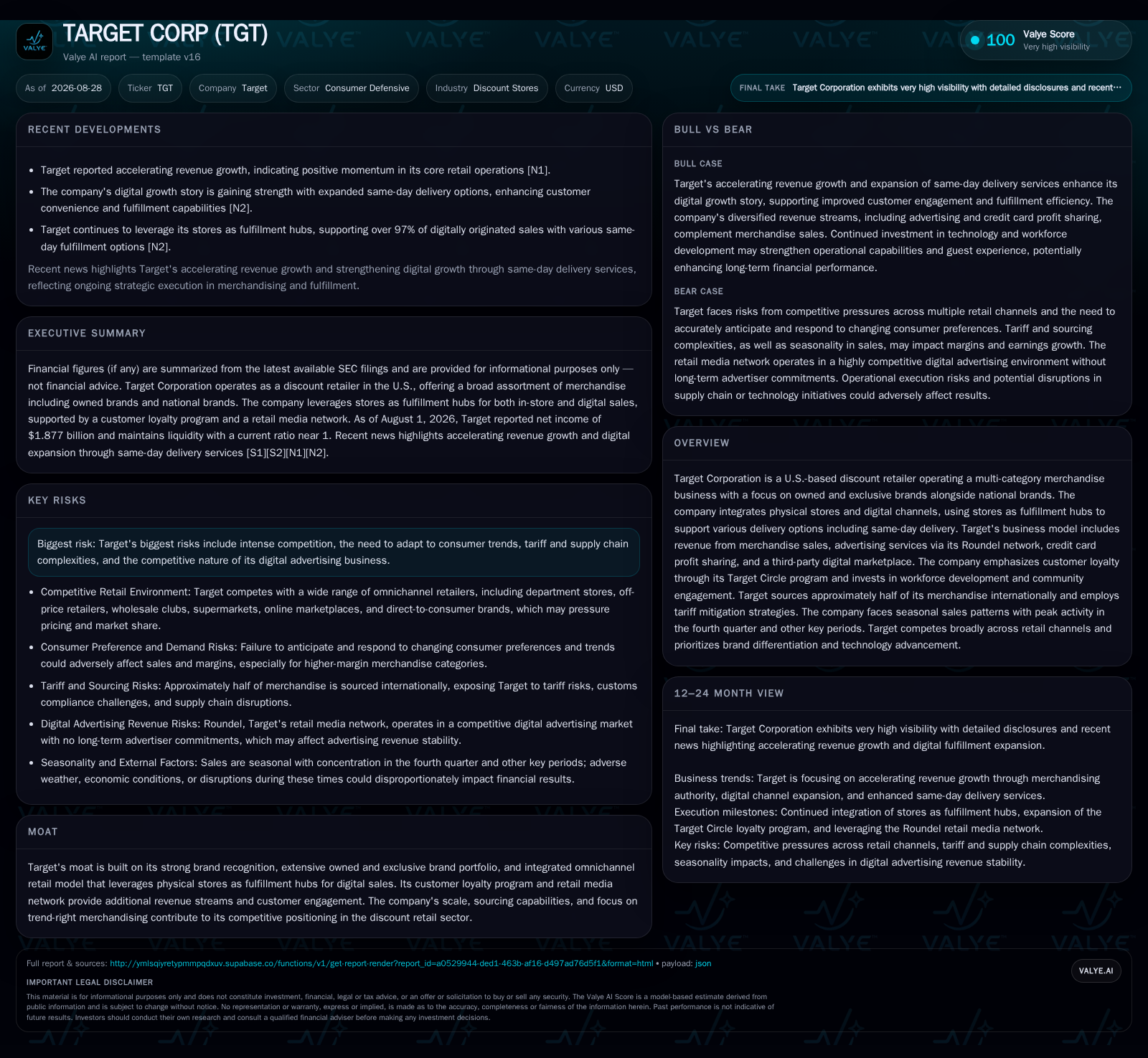
Target leverages an integrated omnichannel model combining owned brands, store-based fulfillment, and diversified revenue streams to drive growth. Recent acceleration in digital sales and same-day delivery expansion highlight strategic execution, while competitive pressures and supply chain complexity remain key challenges.
Target’s multi-category discount retail business benefits from a differentiated product mix anchored by owned brands and an omnichannel fulfillment platform leveraging physical stores. Accelerating revenue growth and expanded same-day delivery options enhance customer engagement and operational efficiency. The company’s moat is underpinned by brand equity, merchandising authority, and a growing retail media network. However, intense competition, tariff risks, and seasonality pose ongoing risks. The outlook hinges on Target’s ability to sustain digital momentum, optimize cost structures, and deepen customer loyalty.
Target Corporation’s retail strategy centers on integrating physical stores and digital channels to create a seamless omnichannel customer experience. The company’s distinctive emphasis on owned and exclusive brands, combined with a robust fulfillment network that supports over 97% of digital sales from stores, powers its accelerating revenue growth. Recent expansion of same-day delivery options enhances convenience and positions Target competitively as consumer expectations for speed and flexibility intensify. Nonetheless, navigating complex sourcing dynamics, seasonal variability, and fierce multi-channel competition remains vital to sustaining margins and growth in the evolving discount retail landscape.
Latest Operating Snapshot
Target reported accelerating revenue growth and strengthening digital sales momentum as of August 2026, driven notably by expanded same-day delivery services such as Order Pickup, Drive Up, and Same-Day Delivery options that leverage physical stores as fulfillment hubs [N1][N2]. This integration enables over 97% of digitally originated sales to be fulfilled from stores, highlighting a critical operational capability that enhances customer convenience and reduces delivery costs compared to relying exclusively on distribution centers.
Financially, Target maintains a solid liquidity position with cash and equivalents totaling $2.68 billion and a current ratio near 1, reflecting balanced short-term assets and liabilities as of August 1, 2026 [S2]. The company’s net income for the quarter stood at $1.877 billion with diluted EPS of $4.11, underscoring profitability amidst competitive pressures. Additionally, Target secured a $4.0 billion unsecured revolving credit facility with maturity in 2031, providing potential financial flexibility to support ongoing investments in technology, fulfillment, and merchandising [S2].
Business Model and Unit Economics
Target generates the majority of its revenue through merchandise sales spanning everyday essentials and trend-driven categories, with approximately 30% derived from owned and exclusive brands like A New Day™ and Cat & Jack™, which typically carry higher margins and foster customer loyalty through differentiation. The remainder comes from national brands, balancing assortment breadth. Pricing dynamics hinge on maintaining a value proposition encapsulated in the “Expect More. Pay Less.” brand promise, balancing competitive pricing with quality and style.
Beyond merchandise, Target diversifies revenue via its Roundel retail media network, which monetizes advertising placements leveraging store and online customer data, and through credit card profit sharing tied to the Target Circle Card program. The company also operates a third-party digital marketplace, Target Plus, expanding assortment without inventory risk. Operating leverage emerges from fixed-cost store infrastructure supporting both in-store sales and digital fulfillment, with fulfillment efficiency gains—particularly same-day delivery—potentially amplifying margins. Capital intensity includes store operations, technology investments, and global sourcing logistics, with international procurement exposing Target to variable costs and tariffs that require mitigation strategies to preserve unit economics.
Moat, Competition and Counterforces
Target’s moat is anchored by strong brand equity, a robust portfolio of owned and exclusive brands that differentiate it from generic discounters, and an integrated omnichannel model that uses physical stores as fulfillment hubs for digital orders. This hybrid approach reduces last-mile delivery costs and improves speed, enhancing customer satisfaction amid rising e-commerce expectations. The loyalty program Target Circle further strengthens customer engagement, while Roundel creates ancillary revenue and data-driven marketing synergies.
Competitive counterforces include a diverse set of omnichannel retailers such as department stores, off-price chains, wholesale clubs, supermarkets, online marketplaces, and direct-to-consumer brands. Many competitors operate with lower cost structures or niche positioning, pressuring pricing and market share. Additionally, digital advertising competition in Roundel’s segment is intense, with no long-term commitments from advertisers increasing revenue volatility. Tariff exposure and supply chain disruptions present operational risks that could erode margins. Sustaining the brand’s relevance and fulfillment excellence will be critical to maintaining competitive advantage.
Bull Case
In the bull scenario, Target leverages its accelerating revenue growth powered by expanding same-day delivery and omnichannel integration to capture increasing digital market share. Enhanced fulfillment capabilities reduce costs and improve margins, while owned and exclusive brands grow in penetration, driving higher margin sales and customer loyalty. The Roundel media network scales effectively, delivering meaningful incremental revenue with improving advertiser retention as Target’s data assets and shopper insights deepen.
Investment in technology and workforce development translates into operational efficiencies and elevated guest experience, fostering a virtuous cycle of customer engagement and sales growth. Tariff mitigation strategies successfully limit cost inflation, and Target’s merchandising authority allows it to anticipate trends ahead of peers, maintaining relevance in a competitive landscape. Confirmation would come from sustained double-digit digital sales growth, margin expansion, and increasing contribution from non-merchandise revenue streams. A falsification test would be failure to maintain digital fulfillment service levels or declining owned brand penetration.
Base Case
The base case assumes Target continues steady revenue growth supported by incremental gains in digital sales and same-day delivery services, maintaining roughly stable margin profiles. Owned and exclusive brands remain a key differentiator but grow modestly relative to total sales. Roundel contributes steadily but does not become a major profit center amid competitive digital advertising markets. The company’s balanced sourcing strategy contains tariff impacts without materially compressing margins.
Competitive pressures persist, keeping pricing discipline tight, while seasonal sales patterns continue to generate fourth-quarter peaks. Operational execution risks are manageable, with occasional supply chain or technology challenges that do not derail overall performance. Target’s financial position remains healthy, supporting necessary capital expenditures to sustain omnichannel capabilities. Confirmation would be consistent mid-single-digit revenue growth, stable or modestly improving operating margins, and steady loyalty program engagement. Falsification would be visible margin erosion or digital sales stagnation.
Bear Case
Under the bear case, intensified competition from online marketplaces and off-price retailers erodes Target’s market share and pricing power, forcing promotional intensity that compresses margins. Consumer preferences shift rapidly, and Target’s merchandising mix fails to keep pace, weakening the appeal of owned and exclusive brands. Supply chain disruptions and tariff increases raise costs materially, and mitigation efforts fall short, further squeezing profitability.
Roundel struggles to gain advertiser traction amid a crowded digital ad market, limiting diversification of revenue and increasing reliance on merchandise sales. Same-day delivery expansion encounters operational bottlenecks or cost overruns, undermining fulfillment economics and customer satisfaction. These factors combine to depress earnings growth and potentially lead to inventory markdowns or increased working capital needs. Confirmation would be declining comparable store sales, margin contraction, and negative customer loyalty trends. Falsification would be sustained execution of digital growth initiatives and margin stability.
What Matters Next
Key metrics to monitor include digital sales penetration and growth rates, particularly same-day delivery volumes and customer adoption of the Target Circle 360 paid membership. Tracking the margin contribution and advertiser retention rates within the Roundel retail media network is crucial to assess revenue diversification progress. Owned and exclusive brand sales as a percentage of total merchandise reveal success in differentiation and margin expansion.
Supply chain and tariff-related cost trends, alongside inventory turnover rates and fulfillment cost per order, will indicate operational efficiency and risk exposure. Customer loyalty program engagement metrics, such as active membership counts and repeat purchase frequency, shed light on brand strength and retention. Lastly, capital expenditure levels and productivity gains in store-based fulfillment infrastructure provide insight into operating leverage potential and scalability of the omnichannel model.
Disclaimer: This is research-only, informational analysis and not investment advice. It may include AI-generated interpretation and general industry context. Always verify important details using primary sources.

Comments