
Gentherm Inc Boosts Market Position Through Strategic Modine Integration and Innovation
Gentherm’s Q1 2026 results underscore operational progress amid the transformative Modine acquisition, reinforcing its leadership in automotive thermal and comfort technologies.
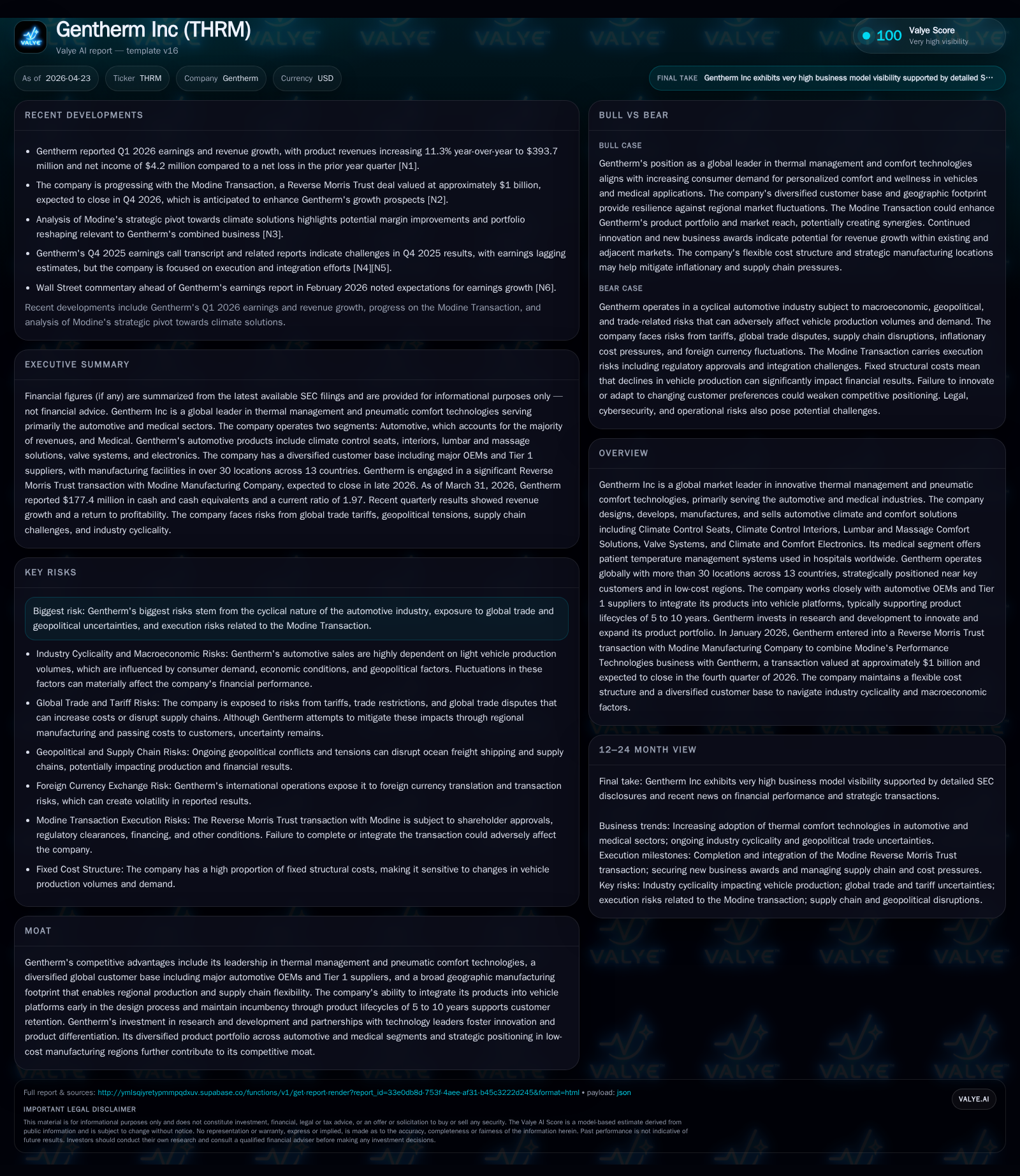
In Q1 2026, Gentherm delivered solid earnings that beat expectations, reflecting ongoing robust demand from automotive OEMs and early momentum toward integrating the recently announced Modine Reverse Morris Trust transaction. The combination is poised to expand Gentherm’s product portfolio into advanced performance technologies, creating synergies across thermal management solutions for automotive and industrial clients. While cyclical factors in vehicle production and integration complexity present challenges, Gentherm’s global footprint, R&D focus, and diversified end markets underpin a clear growth trajectory. Liquidity remains solid with manageable leverage following disciplined capex and free cash flow generation in 2025.
Q1 2026 Performance Highlights and Operational Update
Gentherm Incorporated’s first quarter of 2026 demonstrated resilience in an evolving automotive supply environment as the company reported quarterly earnings that outperformed consensus revenue and profit forecasts [N1], [S2], [S3]. Despite ongoing macroeconomic uncertainties influencing global vehicle production volumes, Gentherm benefited from stable order flow across key regions—North America, Europe, China—and continued adoption of enhanced climate control and comfort packaging by OEMs. The firm also highlighted progress toward consummating the transformational Modine transaction structured as a Reverse Morris Trust (RMT), anticipated to close in late 2026 subject to shareholder approval and regulatory conditions [S2], [S3]. While the integration entails complexity due to regulatory scrutiny and financing requirements, the company views it as a strategic expansion enhancing its performance technologies footprint.
Operating income experienced sequential pressure compared with prior year levels given inflationary inputs and integration-related expenses; however, revenue trends reflected increased content per vehicle amid consumer demand shifts toward wellness-centric vehicle features that Gentherm’s Climate Control Seats (CCS®), Interiors (CCI™), pneumatic Comfort Solutions, Valves Systems, and integrated Climate & Comfort Electronics aim to satisfy [N1], [S2]. Supply chain impacts remain manageable owing to Gentherm’s geographically diversified manufacturing footprint designed for regional responsiveness [S2].
Business Model: Thermal Management Innovations and Market Relevance
Gentherm's core business revolves around designing, manufacturing, and selling advanced thermal management systems primarily for the automotive industry alongside a medical segment focused on patient temperature management devices found globally in hospitals [S1]. Its Automotive products include nuanced climate control solutions embedded within seats (CCS®) and interiors (CCI™), lumbar support with pneumatic massage functionality, valve actuation systems for fluid control, and sophisticated electronics to govern precise thermal comfort.
Customer buying behavior centers on OEM platform-level integrations where Gentherm acts as a key technology partner during early vehicle design phases. This strategy yields high switching costs as products become embedded across platform life cycles typically spanning five to ten years. The company measures profitability not only by unit volume tied to vehicle production levels but also by varying 'content per vehicle'—reflecting consumer preferences for personalized comfort which translates into higher ASPs and broader feature sets per installation [S1].
The medical segment complements this by supplying hospital-grade patient warming/cooling equipment used in critical care flows including hyper-hypothermia therapy and surgical normothermia protocols. This diversification insulates some revenue volatility inherent in automotive production cycles.
Industry Structure: Competitive Dynamics and Supply Chain Nuances
Gentherm operates within a competitive ecosystem dominated by Tier 1 suppliers specializing in automotive seating climate control but differentiates through its proprietary innovations in pneumatic comfort technology that adds wellness value beyond temperature modulation alone [S1]. Key competitors include both vertically integrated seat manufacturers offering bundled solutions and other specialized component suppliers.
Its global footprint spans over three dozen production facilities across thirteen countries including China, Hungary, Mexico, Morocco, North Macedonia, South Korea, Ukraine, Germany, Vietnam—strategically situated near major OEM hubs or low-cost labor pools [S1]. Such positioning affords flexibility against tariff regimes or supply bottlenecks emerging from geopolitical tensions or trade disputes. For example, U.S. tariffs introduced since March 2025 impact raw materials but are largely mitigated via local sourcing strategies or cost pass-through agreements [S1], [S7].
Moreover, Gentherm's independence from direct Tier 1 incumbency allows it to partner flexibly with multiple OEMs worldwide without exclusivity constraints fostering long-term customer retention while capturing upsell opportunities on incremental features.
Growth Catalysts: Modine Acquisition, Product Demand, and R&D Impact
The most significant growth catalyst is the pending acquisition of Modine’s Performance Technologies business via an RMT transaction announced January 29, 2026. This deal would amplify Gentherm’s presence beyond core automotive climate systems into advanced heat transfer products used broadly across industrial markets including electrification platforms [S1]. Benefits include cross-selling potential within existing customer bases alongside margin expansion from higher-value engineered components.
Concurrently, global trends such as electrification propel demand for energy-efficient thermal management solutions tailored to heat-sensitive battery packs or cabin microclimates—areas where Gentherm invests heavily in R&D partnerships aiming to accelerate innovation cycles [N4], [S1]. Increased vehicle content driven by consumer wellness awareness—especially post-pandemic interest in health-supportive features like massage seats or rapid heating/cooling—is structurally supportive rather than cyclical.
Challenges and Constraints: Market Cyclicality, Execution Risk, and Geopolitical Factors
Despite strong secular tailwinds around personalization and electrification demands enhancing content per vehicle growth dynamics face headwinds from the traditionally cyclical nature of light vehicle production tied closely to economic variables such as interest rates, fuel prices, employment trends—and more recently disrupted by geopolitical instability impacting supply chains [S1], [S7]. As a supplier embedded early in platform development cycles usually spanning multiple years forward-looking visibility remains limited until mass production starts.
Additionally, integration risks loom large post-Modine deal close including cultural harmonization between legacy teams/reports lines along with potential short-term dilution related to restructuring charges or capital expenditures required during transition phases noted explicitly as material risks by management [S2], [S3], [S7]. Trade friction scenarios exacerbate complexity requiring agile regional sourcing responses.
Intellectual property protection remains paramount given aggressive competition from certain emerging region-based suppliers particularly Chinese firms expanding their footprint globally which may erode pricing leverage or market share absent ongoing technological differentiation efforts.
Upcoming Milestones: Integration Monitoring, Demand Signals, and Guidance Updates
Investors should keenly monitor several key near-term milestones: shareholder votes on the Modine Transaction expected ahead of Q4 closing; regulatory approvals across multiple jurisdictions; updates on financing arrangements replacing interim bridge loans aligned with the acquisition; quarterly reporting providing deeper diagnostics on merger synergy capture; plus detailed commentary from earnings calls regarding order book evolution especially on next-generation EV platform awards where Gentherm seeks share gains among OEMs [S3], [N1].
Additional operational KPIs such as capacity utilization rates within newly combined manufacturing footprints will offer valuable insight into execution effectiveness amid heightened inflationary pressures.
Financial Overview: Current Liquidity, Leverage, and Profitability Metrics
As of March 31, 2026 quarter-end per latest 10-Q filing data supported by company facts metrics [F1] and SEC reports [S2]:
- Cash & equivalents stood at $177.4 million providing strong liquidity buffers.
- Total debt approximated $219 million resulting in net debt near $42 million given ample cash holdings.
- Current ratio was a robust ~1.97 reflecting balance sheet strength.
- Operating income showed contraction year-over-year by approximately 22.7% indicating margin pressure potentially linked to acquisition-related expenses.[F1]
- Nevertheless free cash flow remained positive at an estimated $61 million for FY2025 after reduced capex spend (~24% year-over-year reduction), signaling prudent capital allocation amidst growth investments.[F1]
- Equity base expanded reflecting retained earnings supporting ongoing funding needs.[F1]
Historical performance (annual)
| FY | CFO ($mm) | OpInc ($mm) | Capex ($mm) |
|---|---|---|---|
| 2025 | 117 | 83 | 56 |
| 2024 | 110 | 107 | 73 |
| 2023 | 119 | 77 | 38 |
| 2022 | 15 | 48 | 40 |
Source: SEC companyfacts cache [F1].
Capital returns and efficiency (annual)
| FY | Buybacks ($mm) | FCF ($mm) |
|---|---|---|
| 2025 | 10 | 61 |
| 2024 | 52 | 36 |
| 2023 | 91 | 82 |
| 2022 | 20 | -25 |
Source: SEC companyfacts cache [F1]. *Estimated CFO minus Capex for FY2025[F1]
This financial posture underpins Gentherm's ability to fund the Modine acquisition while maintaining operational flexibility despite industry headwinds.
Disclaimer: This analysis is based solely on public SEC filings dated through April 23, 2026 and corroborating market news sources. It does not constitute investment advice or recommendations. All projections or forward-looking statements are inherently uncertain and dependent on market conditions beyond direct control of Gentherm Inc.
Disclaimer: This is research-only, informational analysis and not investment advice. It may include AI-generated interpretation and general industry context. Always verify important details using primary sources.

Comments