
Instil Bio's Strategic Pivot After AXN-2510 Discontinuation
Instil Bio narrows focus on proprietary cell therapies following bispecific antibody program halt.
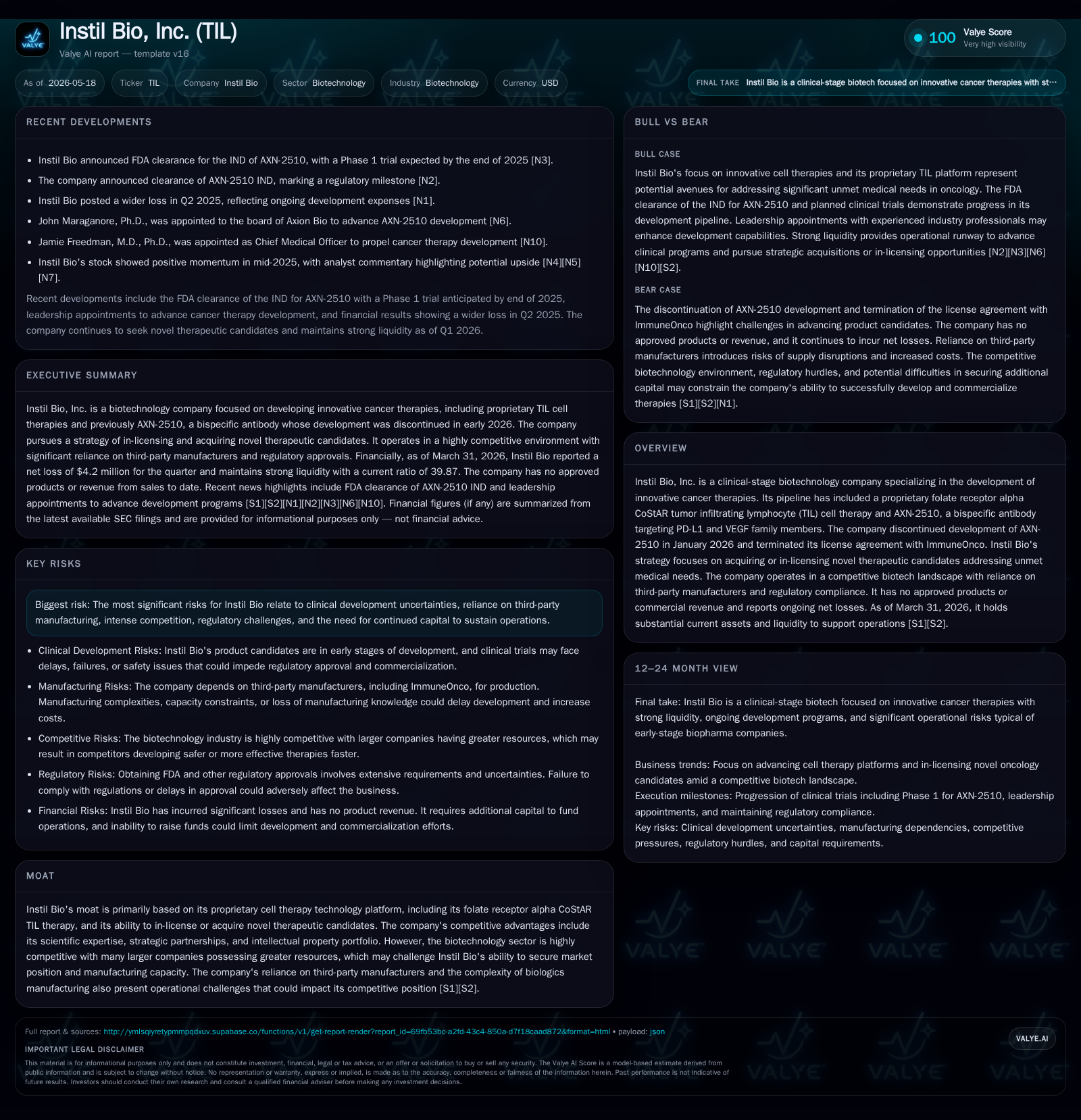
In its May 2026 quarterly filing, Instil Bio announced termination of its AXN-2510 development and licensing agreement, realigning resources toward its folate receptor alpha CoStAR tumor infiltrating lymphocyte cell therapy platform. This strategic pivot refocuses the company on advancing novel cell therapies amid a competitive biotech landscape marked by reliance on third-party manufacturing and regulatory complexities. Future growth hinges on clinical progression of its TIL technology and successful in-licensing or acquisitions, balanced against typical early-stage biotech risks including capital needs and regulatory hurdles.
Latest Quarterly Update: What Changed at Instil Bio
Instil Bio's latest 10-Q and corresponding 8-K filings dated May 15, 2026 spotlight a material strategic shift with discontinuation of their bispecific antibody candidate AXN-2510 and termination of the associated license agreement with ImmuneOnco Biopharmaceuticals [S1][S2][S3]. The months preceding this update saw the winding down of AXN-2510 development as of January 2026, signaling a clear pivot away from this asset. Instead, the company is concentrating efforts on its proprietary folate receptor alpha co-stimulatory antigen receptor (CoStAR) tumor infiltrating lymphocyte (TIL) cell therapy approach
This development is pivotal because it redefines Instil Bio's near-term operational focus and resource allocation amidst a cash-burning stage without commercial revenues. As a clinical-stage biotech, narrowing the pipeline reduces complexity but magnifies reliance on the success of the CoStAR TIL platform and complementary future licensing deals. The timing underscores management's decision to exit a less promising or more resource-intensive program to prioritize advanced immunotherapy candidates with unique mechanistic prospects in oncology.
Business Model and Therapeutic Focus
Instil Bio operates primarily as a clinical-stage biotechnology company developing novel cancer therapies centered on immune-based modalities. The core of its value proposition is the proprietary TIL cell therapy platform leveraging folate receptor alpha targeting through a co-stimulatory antigen receptor mechanism designed to enhance tumor infiltration and cytotoxic efficacy [S1].
Revenue mechanics are currently theoretical; the company does not generate product revenue but invests heavily in research, development, and clinical trials aimed at achieving regulatory approval for therapeutic candidates. Revenue drivers upon commercialization would come from healthcare payers (governmental programs, insurers) reimbursing for highly specialized cell therapy treatments administered through healthcare providers. Pricing power will depend significantly on demonstrated efficacy/safety profiles relative to competitors and negotiated reimbursement levels in oncology markets.
Strategically, Instil Bio also pursues the acquisition or in-licensing of additional therapeutic candidates that address significant unmet medical needs in oncology. This hybrid model mitigates risk through pipeline diversification while capitalizing on their scientific expertise and existing intellectual property portfolio anchored by CoStAR technology [S1].
Competitive Landscape and Manufacturing Dynamics
The biotechnology sector focused on oncologic cell therapies is intensely competitive with rapid innovation cycles driven by scientific breakthroughs and large investments from major pharmaceutical companies. Many competitors possess deeper financial resources, established relationships for clinical trial recruitment, broader manufacturing capacities, and more extensive regulatory experience [S1]
Instil Bio’s reliance on third-party contract manufacturers (CMOs) for biologics production presents operational constraints—capacity bottlenecks can delay scale-up necessary for late-stage trials or commercialization. Biologics manufacturing demands compliance with rigorous Current Good Manufacturing Practice (cGMP) standards enforced by regulatory authorities, adding complexity and cost [S1][S2]. These factors elevate switching costs due to technical transfer challenges inherent in advanced cell therapies.
Further intensifying competition is the crowded field pursuing immune-oncology agents including other TIL approaches and bispecific antibodies—now discontinued by Instil Bio but prevalent among peers—requiring differentiated efficacy/safety profiles to capture commercial market share.
Growth Drivers in Novel Cell Therapy Development
Key growth catalysts for Instil Bio stem from successful advancement of their lead folate receptor alpha CoStAR TIL therapy through critical clinical milestones such as patient enrollment completion, safety data readouts, and eventual demonstration of clinical efficacy [S1][S2]. Positive early-phase findings could validate their proprietary technology’s utility across select cancer indications
Additionally, executing on strategic objectives like acquiring or licensing new therapeutic candidates complements internal R&D efforts by filling pipeline gaps or expanding into novel oncology niches experiencing substantial unmet need. Partnerships can also enhance access to complementary technologies or trial networks.
Enhancing scientific expertise via hiring key talent or forming collaborations amplifies the company’s ability to innovate and efficiently manage increasingly complex clinical development programs.
Key Risks and Operational Challenges
Instil Bio faces multifaceted risks typical of early-stage biotechnology enterprises:
- Clinical Development Uncertainty: Trial outcomes are inherently unpredictable, with potential delays or failures significantly impacting valuation.
- Manufacturing Complexity: Outsourced production subjects the company to capacity limits, quality control variability, supply chain risks, and regulatory scrutiny [S1][S2].
- Competitive Pressures: Larger firms may develop safer or more effective products faster; intellectual property disputes can arise [S1].
- Regulatory Challenges: Approval processes involve evolving guidelines like dose optimization mandates (Project Optimus from FDA Oncology Center), stringent cGMP compliance requirements, post-market study obligations, and ongoing surveillance burdens [S1][S4][S5].
- Capital Intensity: Sustaining R&D operations without product revenues demands continuous funding; liquidity tightness could constrain trial execution [F1].
- Compliance and Cybersecurity Risks: Data privacy laws (HIPAA/HITECH), fraud laws (Anti-Kickback Statute), transparency requirements increase compliance complexity; cybersecurity breaches could cause operational disruptions [S1].
Upcoming Catalysts and Monitoring Points
Stakeholders should monitor several near-term indicators to gauge progress:
- Clinical trial enrollment rates and forthcoming data releases for the CoStAR TIL program will be critical proof-of-concept milestones.
- Any announcements regarding new licensing deals or acquisitions that expand pipeline breadth signify strategic momentum.
- Updates on manufacturing partnerships ensuring scalable supply capabilities are essential given outsourcing dependence.
- Financial results reporting cash burn pace along with disclosures around financing plans (equity raises or collaborations) will illuminate runway sufficiency [S2][S3]
These checkpoints collectively underpin operational execution confidence amid prevailing biotech sector challenges.
Financial Overview: Capital Position and Runway
As of March 31, 2026, Instil Bio reported cash & equivalents totaling approximately $5.0 million alongside robust current assets of $188.3 million against nominal current liabilities around $4.7 million — yielding an exceptionally healthy current ratio near 40x which signals strong short-term liquidity available to fund ongoing operations [F1][S2]
Despite these liquid reserves supporting near-term R&D spending, absence of any approved products means reliance remains on securing additional capital inflows over time to sustain multi-year clinical development horizons marked by significant net losses recorded at prior fiscal year-end ($78.6 million operating loss as of December 31, 2025) [F1]
Maintaining investor confidence through execution transparency on pipeline progression and cost management will be vital given sector capital intensity dynamics.
This analysis is based exclusively on publicly filed SEC documents as of May 18, 2026. It does not offer investment advice but aims to provide an informed industry perspective grounded in verifiable disclosures.
Financial position in context
As of 2026-03-31, companyfacts shows $5mm in cash and equivalents [F1]. Current assets of $188mm and current liabilities of $5mm imply a current ratio near 39.87x for 2026-03-31 [F1].
Disclaimer: This is research-only, informational analysis and not investment advice. It may include AI-generated interpretation and general industry context. Always verify important details using primary sources.

Comments