
Valion Bio's Strategic Shift to Biopharma Targets TLR5 Agonist Potential
Valion Bio pivots from medical devices to a focused biopharmaceutical strategy centered on the Phase III drug Entolimod amid stable liquidity and continued net losses.
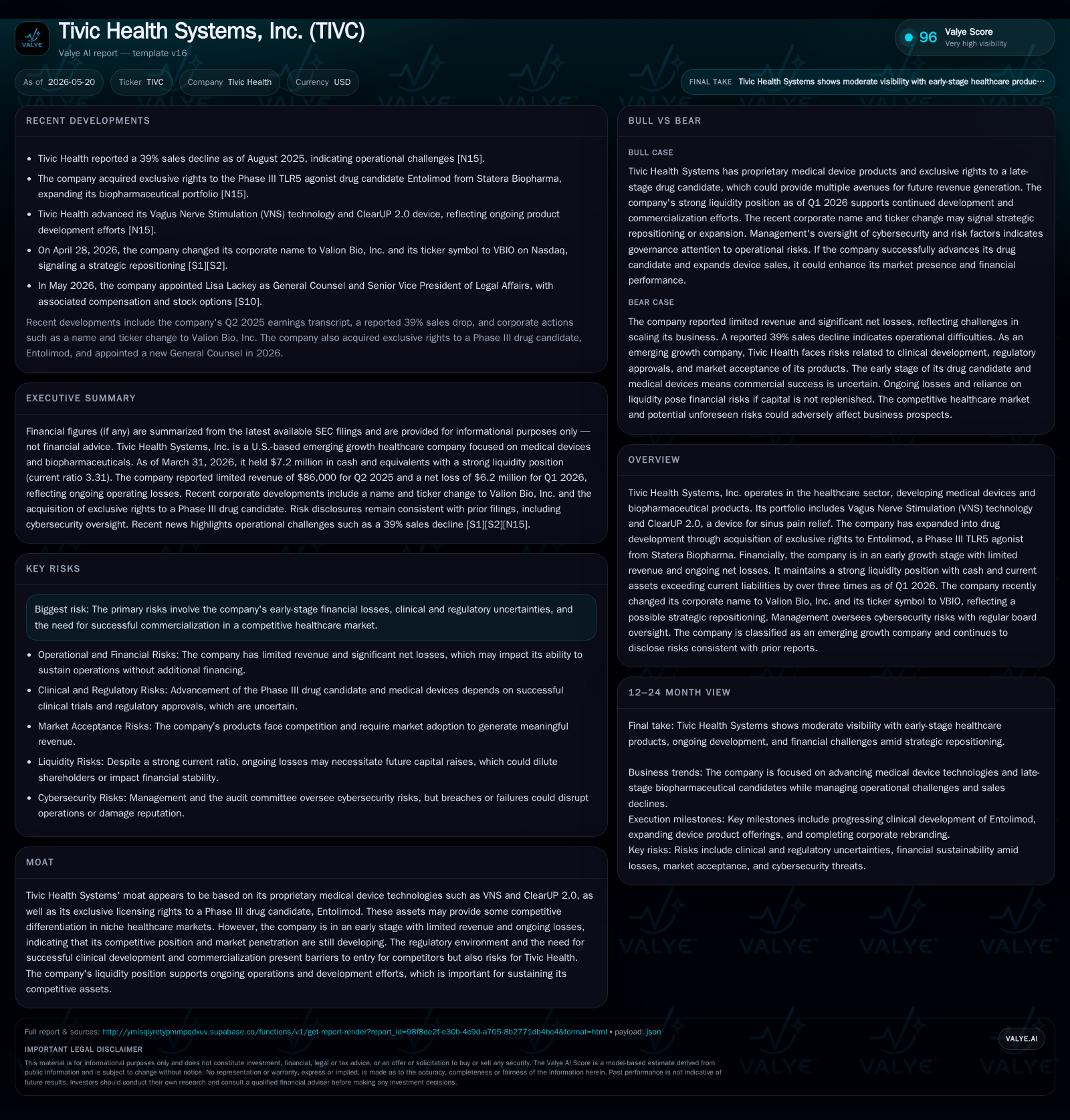
In Q1 2026, Tivic Health Systems formalized its transformation into Valion Bio, Inc., reflecting a strategic shift from a legacy medical device business to biopharmaceutical innovation anchored by Entolimod, a Phase III TLR5 agonist. The company complements this pivot with its CDMO subsidiary Velocity Bioworks aiming to support internal pipeline and third-party manufacturing. Despite ongoing net losses, Valion Bio maintains a strong liquidity position with current assets exceeding liabilities by more than threefold, enabling continued clinical development and operational execution. The path forward hinges on Entolimod's regulatory progress and commercial traction in niche acute radiation syndrome markets.
Q1 2026 Operating Update and Strategic Highlights
Tivic Health Systems' latest 10-Q filed May 14, 2026 [S2] confirms continuation of the company’s strategic transformation without material changes to risk disclosures or operating outlooks. Concurrently, an 8-K filing on the same date formalizes the corporate name change to Valion Bio, Inc., effective April 28, 2026, alongside ticker update from TIVC to VBIO [S3], [S12]. This rebranding underscores management’s intent to reposition from a bioelectronic medical device company toward a focused biopharmaceutical entity. While no new operational events materially altered short-term prospects during the quarter, filings reinforce ongoing execution of the post-2025 strategic pivot.
Transformation from Medical Devices to Biopharmaceutical Innovation
Fiscal year 2025 marked a foundational shift with acquisition of exclusive global licensing rights for Entolimod—a Toll-like Receptor 5 (TLR5) agonist in Phase III trials originally developed by Statera Biopharma [S1]. Rights also include its next-generation compound Entolasta. Complementing this was establishment in December 2025 of Velocity Bioworks™, a contract development and manufacturing organization (CDMO) subsidiary designed to support both internal pipeline candidates and third-party customers [S1].
This bifurcation defines two primary operational domains: proprietary biologic drug development targeting acute radiation syndrome (ARS), supported by government countermeasure designations; and advanced biologics manufacturing services via Velocity Bioworks. Legacy bioelectronic medical devices such as Vagus Nerve Stimulation products and ClearUP 2.0 sinus pain relief remain but are deprioritized strategically in capital allocation.
Core Business Model and Product Ecosystem
Revenue currently derives primarily from modest sales of existing medical devices alongside anticipated future licensing or government procurement revenues linked to Entolimod [F1], [S1]. Device sales reflect early commercial-stage penetration with reported end-2024 revenue around $780,000 [F1].
Entolimod’s commercial model targets governmental purchasers for ARS countermeasures—especially U.S. federal agencies managing the Strategic National Stockpile. This business-to-government framework implies pricing aligned with negotiated contracts rather than open-market premiums typical in chronic therapies [S1]. The ability to replace or augment FDA-approved granulocyte colony-stimulating factor (G-CSF) agents (e.g., Neupogen®, Neulasta®) depends heavily on clinical validation outcomes and government stockpiling cycles
Velocity Bioworks adds a fee-for-service revenue stream through biologics manufacturing services—a high-margin segment dependent on capacity utilization and customer diversification. This vertical integration aims to reduce external supply chain reliance for Valion Bio’s drug candidates while monetizing excess production capabilities externally.
Competitive Landscape and Industry Dynamics
Valion Bio operates at the intersection of niche medical devices and biopharma segments focusing on immune modulation and radiation countermeasures. In devices, proprietary VNS technology competes within neuromodulation markets that include implantable and noninvasive stimulators; ClearUP offers consumer-accessible differentiation based on ease-of-use.
Biopharmaceutically, Entolimod competes against entrenched FDA-approved G-CSFs dominating ARS treatment with large government contracts supported by established stockpiles [S1]. Switching costs for governmental buyers include efficacy demonstration, storage stability, dosing regimens, and manufacturing scalability considerations. Regulatory barriers are significant given safety profiles’ criticality in emergency countermeasures.
Market size is limited structurally by infrequent use scenarios centered on government preparedness rather than chronic patient populations; this constrains volume but may justify premium reimbursement.
Growth Catalysts Centered on Entolimod and CDMO Expansion
Key growth drivers include anticipated positive Phase III data readouts essential for advancing regulatory submissions that could lead to product approvals and contract awards [S1]. Demonstrating superior efficacy or safety relative to G-CSFs could significantly expand procurement tenders globally.
Velocity Bioworks’ scale-up represents a parallel growth avenue where increasing production capacity combined with third-party client development enhances recurring revenues beyond internal R&D support [S1]. Important KPIs will track manufacturing throughput utilization rates and client pipelines.
The synergy between drug candidate progression mitigating time-to-market risk alongside a flexible manufacturing platform supports Valion Bio’s vision as an integrated innovator-manufacturer within niche biologic therapeutic spaces.
Risks From Clinical Development, Market Adoption, and Financial Pressure
Primary risks include inherent Phase III clinical trial uncertainties where failures or delays could disrupt timelines and capital efficiency [S2]. Uptake risks arise from competition with established alternatives held in government stockpiles.
Ongoing operating losses highlight that profitability remains distant; thus financial endurance depends on prudent liquidity management supported by current strong working capital [F1]. Cybersecurity risks require continuous oversight due to complex regulatory compliance demands across device and biopharma operations [S1].
Upcoming Milestones and Executional Watchpoints
Near-term milestones include expected interim or final Phase III trial data releases pivotal for regulatory filing strategies [S3]. Monitoring Velocity Bioworks’ contract wins or capacity utilization shifts will indicate scaling success.
Regulatory feedback on submissions plus updates on government procurement cycles for ARS countermeasures will directly impact near- to medium-term revenue visibility. Market perception following brand transition may also influence investor sentiment requiring clear communication.
Financial Position Supporting Growth Strategy
As of March 31, 2026 quarter-end, Valion Bio held approximately $7.2 million in cash and equivalents with total current assets near $8.7 million versus current liabilities around $2.6 million—yielding a healthy current ratio of about 3.31—enabling sustained investment into clinical programs alongside CDMO expansion despite net losses exceeding $8.8 million in fiscal year 2025 [F1]. This liquidity supports ongoing execution pending additional funding or milestone-driven revenues.
Disclaimer: This analysis is based solely on publicly available information as of May 2026 including SEC filings and recognized financial disclosures [F1]. It does not constitute investment advice or research views regarding shares of Valion Bio (formerly Tivic Health Systems). Readers should conduct independent due diligence before making investment decisions.
Disclaimer: This is research-only, informational analysis and not investment advice. It may include AI-generated interpretation and general industry context. Always verify important details using primary sources.

Comments